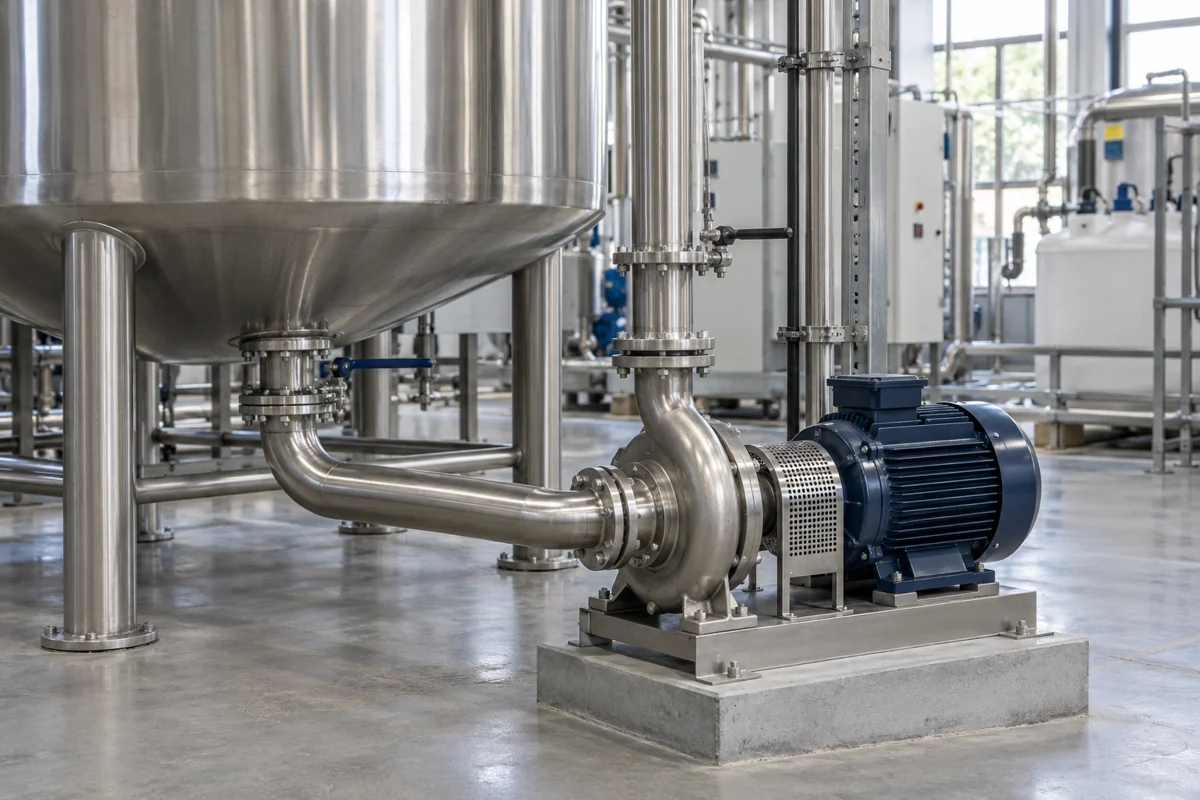
A centrifugal pump transfers energy through a rotating impeller; its delivered flow depends on the connected system and its control. Follow the assembly, find the actual operating point, assess suction margin, and check the unresolved pressure limits and units in a published Kaysen range.
Industrial pumps include more than one pumping principle. The hydraulic selection guidance here concerns centrifugal pumps. A sanitary reference range does not establish suitability for an arbitrary chemical.
CNFX editorial research · Sources checked October 12, 2026 · 10 sources
Liquid enters a centrifugal impeller and receives energy as it moves through the rotating passages; a volute or diffuser collects the discharge. That mechanism differs from a piston or other positive-displacement pump. [5] The table is a conventional end-suction functional assembly reference, not Kaysen’s manufacturing BOM. [8]
Assembly
Role in the pump
Configuration and material evidence
Impeller
Transfers shaft energy to the liquid.
Kaysen identifies an open impeller, but gives no diameter, clearance, part number or component-specific grade. SS304/SS316L are range-level labels. [3]
Casing and cover
Enclose the flow path and collect impeller discharge.
Casing shape helps convert velocity energy to pressure. Obtain the actual wetted casting/cover grades and pressure-temperature rating. [8][3]
Shaft
Carries the impeller and transmits rotation.
Direct motor-shaft, stub-shaft and separate pump-shaft arrangements differ. Kaysen’s page does not identify its shaft construction or grade. [8]
Shaft seal assembly
Controls leakage where a rotating shaft exits the liquid casing.
This conventional reference uses a mechanical seal; Kaysen does not specify face materials, secondary seals or arrangement. Request the actual seal bill and liquid compatibility. [8]
Bearings and support
Support rotating shafts and their loads.
A close-coupled arrangement can use motor bearings without a separate pump bearing housing. Long/flexibly coupled pumps have a dedicated bearing bracket. Housing material and lubricant remain model-specific. [9][8]
Driver
Supplies the mechanical input.
Kaysen lists an electric-motor range but no identified motor model, electrical supply or duty rating. Pump absorbed power is not the same as motor nameplate output. [3][6]
Coupling, where fitted
Connects separate motor and pump shafts.
Close-coupled assemblies omit a separate coupling; a flexible coupling still needs the specified alignment. No coupling configuration is established for the Kaysen range. [9]
Baseplate or motor adapter
Supports the selected pump/driver arrangement.
Mounting and service access depend on close-, split- or long-coupled construction. Request the arrangement drawing, loads and assembly identifiers; do not assign an anonymous cast-iron material. [8]
Pistons belong to reciprocating positive-displacement designs; diaphragm pumps require their own assembly and selection basis. Neither is an extra component of this centrifugal reference. [5]
02
Specify head, then convert to pressure for your liquid
Rotodynamic pumps add energy expressed as total head in metres or feet; 1 psi equals 2.31 ft of water at 68 °F, and for other liquids the conversion is divided by specific gravity [1].
Rows 2–3 and the SG 1.2 column are rounded arithmetic from the stated pressure/head relationship, not an offered pump rating. [1] Head expresses energy per unit weight; density changes the pressure associated with a given head. This does not make a water-tested pump curve valid for every liquid: viscosity can change flow, head, efficiency, power and suction requirements. [6][5]
03
Find where the pump will actually run
For a passive system, the operating flow is found by intersecting the pump curve with the system curve including its actual losses. An actively modulating control valve needs separate treatment when its varying loss is omitted from the plotted system curve. [2]
A control-valve setpoint is not the bare system-curve intersection
HI’s active-valve example plots the valve’s loss as the head difference between pump and system at the controlled flow. If that loss is omitted from the system curve, their intersection is not the controlled operating point. Give the supplier the control scheme and available valve pressure drop. [2]
Build the system curve
Include the difference in levels and vessel pressures, with pipe, valve and fitting losses at the relevant flows. Supply minimum and maximum conditions, rather than only a destination pressure. [2]
Overlay candidate pump curves
The intersection is the operating point; check it at minimum and maximum system conditions, not only the design case [2].
Account for control
Distinguish a passive throttling valve, which changes the system resistance, from an active valve maintaining a setpoint. Speed and impeller changes alter the pump curve; a valve can absorb the difference in head while maintaining the same controlled flow. [2]
Aim close to best efficiency
Using the curves helps keep operation near the best efficiency point, which reduces energy and increases reliability [2].
04
Stay inside the preferred operating region
Impellers are designed for a flow near the best efficiency point (BEP); away from it the liquid meets the vanes at the wrong angle, raising the risk of separation and cavitation [1].
Ask for the curve, not the range
Request the performance curve for the exact model, impeller diameter and speed, with BEP, POR and AOR marked, and plot your minimum, normal and maximum duty on it.
Preferred operating region (POR)
The flow range near BEP for which efficiency and reliability are not substantially degraded. The 2024 ANSI/HI 9.6.3 summary relates POR to pump specific speed; no universal 70–110% band is established for the offered pump. [10][6]
Allowable operating region (AOR)
The manufacturer sets the permissible operating envelope considering cavitation, heating, vibration, shaft loads and related limits. Obtain the boundaries for the supplied speed and impeller, including continuous versus temporary operation. [6]
Outside the POR
Flow recirculation and separation can add hydraulic loading, vibration and cavitation. A flow range in a catalogue is not an operating-region approval. [1]
The older explanatory article cites the 2017 operating-region edition. The public ANSI catalogue identifies ANSI/HI 9.6.3-2024 as the revision; its numerical clauses are not inferred from the summary. [1][10]
05
Compare available suction head with the supplied NPSHR curve
NPSHA is a system quantity: total absolute suction head at the first-stage impeller datum, less the liquid’s absolute vapour-pressure head. It is not just a suction gauge-pressure reading. NPSHR is the manufacturer’s requirement at a stated flow, speed and liquid. [4]
Hot liquids and vacuum vessels need care
Hot liquid increases vapour pressure; a vacuum vessel reduces surface pressure. Provide actual liquid properties and the worst suction conditions. A positive numerical difference alone does not establish the recommended margin or eliminate every cavitation mechanism. [4]
Static tank illustration
HI’s illustration uses 23 ft water depth with 0 psig at the water surface, giving about 10 psig at the tank bottom. Adding 14.7 psia atmospheric pressure gives 24.7 psia, or about 57 ft of water; subtracting 0.34 psia vapour pressure (about 0.78 ft) gives about 56.2 ft NPSHA at the tank bottom. This is a static illustration, not the available head at a connected operating pump: the suction route, datum and losses still need evaluating. [1]
Lowest available head
Evaluate surface pressure, minimum liquid level, temperature/vapour pressure, inlet losses and changing system conditions across the duty range. The 2024 update specifically calls for considering the lowest NPSHA. [4]
NPSH3 is a test criterion
NPSH3 denotes suction conditions causing a 3% reduction in total head due to cavitation. Equality of NPSHA and NPSH3 already permits that head loss; it is not a cavitation-free operating condition. [1][4]
The 2024 margin basis
ANSI/HI 9.6.1-2024 changes margin determination to manufacturer-supplied NPSHR, which must be at least the tested NPSH3. Request the curve’s stated basis and the application-specific margin; no universal extra 0.5 m is established here. [4]
06
Read a range table critically
Kaysen's sanitary square-cover open-impeller centrifugal pump page shows how a range table needs checking [3].
Confirm actual loaded shaft speed and the corresponding curve; do not infer an identical hydraulic rating at both frequencies.
Temperature
“MAX temperature: 120degree”; temperature scale and pressure pairing are not supplied. [3]
Confirm °C/°F, continuous versus cleaning conditions, seal limits and the pressure-temperature rating.
Material and standard labels
SS304/SS316L and ISO/IDF/3A/BPE/DIN, without specific component mapping or complete edition/connection dimensions. [3]
Request wetted-part grades, ends and applicable standard identifiers. These labels do not verify a product certificate.
75 m of head corresponds to approximately 7.4 bar pressure increase for water with SG 1, using the stated conversion. This arithmetic does not resolve 7 versus 10 bar: it does not establish the casing rating, inlet pressure, shut-off condition or temperature limit. Kaysen’s certificate list also lacks verified model-specific documents here. [1][3]
07
Specify the liquid, hydraulic duty and supplied assembly
Give the supplier enough information to select an exact pump and driver across your operating conditions. Published range values do not replace an offered-model data sheet; the fields below explain what each requested value means.
Field to specify
Meaning and evidence boundary
Flow, with units
Minimum, normal and maximum liquid delivery; percentage of BEP is an operating-region reference, not the flow unit. Identify continuous and controlled duties. [6]
Total head, m of liquid
Energy increase per unit weight across the pump; distinguish it from one outlet gauge reading or a casing pressure limit. [6]
Motor rating and pump input power
Get the absorbed-power curve for the liquid and speed, and the selected driver rating over the operating envelope. Pump input power and motor rating are different quantities. [6]
Allowable pressure, with temperature
Resolve the Kaysen 7/10 bar conflict. Obtain the casing pressure-temperature rating, maximum inlet pressure and operating/shut-off discharge conditions for the offered model. [3]
Inlet and discharge connections
State dimensions and the exact end standard/edition. Kaysen’s list of standard names does not establish an EN 1092-1 flange or any particular DN. [3]
Materials in contact with liquid
Specify grades for casing, impeller, shaft and seals separately. SS304/SS316L range labels do not establish every wetted component or chemical compatibility. [3]
Liquid and cleaning temperatures
Provide normal/worst liquid and separate cleaning conditions. Kaysen’s “120degree” leaves the temperature scale and pressure pairing unresolved. [3]
Sealing arrangement
Request the actual shaft-seal arrangement, faces, elastomers and support needs, with compatibility confirmed for the liquid. [8]
Efficiency at the duty and BEP
Efficiency varies with flow, speed, impeller and liquid. Obtain the offered configuration’s curve and values at the actual duty. [6][5]
NPSHR curve and basis
Require manufacturer data at the supplied configuration and confirm its stated basis. NPSH3 is not automatically equal to the manufacturer’s NPSHR. [4]
Duty pattern
State operating hours, starts/stops, standby, speed range and transients. Obtain the offered pump/driver’s allowed duty, rather than assume an undocumented motor duty class. [4]
Service life and replacement parts
Request the supplied manual, parts identifiers and duty-dependent maintenance/contract terms. Wear and aging affect required suction head; an unqualified life figure cannot predict service in your liquid. [4]
Electrical and seal-support utilities
Confirm voltage/phase/frequency and any specified seal support. Kaysen’s 50/60 Hz speed entry does not specify supply voltage or seal-support utilities. [3]
Available suction head
Provide the system’s lowest NPSHA at the proper datum, with absolute pressures and vapour pressure; a suction pressure reading is not the same quantity. [4]
Viscosity at operating temperature
Supply measured viscosity and units at operating temperature. A water curve can need correction for head, flow, efficiency, power and suction conditions. [5]
Solids and entrained gas
Describe particle size, concentration, abrasion and gas content. An open impeller alone establishes no solids-concentration limit or passage size. These properties affect the suction-margin evaluation. [4][7]
Obtain the offered model’s curves, arrangement, component materials and acceptance documents before treating these requested fields as confirmed specifications.
08
Tie maintenance records to the supplied assembly and duty
A useful handover connects the hydraulic selection to the machine that was delivered. The reference product page provides no operating/service manual, exploded bill or completed performance report for an identified pump.
Keep the actual build record
Retain model/serial, impeller diameter, seal code, motor data, coupling arrangement, wetted-material documents and replacement-parts list. The component roles above do not supply part numbers. [8]
Match installation checks to the coupling
Ask for the supplier’s base/mounting and alignment procedure. Flexible coupling and dedicated bearing assemblies introduce service points absent in a direct motor-shaft arrangement. [9]
Record operating measurements against the agreed curves
Use actual liquid, speed, flow, total head and power to compare with the supplied performance envelope. Preserve minimum/maximum suction conditions and the NPSHR/margin basis. [6][4]
Obtain model-specific inspection and service instructions
Ask for safe isolation, seal/bearing checks, allowed lubricant and inspection intervals from the supplied pump’s manual. These are document requests, not a generic disassembly or maintenance procedure.
Certificate names do not replace the supplied machine’s instructions or agreed acceptance results.
09
Copy this RFQ and fill in the brackets
Paste it into your enquiry below or into an email to a maker, then replace every bracket.
Product and configuration: centrifugal pump, tag [ ], quantity [ ]
Liquid and properties at temperature: [ ], [°C], SG [ ], viscosity [units], solids/particle size [ ], gas [ ], vapour pressure [bar absolute]
Delivery duty: minimum/normal/maximum flow [units]; total head at each duty [m]
System envelope: source/destination pressures [bar absolute], level differences [m], pipe/fitting losses [ ]
Controls: passive throttle / active flow-pressure valve / variable speed [ ]; valve pressure allowance [ ]
Suction assessment: datum [ ], lowest NPSHA [m], method and assumptions [ ]
Offered pump curves: exact model, impeller and speed; head/flow, efficiency, absorbed power, BEP/POR/AOR, NPSHR and stated basis
Pressure and temperature: allowable casing rating [ ], inlet and shut-off conditions [ ], normal/cleaning temperatures [ ]
Build: wetted grades per component [ ], shaft/coupling arrangement [ ], seal faces/elastomers/support [ ], exact end standards and dimensions [ ]
Drive and operation: supply [ ], motor duty [ ], hours and starts [ ], speed range [ ]
Handover: arrangement/BOM and spare-part identifiers, material and agreed performance-test documents, operating/service manual [ ]
Destination and required delivery: [ ]
The companies below cover centrifugal and positive-displacement pumps, plus a group sales office. Read the individual product scope.
China Sanitary Valve
Longwan, Wenzhou, Zhejiang (factory region per official site), CN
Kaysen lists a sanitary open-impeller centrifugal range and custom fabrication. Its missing flow unit, unspecified temperature scale and 7/10 bar pressure entries require resolution for the offered model. A stainless sanitary pump is not automatically suitable for every chemical.
WMFTS identifies this Shanghai entity as its China sales office. The group’s MasoSine Certa/SPS offerings are sinusoidal process pumps, not the Kaysen centrifugal assembly. A group product range does not establish pump manufacture at this sales office.
Chongmu lists end-suction, multistage, split-case, inline, sewage and slurry pumps, plus OEM configurations. Its category table supplies no offered-model duty curve; select the hydraulic family and material for the actual liquid.
Fushi’s industrial category lists LC process, WN dredge, desulfurization, non-clog sewage, foam and slurry pump series. Those duties need different hydraulics and wear provisions; a sanitary range does not rate them.
GIM lists centrifugal, multistage and split-case pumps alongside AODD diaphragm and progressive-cavity products. Specify the pumping principle first; this centrifugal head/curve explanation is not a complete PD-pump selection method.
QEEHUA lists chemical-transfer centrifugal, magnetic-drive, vertical, diaphragm and metering pumps, plus filtration. Confirm the actual wetted construction and medium rather than transfer a stainless sanitary pump’s limits or assume every magnetic drive has the shaft seal illustrated above.
Lead Fluid’s current range comprises peristaltic, syringe and gear pumps and filling systems. These are distinct from an impeller/volute centrifugal assembly; contact it for the corresponding precision-fluid-transfer duty.
LEFOO’s BLDC category lists LFP4024, LFP5024 and LFP5012/6012 variants for circulation/OEM integration. Confirm the exact electrical supply, control and hydraulic curve; its compact DC range is distinct from the Kaysen AC-motor range.
LobePro’s US contact page links its China manager to this Chinese site, which identifies the Shanghai entity and describes a Hunan research/manufacturing base. Its range is rotary-lobe pumps and related solids-handling systems, not centrifugal pumps. Manufacturing-location and capability statements remain company claims.
TianSure lists non-self-priming sanitary centrifugal pumps for its pharmaceutical water/liquid systems. Its page says clean liquid without solids but later includes 3–6 mm particles in applications. Obtain a model-specific passage/solids confirmation; do not turn either line into a universal limit.
Purity lists end-suction, close-coupled, split-case, multistage, inline, sewage and fire-water products. Some category entries show questionable units, including head in mm; request the selected model’s issued curve.
Explore company information and manufacturing capabilities, then discuss the scope of your project with a relevant supplier.
Share this page
Compiled and source-reviewed by the CNFX editorial team.
Each manufacturer above links to the page on that company's own website where the product is listed, with the date we checked it. How we source and review
· Page last updated 13 October 2026
Buyer questions
Does the same head mean the same performance on every liquid?
No. Density sets the pressure associated with a given head, but viscosity can alter flow, head, efficiency, power and suction requirements. A water performance curve must be assessed for the actual liquid. [6][5]
Where will my pump actually operate?
For a passive system, include actual losses and find the pump/system intersection. If an active valve holds a setpoint and its variable loss is omitted from the system curve, the bare intersection is not the controlled duty. Supply the control scheme. [2]
Can I use NPSH3 plus a fixed 0.5 m margin?
No universal 0.5 m margin is established here. NPSH3 is the 3% head-drop test criterion; the 2024 guideline uses manufacturer-supplied NPSHR, at least the tested NPSH3, for application-specific margin assessment. [4]
What is the preferred operating region?
It is the flow region near BEP where efficiency and reliability are not substantially degraded. Obtain the offered configuration’s own boundaries; a category flow range does not establish its preferred operating region. [6][10]
Does Kaysen’s 75 m range prove its 7 bar pressure limit?
No. About 7.4 bar is the pressure increase associated with 75 m of SG 1 water, not a casing-pressure rating. The site separately lists 7 and 10 bar; inlet, shut-off, temperature and model conditions remain to be resolved. [1][3]
Sources and what still needs a direct check
Sources checked 2026-10-12. The Hydraulic Institute’s 2022 explanations are read alongside its 2025 account of the 2024 NPSH guideline update. ANSI’s operating-region summary supports edition and scope only; paid clauses were not read. Grundfos and Wilo explain conventional end-suction assemblies. Kaysen publishes a range, not the curve or manufacturing BOM of an identified offered model.