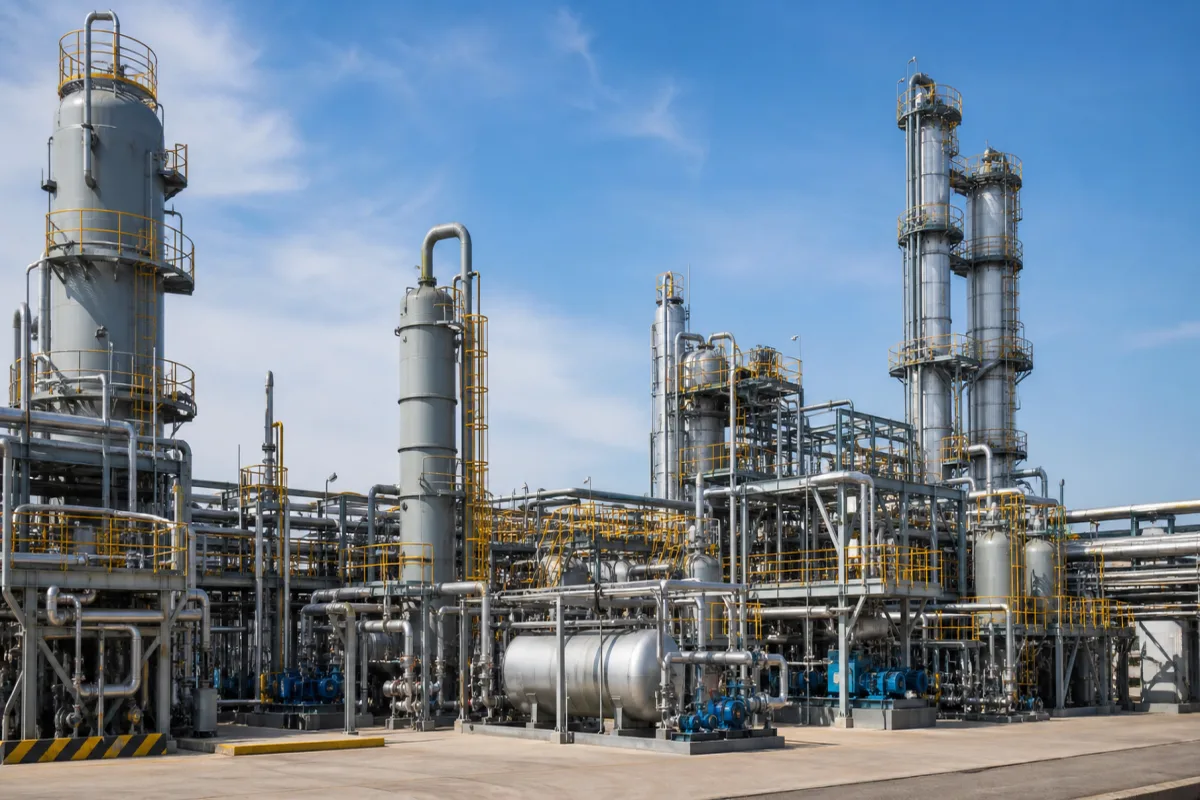
A nitric acid production and concentration system converts ammonia to nitrogen oxides, absorbs them to make weak acid and, where ordered, concentrates that acid in a separate dehydration train. Define the acid products, pressure scheme, heat recovery and tail-gas treatment as one plant scope, with separate performance guarantees for production and emissions.
Weak nitric acid plants (ammonia oxidation, NO oxidation, absorption, bleaching, tail-gas treatment and power recovery) and high-strength nitric acid concentration units. Ammonia synthesis, ammonium nitrate and fertilizer finishing plants, and acid storage and loading alone are outside this page except where compared. Standalone ammonia-oxidation catalyst gauze packs are covered on 5030; this page concerns the integrated acid-production and concentration trains.
CNFX editorial research · Sources checked October 18, 2026 · 4 sources
The February 1998 EPA AP-42 Section 8.8 describes a 1:9 ammonia–air mixture oxidised at 1,380–1,470 °F, with oxidation temperatures also reported up to 1,650 °F. Its catalyst description is 90% platinum / 10% rhodium gauze, with 93–98% nitric-oxide yield under the described conditions. These are historical process descriptions, not a catalyst or temperature specification for every ordered plant. [1]
AP-42 describes cooling the gas to 100 °F or less at pressures up to 116 psia for nitric-oxide oxidation, then absorbing the nitrogen oxides in water. Its stated product concentration is 55–65%, within a stated 30–70% weak-acid range. The described dual-pressure route uses slightly negative pressure to about 58 psia for oxidation and 116–203 psia for absorption; the tail gas is reheated to about 392 °F before power recovery. Retain the absolute-pressure units and the identified process positions. [1]
The same source describes 98–99% strong acid obtained by extractive distillation with a dehydrating agent. Weak acid cannot be concentrated to that product by simple fractional distillation. Its example feeds concentrated sulfuric acid and 55–65% nitric acid to a packed column near atmospheric pressure, recovers 99% nitric-acid vapour through bleaching and condensation, and returns recovered nitrogen oxides to absorption. Confirm the dehydrating-agent circuit and acid product separately from the weak-acid plant. [1]
Give the supplier the capacity (as 100% HNO₃ per day), product strength(s), single- or dual-pressure preference, ammonia and air supply conditions, catalyst and recovery-filter arrangement, steam export and power recovery targets, tail-gas NOx and N₂O limits and the control technology, concentration route and dehydrating agent, materials of construction, utilities, site and permitting constraints.
02
Control NOx in the absorber tail gas
AP-42 identifies absorber tail gas as the main NOx source and discusses extended absorption and catalytic reduction. Table 8.8-1 is rated E: its historical weak-acid tail-gas factors are 57 lb/ton uncontrolled, 0.4 lb/ton with natural-gas catalytic reduction, 0.8 with hydrogen, 1.9 for extended absorption under the table’s single-stage process row and 2.1 under its dual-stage process row. The high-strength acid plant row is separately 10 lb/ton. The footnotes distinguish the process categories and underlying plant samples; the rows are not a guaranteed reduction range for an unidentified installation. All factors use 100% acid production. [1]
Editorial calculation: assuming a hypothetical steady daily production of 500 US short tons of 55 wt% acid, the pure-acid equivalent is 500 ×0.55 =275 US short tons/day. Applying the separate historical AP-42 factors gives 275 ×57 =15,675 lb/day uncontrolled, 275 ×0.4 =110 lb/day for the natural-gas catalytic-reduction example, or 275 ×1.9 =522.5 lb/day for the table’s single-stage extended-absorption example. These are conditional estimates using distinct control cases, not manufacturer-published performance or measured daily emissions. A US short ton is not a metric tonne: the table explicitly converts lb/ton to kg/Mg by multiplying by 0.5. Obtain the applicable permit basis and plant-specific guarantee. [1]
03
Ask for N₂O abatement and a measured N₂O emission factor
The 2006 IPCC Guidelines describe N₂O as an unintended by-product of ammonia oxidation, dependent on combustion conditions, catalyst and burner design. Their Table 3.3 gives inventory defaults per metric tonne of 100% acid; these differ in purpose and units from the AP-42 NOx factors. The table entries below are historical inventory defaults, not plant emission limits or measured outcomes. [4]
The IPCC discussion distinguishes burner measures, process-gas treatment, tail-gas treatment upstream of the expander and end-of-pipe treatment downstream of it. It describes direct tail-gas decomposition as attractive above 723 K in that discussion. Editorial calculation: 723 −273.15 =449.85 °C, approximately 450 °C; this is a temperature-unit conversion, not a specified reactor setpoint or measured plant temperature. For N₂O inventory calculations, use measured plant data and a production mass stated in metric tonnes; the AP-42 short-ton example is a separate calculation. [4][1]
State the N₂O limit or target, the abatement position (burner, process gas or tail gas) and the measurement method for the guarantee.
04
Pick the pressure level against yield and tail-gas NOx
Fertilizers Europe’s 2000-edition BAT booklet describes weak-acid fertilizer plants at low (below 1.7 bar), medium (1.7–6.5 bar) and high (6.5–13 bar) pressure, and weak acid of 50–65%. Its gauze description is about 90% platinum alloyed with rhodium. The stated 60–80% getter recovery concerns total catalyst losses, rather than a separately measured platinum-only recovery. These historical process values do not establish present permit conditions. [3]
The booklet discusses minimum NSCR preheat of 300 °C with hydrogen or 550 °C with methane. Its dated cost example concerns reducing NOx from 1,000 to 200 ppmv, adding about 1.1% to nitric-acid plant operating cost, with SCR maintenance listed as 2.5% of SCR capital cost. These are the booklet’s historical examples, not current commercial quotations or universal operating requirements. [3]
Editorial calculation: assuming a hypothetical plant actually produces 1,000 metric tonnes/day of 100% acid and its normalised tail-gas flow is 3,300 Nm³ per metric tonne, 1,000 ×3,300 =3.3 million Nm³/day. The assumed specific flow lies within the booklet’s 3,100–3,400 Nm³/t range. This conditional arithmetic is neither manufacturer-published plant throughput nor measured gas flow; agree the reference conditions and actual gas balance separately. [3]
Historical booklet level, existing plants (24 h average)
200 ppmv ≈ 1.4 kg NO₂ per t (SCR-equipped plants up to 400 ppmv) [3]
State the plant capacity (t/d of 100% HNO₃), product strength, the absorber pressure scheme and the NOx and N₂O limits the plant must meet, and ask for guaranteed tail-gas values and abatement method.
05
Weak-acid train and optional concentration plant
The EPA process diagrams distinguish the oxidation and absorption train from the strong-acid dehydration train. Specify the concentration plant only where that acid product is required. [1][2]
Configurations include single-pressure and dual-pressure weak acid plants, with tail-gas control by extended absorption, catalytic reduction or chilled absorption with caustic scrubbing, and high-strength concentration units using extractive distillation; EPA's background report for the section gives the same process basis, including the 90% platinum / 10% rhodium catalyst. [1][2]
06
Oxidiser, absorber, expander and dehydrating circuit
The process diagram places heat recovery and tail-gas control around the weak-acid train. A concentration package adds its own dehydration, bleaching and condensation duties. [1][2]
Record acid basis, pressure units and emission guarantees
Use one stated production-mass basis for each balance. Historical source factors and guidance examples remain separate from the supplier’s plant guarantee and the permit conditions.
Explore company information and manufacturing capabilities, then discuss the scope of your project with a relevant supplier.
Share this page
Compiled and source-reviewed by the CNFX editorial team.
Each manufacturer above links to the page on that company's own website where the product is listed, with the date we checked it. How we source and review
· Page last updated 13 October 2026
Buyer questions
How is weak nitric acid made?
AP-42 describes oxidising a 1:9 ammonia–air mix over platinum–rhodium gauze, oxidising NO to NO₂ and absorbing it in water to give 30–70% acid. [1]
Why do newer plants use two pressures?
Ammonia oxidation is favoured by low pressure and NO oxidation and absorption by high pressure, so dual-pressure plants put a compressor between oxidiser and condenser. [1]
How much NOx does a nitric acid plant emit?
The February 1998 AP-42 table gives historical factors on a 100% acid basis, with rating E and separate process/control rows. These are inventory estimates rather than a guaranteed emission range; use consistent short-ton or metric-tonne units and plant-specific data. [1]
Does the booklet’s NOx value establish the current plant limit?
The 2000-edition booklet gives 100 ppmv for new plants in normal operation and 200 ppmv as a 24-hour average for existing plants, with a stated SCR exception up to 400 ppmv. These are dated guidance values, not confirmation of the current permit requirement. [3]
How much N₂O does a nitric acid plant emit?
The 2006 IPCC Guidelines give default factors from 2 kg N₂O per tonne of 100% acid for plants with NSCR to 9 kg per tonne for high-pressure plants; plant measurements take precedence over these defaults. [4]
Sources and what still needs a direct check
Sources checked 2026-10-18. EPA’s historical AP-42 section and background report describe process trains and emission factors. The Fertilizers Europe booklet and IPCC inventory chapter have different purposes; retain their dates, mass units and scope rather than treating their values as a current plant guarantee.