Industry-Verified Manufacturing Data (2026)

Melt Surge Tank

Based on aggregated insights from multiple verified factory profiles within the CNFX directory, the standard Melt Surge Tank used in the Chemical Manufacturing sector typically supports operational capacities ranging from standard industrial configurations to heavy-duty production requirements.

Technical Definition & Core Assembly

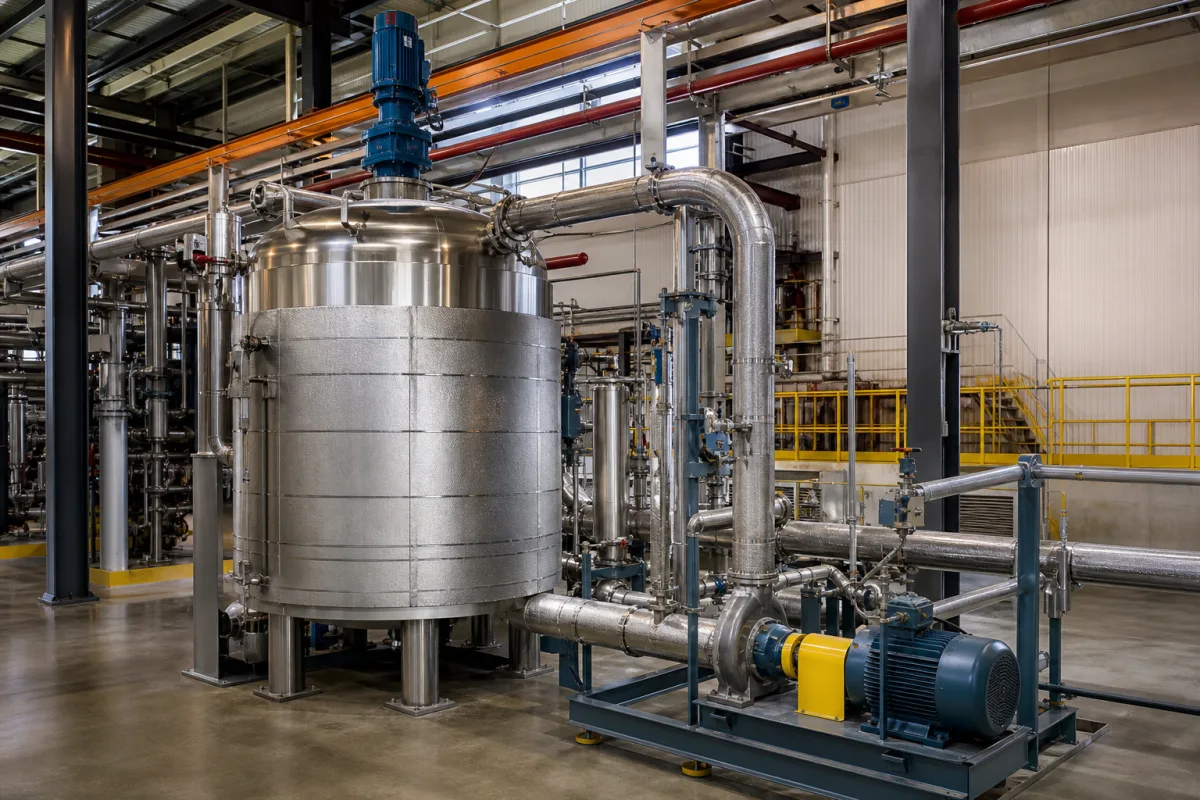
A canonical Melt Surge Tank is characterized by the integration of Tank Shell and Heating Jacket/Coils. In industrial production environments, manufacturers listed on CNFX commonly emphasize Stainless Steel (e.g., 304L, 316L) construction to support stable, high-cycle operation across diverse manufacturing scenarios.

A specialized tank designed to temporarily store and regulate the flow of molten ammonium nitrate within a continuous production system, preventing pressure surges and ensuring stable operation.
Product Specifications

Technical details and manufacturing context for Melt Surge Tank

Definition
The Melt Surge Tank is a critical component within the Continuous Ammonium Nitrate Melt Production and Concentration System. It acts as an intermediate buffer vessel that receives molten ammonium nitrate from the concentration stage. Its primary function is to absorb flow variations and pressure fluctuations, providing a steady, controlled supply of melt to downstream processes such as prilling or granulation. This regulation is essential for maintaining product quality consistency, preventing system overloads, and ensuring the safety and efficiency of the continuous chemical manufacturing line.
Working Principle
The tank operates by receiving a variable inflow of hot, concentrated ammonium nitrate melt. Its volume provides hydraulic capacitance, allowing the liquid level to rise and fall to dampen flow rate changes. It may be equipped with level sensors, heating jackets or coils to maintain the melt above its crystallization point, and an outlet control valve or pump. The principle is one of mass balance and pressure equalization, transforming an intermittent or variable input into a more constant, manageable output for the next stage of the process.
Common Materials
Stainless Steel (e.g., 304L, 316L), Carbon Steel (with appropriate lining)
Technical Parameters
  • Working volume capacity, determining the surge absorption capability and residence time of the melt. (m³) Customizable
Components / BOM
  • Tank Shell
    Primary pressure-containing body of the vessel.
    Material: Stainless Steel / Carbon Steel
  • Heating Jacket/Coils
    Maintains the ammonium nitrate melt in a liquid state by providing external heat.
    Material: Stainless Steel
  • Level Sensor/Transmitter
    Measures and controls the melt level within the tank to regulate inflow/outflow.
    Material: Stainless Steel (wetted parts)
  • Insulation Layer
    Minimizes heat loss from the tank to improve energy efficiency and maintain safe external surface temperatures.
    Material: Mineral Wool / Calcium Silicate
Engineering Reasoning
0.5-2.0 MPa (5-20 bar) at 170-185°C
3.5 MPa (35 bar) internal pressure or 250°C wall temperature
Design Rationale: Thermal decomposition of ammonium nitrate at 210°C producing N₂O gas causing rapid pressure increase exceeding yield strength of 316L stainless steel (205 MPa)
Risk Mitigation (FMEA)
Trigger Cooling jacket flow reduction below 0.1 m³/min
Mode: Molten ammonium nitrate temperature exceeds 210°C initiating exothermic decomposition
Strategy: Dual redundant cooling circuits with independent temperature sensors and automated emergency dump valves
Trigger Level sensor calibration drift exceeding ±5%
Mode: Overfill causing liquid contact with vapor space leading to rapid pressurization
Strategy: Three independent level measurement systems (radar, capacitance, differential pressure) with 2oo3 voting logic

Industry Taxonomies & Aliases

Commonly used trade names and technical identifiers for Melt Surge Tank.

Industrial Ecosystem & Supply Chain DNA

Complementary Systems
Downstream Applications
Specialized Tooling

Application Fit & Sizing Matrix

Operational Limits
pressure: 0-2 bar gauge (designed for low-pressure surge absorption)
flow rate: Up to 50 m³/h (dependent on system configuration)
temperature: 170-200°C (typical ammonium nitrate melt temperature range)
slurry concentration: Not applicable - designed for pure molten ammonium nitrate (100% melt)
Media Compatibility
✓ Molten ammonium nitrate production ✓ Continuous fertilizer manufacturing lines ✓ Nitric acid-based chemical processes
Unsuitable: Aqueous ammonium nitrate solutions or slurry systems (requires different corrosion/design considerations)
Sizing Data Required
  • Maximum expected surge volume (m³)
  • System pressure rating requirements (bar)
  • Required residence time for stabilization (seconds)

Reliability & Engineering Risk Analysis

Failure Mode & Root Cause
Thermal stress cracking
Cause: Rapid temperature fluctuations in molten material causing uneven expansion/contraction of tank walls and welds
Corrosion/erosion at liquid-air interface
Cause: Oxidation and chemical attack at the melt surface level combined with material flow patterns
Maintenance Indicators
  • Visible weeping or small leaks at weld seams indicating crack propagation
  • Abnormal temperature gradients on tank exterior detected via thermal imaging
Engineering Tips
  • Implement controlled heating/cooling cycles with ramp rates not exceeding manufacturer specifications to minimize thermal shock
  • Install sacrificial anode system or apply protective refractory lining at the liquid-air interface zone to combat localized corrosion

Compliance & Manufacturing Standards

Reference Standards
ISO 9001:2015 - Quality Management Systems ASME BPVC Section VIII - Pressure Vessels EN 13445 - Unfired Pressure Vessels
Manufacturing Precision
  • Wall Thickness: +/-5% of nominal thickness
  • Nozzle Alignment: +/-1.5° from specified orientation
Quality Inspection
  • Hydrostatic Pressure Test
  • Ultrasonic Thickness Testing

Factories Producing Melt Surge Tank

Verified manufacturers with capability to produce this product in China

✓ 94% Supplier Capability Match Found

P Project Engineer from United Arab Emirates Feb 02, 2026
★★★★★
"The Melt Surge Tank we sourced perfectly fits our Chemical Manufacturing production line requirements."
Technical Specifications Verified
S Sourcing Manager from Australia Jan 30, 2026
★★★★★
"Found 17+ suppliers for Melt Surge Tank on CNFX, but this spec remains the most cost-effective."
Technical Specifications Verified
P Procurement Specialist from Singapore Jan 27, 2026
★★★★★
"The technical documentation for this Melt Surge Tank is very thorough, especially regarding technical reliability."
Technical Specifications Verified
Verification Protocol

“Feedback is collected from verified sourcing managers during RFQ (Request for Quote) and factory evaluation processes on CNFX. These reports represent historical performance data and technical audit summaries from our B2B manufacturing network.”

5 sourcing managers are analyzing this specification now. Last inquiry for Melt Surge Tank from Turkey (1h ago).

Supply Chain Compatible Machinery & Devices

Continuous Flow Reactor System

Automated chemical synthesis system for continuous production.

Explore Specs →
Modular Distillation Column System

Pre-engineered modular system for continuous separation of chemical mixtures via distillation.

Explore Specs →
Automated Batch Crystallization System

Automated system for controlled crystallization of chemical compounds in batch processes.

Explore Specs →
Automated pH Monitoring and Dosing System

Automated system for continuous pH monitoring and chemical dosing in process streams.

Explore Specs →

Frequently Asked Questions

What is the primary function of a Melt Surge Tank in chemical manufacturing?

The Melt Surge Tank temporarily stores and regulates the flow of molten ammonium nitrate within continuous production systems, preventing pressure surges that could disrupt operations and ensuring stable, consistent process flow.

What materials are recommended for constructing a Melt Surge Tank?

Melt Surge Tanks are typically constructed from corrosion-resistant materials like Stainless Steel (304L or 316L grades) or Carbon Steel with appropriate protective linings to withstand the high temperatures and chemical properties of molten ammonium nitrate.

What key components are included in a standard Melt Surge Tank BOM?

A standard Bill of Materials includes: Tank Shell (primary containment), Heating Jacket/Coils to maintain optimal temperature, Insulation Layer for thermal efficiency, and Level Sensor/Transmitter for precise monitoring and control of molten material levels.

Can I contact factories directly on CNFX?

CNFX is an open directory, not a transaction platform. Each factory profile provides direct contact information and production details to help you initiate direct inquiries with Chinese suppliers.

Get Quote for Melt Surge Tank

Request technical pricing, lead times, or customized specifications for Melt Surge Tank directly from verified manufacturing units.

Your business information is encrypted and only shared with verified Melt Surge Tank suppliers.

Thank you! Your message has been sent. We'll respond within 1–3 business days.

Need to Manufacture Melt Surge Tank?

Connect with verified factories specializing in this product category

Add Your Factory Contact Us
Previous Product
Medical-Grade Polypropylene Syringe
Next Product
Metering Valve