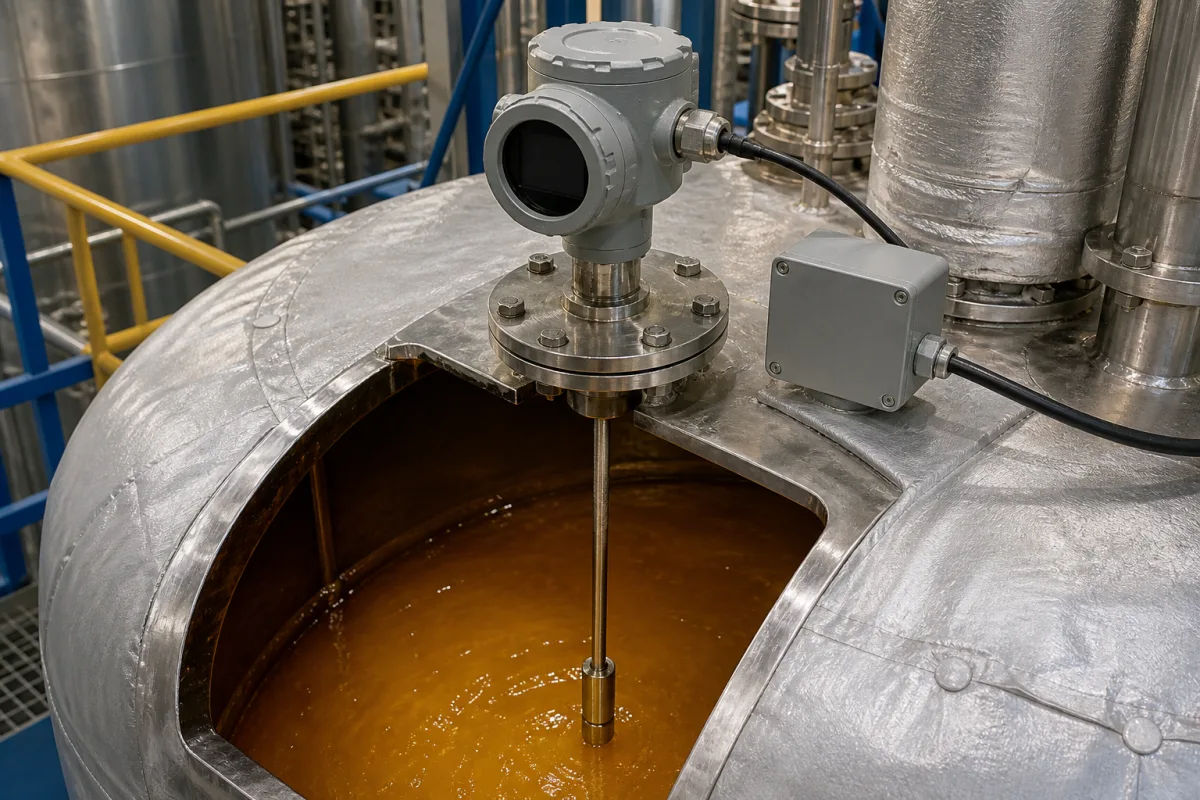
Melt tank level sensor/transmitter: high-temperature guided radar and radiometric gauges
Level sensors for heated melt tanks · high-temperature guided wave radar probes and external radiometric gauges for molten sulphur, urea, resin and polymer melts
A melt tank level sensor/transmitter measures the level of a material that is only liquid because the tank is heated: molten sulphur in a pit, urea or resin melt, or polymer melt in a surge vessel ahead of a pump or die. The melt is hot, can solidify or crystallise on anything cooler, and is costly to spill or run dry. This page covers two approaches: a guided wave radar probe rated for the process temperature, or a radiometric gauge whose source and detector stay outside the melt. Ask three things first: the highest melt and vapour-space temperature, whether build-up or solidified crust will form on a probe, and whether a radioactive source is acceptable on site.
Continuous level sensors and transmitters for heated melt tanks and pits (molten sulphur, urea, resin and polymer melts), specified by process temperature, build-up behaviour and contact or non-contact principle. General level transmitters for water, chemicals and fuels in ordinary tanks, with radar, ultrasonic, capacitance and hydrostatic types, are covered on the Level transmitter page. Point level switches, melt pressure transducers and weighing systems are outside this page except where compared.
CNFX editorial research · Sources checked October 12, 2026 · 4 sources
Rate a guided radar probe for the melt temperature
KROHNE's OPTIFLEX series brochure lists the OPTIFLEX 8200 guided radar (TDR) for liquids at high temperature and pressure, with a single or double ceramic process seal system, process conditions up to +315 °C and 320 barg, ±2 mm accuracy, SIL 2/3-certified outputs and measuring distances up to 60 m; its target applications include fertiliser (urea), resin, paint and ink. [1]
The same brochure gives the general-purpose OPTIFLEX 7200 a lower limit of +250 °C and 100 barg, and states that the series measures liquids with dielectric constants as low as 1.3. [1] Editorial note: the rating that matters is the one for the probe, seal and process connection as ordered, at the temperature of the heating medium (steam or hot oil jacket) as well as the melt. Ask for the temperature–pressure curve of the exact probe and flange, and whether the electronics need a remote or extended housing to stay cool.
In a guided radar, a low-amplitude microwave pulse runs down a rod or cable probe, reflects from the melt surface and is timed. [2] Editorial note: in a melt that is heated by jacket or coils, ask the supplier where the probe can be mounted so that it does not sit in a cold zone where melt freezes onto it.
Give the supplier the melt (and its composition), normal and maximum melt temperature, heating medium and its temperature, vapour-space pressure, tank or pit dimensions and nozzle, agitation, expected build-up or crust, required accuracy, output and SIL level, hazardous-area classification, and whether a radioactive source is acceptable.
02
Plan for build-up, or keep the sensor out of the melt
VEGA, describing its VEGAFLEX 81 guided radar in refinery sulphur pits, explains that the pits are kept hot to stop sulphur solidifying, but an upset can let sulphur vaporise and crystallise on everything inside. Build-up only slows the pulse slightly along the rod or cable probe; once the build-up has stabilised after installation, operators can recalibrate, and the factory-configured sensor otherwise gives readings within 2 mm. [2]
Where nothing should touch the melt, a radiometric gauge measures through the vessel wall. Berthold describes a gamma source and detector on either side of the vessel: the higher the level, the less radiation reaches the detector, and it states the measurement is not influenced by pressure, temperature, viscosity, colour or chemical properties of the product. Its SENSseries LB 480 detectors are certified for SIL 2 applications, with SIL 3 by homogeneous redundancy. [4]
Endress+Hauser's FQG74 source container holds up to 20 internal radioactive sources for long measuring ranges, positioned on ropes extendable to 30 m in a dip tube, and works with the Gammapilot FMG50 detector, which operates up to 80 °C without additional cooling. In its PTA oxidation reactor example, multiple internal sources in a dip tube reduce the influence of pressure change and build-up while the detector stays outside the vessel. [3] Editorial note: a radiometric gauge brings licensing, source handling and radiation protection duties; check the local requirements before choosing it.
03
Probe, ceramic seal, housing, or source and detector outside the melt
The process seal and probe carry the temperature rating in a guided radar; in a radiometric gauge nothing touches the melt.
Component
Role
Fix in the order
Probe (rod, cable or coaxial)
Guides the radar pulse to the melt surface. [2][1]
Type, material, length.
Process seal
Separates melt and vapour from the electronics; ceramic in high-temperature versions. [1]
Explore company information and manufacturing capabilities, then discuss the scope of your project with a relevant supplier.
Share this page
Compiled and source-reviewed by the CNFX editorial team.
Each manufacturer above links to the page on that company's own website where the product is listed, with the date we checked it. How we source and review
· Page last updated 13 October 2026
Buyer questions
How hot can a guided radar level transmitter go?
KROHNE lists its OPTIFLEX 8200 with a ceramic process seal for up to +315 °C and 320 barg; the rating applies to the probe, seal and connection as ordered. [1]
Does build-up on the probe stop a guided radar measuring?
VEGA says build-up in sulphur pits only slows the pulse slightly, and the sensor can be recalibrated once the build-up has stabilised. [2]
When is a radiometric level gauge used on a melt tank?
When nothing should touch the process; Berthold and Endress+Hauser place the detector outside the vessel and the source outside or in a dip tube. [4][3]
Sources and what still needs a direct check
Sources checked 2026-10-12. KROHNE, VEGA, Endress+Hauser and Berthold describe their own instruments and applications; VEGA's sulphur-pit account appeared in Hydrocarbon Engineering. The supplier's certified ratings for the device as ordered govern.