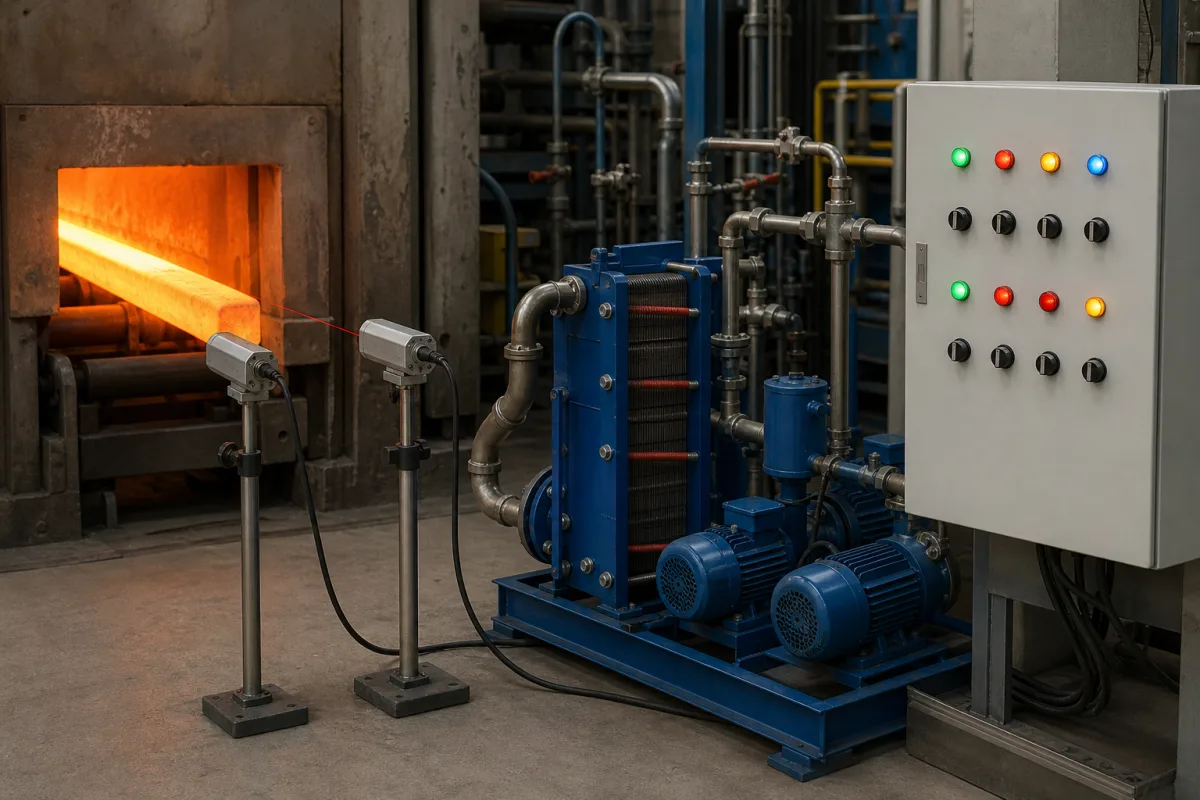
Temperature control system for induction billet heating (exit pyrometers, zone power and what the line does when the press stops)
Billet temperature control for induction forging heaters · exit pyrometers, single power unit versus zone/coil control, creep speed, stopped hold, standby and rapid-start recipes, emptying the coil line
On an induction forging line the temperature control system is the part that decides how hot each billet leaves the coil: a pyrometer reads the billet at the exit, the controller sets inverter power and line speed, and recipes tell the heater what to do when the press stops. Buy it by asking how the coils are powered, what the line can do during a stop without scrapping billets, and how exit temperature is measured on a scaled surface.
The temperature control of induction billet and bar heaters for forging: exit pyrometers and their use for control and sorting, single-supply versus zone/coil power control, creep speed, stopped hold, standby and restart recipes, and coil-line emptying. The heater as a whole is covered on the Induction heater page; complete forging lines on the Automated hot forging line page; spot pyrometers on the Infrared pyrometer for hot metal and furnace processes page; peak and valley hold logic on the Signal processor for mill pyrometers page; induction cooling water on the Water cooling system for induction equipment page; fuel-fired furnaces on the Reheating furnace page; panel temperature controllers on the Temperature controller page.
CNFX editorial research · Sources checked October 12, 2026 · 5 sources
One power unit for all coils, or one inverter per zone
David A. Lazor and Donald A. Gibeaut of Ajax Tocco's American Induction Heating division separate two layouts. In the traditional linear system "a single power unit supplies power to multiple coils" and power is controlled to the entire line of coils; in the zone/coil control system "each zone/coil is powered by a separate inverter", so power to each zone can be set independently. [1]
The layout decides what the control system can do during a stop. With a single supply, they write, the line "cannot be stopped to hold temperature" because the ratio of power delivered to the billets in each coil is fixed. With zone control the slowest workable creep speed falls, and "The more independently controlled zones incorporated, the slower the creep speed capability will be." [1]
02
Creep speed, stopped hold or shutdown when the press stops
The same authors frame the choice as keep running and reject, slow to creep speed, or stop. Creep speed is "the minimum speed at which the system can be continuously run where the thermal profile of the billets along the length of the line can be maintained within an acceptable range." They give "Most" single-supply lines a creep speed of 30-50% of full production speed, a further reduction to 5-20% at the cost of rejecting the billets in the last coil(s), and 5-10% for zone-controlled systems "without rejecting any billets within the coils". [1]
Their worked example: a 120-in. coil line putting out a 3-in. OD × 12-in. billet every 20 seconds holds 10 billets and takes 200 seconds per billet to pass through; at 30% creep a billet leaves every 67 seconds and a full line length is rejected in 667 seconds, so with downtime expected to be "much more than 15 minutes" they would stop and shut off. A cold restart "Typically" takes one line length of billets. [1]
Editorial calculation on the same example at a 5% creep speed, the low end they give for zone control: 20 s ÷ 0.05 = 400 s per billet, and 10 billets × 400 s = 4,000 s, about 67 minutes for a line length. [1]
Restarting with billets that have not cooled to room temperature, they warn, gives overheated billets, billets welded together or partial melting that can damage the coil; "devices available to quickly empty the coil line" help make shutdown practical. [1]
Situation
What the article says
Source
Short stop, single power unit
Creep at 30-50% of full speed; 5-20% if the last coil(s) can be rejected.
Ask the heater maker for the creep speed of your billet sizes, the stopped-hold behaviour, the time to empty the coil line and the number of billets lost on a cold restart, as figures.
03
Reading the billet at the coil exit
Tempsens gives the workpiece temperature before forging as "between 950 °C and 1250 °C" depending on material and process, says thermocouple measurement does not apply in inductively heated furnaces, and lists dust, smoke, steam, scale and object size as factors that affect the reading; it adds that "we can control Power & Production speed from Pyrometer". [3] Keller writes that forged blocks are measured by pyrometer and "temperatures of oxidized or scaled surfaces must also be measured reproducibly", that its PKL pyrometers' "short response times from 2 ms enable process controls", and that its CellaInduction report places the measurement "at the outlet of the heating furnace before the forming process". [4][5]
In one heater Inductoheat shipped, a 500 kW / 3 kHz module supplying two in-line coils heats billets to 2,250 °F ±50 °F at a nominal 300 pieces an hour; set points for "Standby and Rapid Start" are stored as recipes in the heater's PLC, and at the exit "the infrared temperature pyrometer activates the over and under accept / reject system". [2]
Tempsens lists single-colour and two-colour models for induction forging; on the two-colour model the emissivity slope is adjustable from 0.75 to 1.25. [3]
04
Billet heater temperature control details
Paste it into your enquiry below or into an email to a maker, then replace every bracket.
Billets: [material; diameter; length; rate]
Target: [exit temperature; tolerance]
Coils and power: [single supply or zone/coil inverters; number of zones]
Stops: [creep speed; stopped hold; standby and restart recipes]
Shutdown: [coil-line emptying; cold restart loss]
Measurement: [pyrometer type; single or two colour; position; scale]
Sorting: [over/under accept-reject]
Control: [PLC; HMI; data logging]
Explore company information and manufacturing capabilities, then discuss the scope of your project with a relevant supplier.
Share this page
Compiled and source-reviewed by the CNFX editorial team.
Each manufacturer above links to the page on that company's own website where the product is listed, with the date we checked it. How we source and review
· Page last updated 13 October 2026
Buyer questions
Can every billet heater hold temperature when stopped?
Ajax Tocco's authors say a line with a single power supply feeding multiple coils cannot be stopped to hold temperature; zone/coil-controlled lines can hold for a time before the profile is lost. [1]
How slow can the line run during a short stop?
They give 30-50% of full speed for single-supply lines and 5-10% for zone-controlled lines, depending on billet size and coil arrangement. [1]
Why measure billet temperature with a pyrometer?
Tempsens notes thermocouples do not apply in inductively heated furnaces; pyrometers read the billet without contact at the exit. [3][5]
What does the exit pyrometer do besides control?
In Inductoheat's heater it drives an over and under accept/reject system. [2]
Sources and what still needs a direct check
Sources checked 2026-10-12. New Equipment Digest published the Ajax Tocco engineers' article on holding billet heaters and a report on an Inductoheat billet heater; Tempsens and Keller publish pyrometer application pages for induction forging.