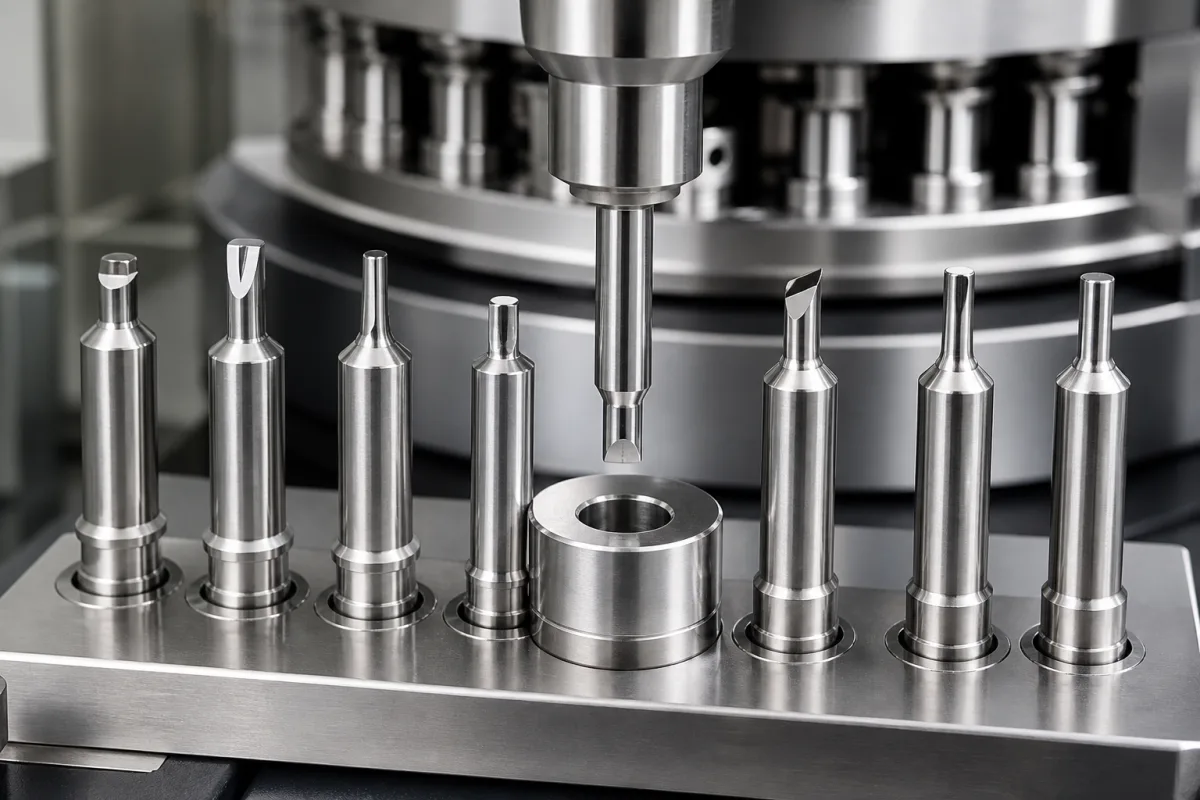
Tablet press punch tips · The compression end of upper and lower punches: TSM and EU tooling standards, single-tip and keyed multi-tip punches in cap-assembly or monoblock form, tool steels, carbide, coatings, and inspection and polishing
A punch tip is the working end of a tablet press punch: its face shapes the tablet and carries any embossing or score line, and it enters the die to compress the powder between upper and lower punches. Ask three things first: which press and tooling standard it must fit, whether one tip or more per punch, and which steel, carbide or coating suits the formulation.
The tips of upper and lower tablet punches, including single-tip punches and multi-tip punches with replaceable cap assemblies or one-piece monoblocks, and their materials, coatings and care. Dies, die segments, tablet presses and tablet coating machines (see pharmaceutical tablet coating machine) are outside this page.
CNFX editorial research · Sources checked October 12, 2026 · 4 sources
Elizabeth describes tablet tooling as an upper punch, a lower punch and a die: powder is filled into the die and compressed between the two punches, and the tooling sets the tablet's shape, size and markings. Elizabeth, Fette Compacting and LFA each list standard TSM and EU tooling formats. [1][2][3]
Elizabeth names B, D, BB and DB tooling types and says the choice depends on tablet size, press specifications and production requirements. [1] LFA notes that its own presses take TDP, RTP, EU or TSM compatible tooling and asks buyers to check tooling size against the press specification. [3]
For more output per press, Elizabeth offers multi-tip tooling in cap-assembly or solid monoblock form, precision-keyed so each tip aligns with its die bore, and claims up to 300% higher tablet output without new presses. [1] Fette Compacting supplies cleaning components for both simple and multi-tip tools. [2]
Give the supplier the press model and turret, tooling standard and type (TSM or EU; B, D, BB or DB), tablet shape, size, cup depth, embossing or score line, number of tips per punch, cap-assembly or monoblock design, material, coating, formulation behaviour (abrasive, sticky, humid), and the number of sets.
02
Choose the tip material and coating for the formulation
Elizabeth lists S7 steel with a micro-polish finish for pharmaceutical tooling; 440C high-chromium stainless steel for humid environments and washable presses; and tungsten carbide for highly abrasive formulations, which it says gives 3 to 10 times the life of standard materials. [1] LFA supplies GCr15 steel as standard and offers S7, S5 and 405 steels. [3]
Elizabeth's surface options are chrome plating for corrosion resistance and lubricity against powder sticking, titanium nitride (TiN) for wear and corrosion resistance, chromium nitride (CrN) against wear, corrosion and sticking, and ion beam enhanced deposition (IBED). It lists coatings, punch-face polishing, formulation flow and compression settings as ways to reduce sticking. [1]
Fette Compacting recommends a visual inspection of the tools after each use and polishes tool surfaces after cleaning. [2] Elizabeth lists visible wear or damage, tablet defects, inconsistent weight or hardness and increased machine strain as signs that tooling needs replacing. [1]
03
Know when split punch holders and multi-tip tools replace standard punches
GEA's R55 rotary press page describes tooling for high-force industrial tableting that departs from EU or TSM punches. The R55 makes single-sided tablets at compression forces of up to 130 kN, with 16 or 12 stations, outside die diameters of 48 or 70 mm, punch-holder bodies of 40 or 45 mm and a maximum output of 30,720 or 23,040 tablets per hour. GEA states that its punch holders differ from the EU or TSM standard in three ways: a milled high-pressure head gives line contact with the compression roller instead of the point contact of a mushroom head, reducing specific contact pressure; the tooling is split into a punch holder and a separately replaceable punch tip, because the holder is not subject to heavy wear; and side rollers run in a cam track, which it says allows ejection forces up to 10 kN without excessive wear. It also lists core rods and multi-tip punches, where “A number of smaller punch tips are fastened on a larger punch holder” and output multiplies by the number of tips. [4]
GEA writes that “Generally speaking, pharmaceutical presses are equipped with standardized mushroom-head tooling”, the EU and TSM tooling and multi-tip designs described above; its split design is aimed at high-force industrial tablets. [1][2][3]
Editorial calculation: 30,720 tablets/h over 16 stations is 1,920 per station per hour, or 32 turret revolutions per minute; a 4-tip tool on the same press would raise the theoretical output to 122,880 tablets/h.
GEA R55 data
16-station
12-station
Max. compression force
130 kN
130 kN
Outside die diameter
48 mm
70 mm
Punch-holder body diameter
40 mm
45 mm
Max. output
30,720 tablets/h
23,040 tablets/h
Max. fill depth
55 mm
55 mm
For high-force or very large tablets, ask whether the press uses standard EU/TSM punches or split holder-and-tip tooling, the tip force rating, and whether tips can be replaced without the holder.
04
Tip drawings, hardness, coating and keying to get with a punch tip quote
Ask any supplier for tooling standard and type, tip drawings with dimensions and tolerances, material and hardness, coating, surface finish, keying method for multi-tip tooling, inspection report, lead time and minimum order.
05
Tip face, die bore fit, cap assembly, key and coating
Part
Role
Fix in the order
Tip face
Shapes the tablet; carries embossing or score line. [1]
Tip diameter, profile, hardness and concentricity for a punch tip order
Diameter, hardness, tip length and concentricity are not stated in the reviewed sources, so those rows have to come from the tip drawing for your tablet. [1][3]
Field
What it means and published values
Ask the supplier for
Tip Diameter (mm)
Set by tablet size; not stated in the reviewed sources.
1 company lists this product among what they make. Company figures are quoted from each
company's own website; every card states where the relationship came from.
Explore company information and manufacturing capabilities, then discuss the scope of your project with a relevant supplier.
Share this page
Compiled and source-reviewed by the CNFX editorial team.
Each manufacturer above links to the page on that company's own website where the product is listed, with the date we checked it. How we source and review
· Page last updated 13 October 2026
Buyer questions
What standards do tablet punches follow?
Elizabeth, Fette Compacting and LFA all list TSM and EU tooling formats. [1][2][3]
How do multi-tip punches stay aligned?
Elizabeth says its multi-tip tooling is precision-keyed for tip-to-die entry, in cap-assembly or monoblock form. [1]
Which tip material suits abrasive formulations?
Elizabeth recommends tungsten carbide, which it says lasts 3 to 10 times longer than standard materials. [1]
Can a punch tip be replaced without the whole punch?
GEA's R55 industrial press uses tooling split into a punch holder and a separate punch tip so each can be exchanged; it is rated to 130 kN compression. [4]
Sources and what still needs a direct check
Sources checked 2026-10-12. Elizabeth, Fette Compacting and LFA Machines make tablet presses and compression tooling.