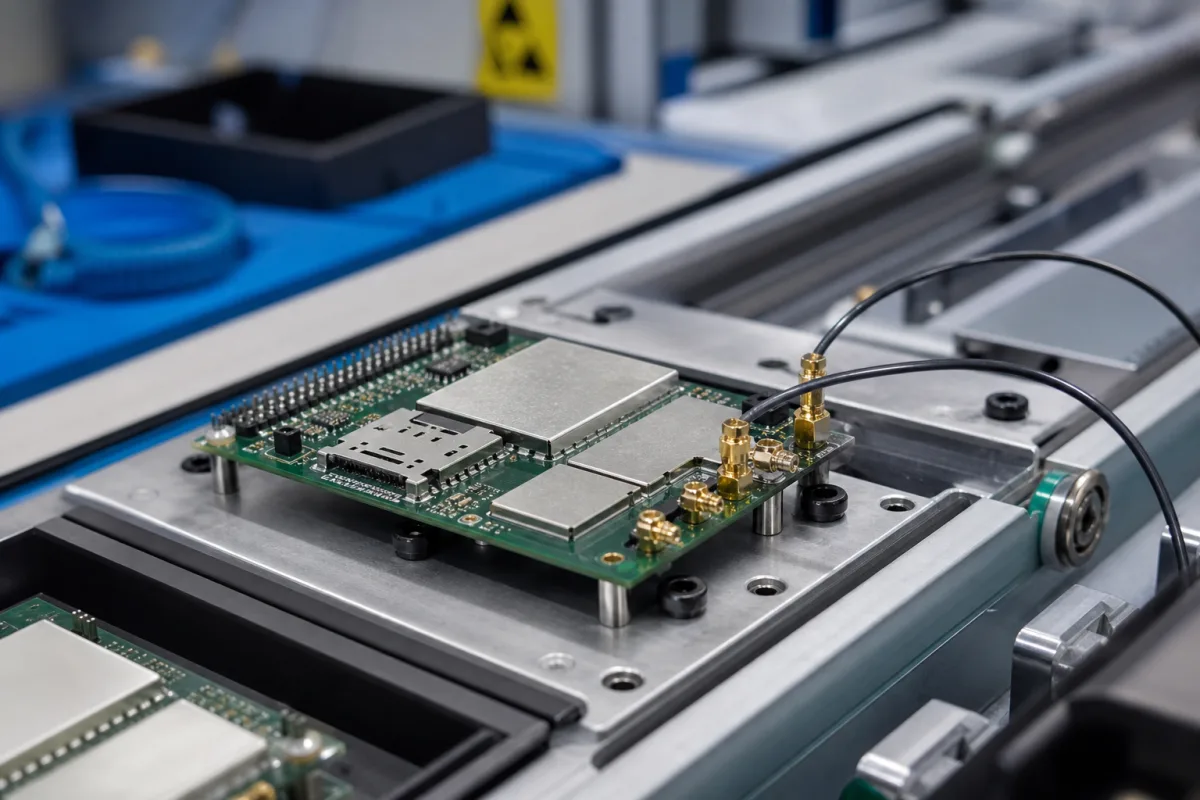
Cellular modem (complete industrial modem or DTU that connects serial or USB equipment to a 4G/LTE network)
Industrial cellular modems and serial-to-cellular DTUs · LTE Cat 1 with 2G fallback, RS232/RS485/USB host ports, SIM slot and SMA antenna, transparent TCP/UDP/MQTT, AT and SMS configuration
A cellular modem here is a finished device, not a chip to solder: a board or housing with a SIM slot, antenna connector, power input and a serial, RS-485 or USB port, so existing equipment can send data over 4G/LTE (with 2G or 3G fallback) without redesigning its electronics. Ask three things first: which network bands, LTE category and fallback the region needs, which host port and protocol (transparent serial, TCP/UDP, MQTT, PPP) the equipment uses, and the power, housing and temperature the installation needs.
Complete industrial cellular modems and serial-to-cellular data terminal units (DTUs) with SIM holder, antenna port and host interface, ready to connect to existing equipment. Solder-down or plug-in radio modules for host products, including cellular modules, are covered on the Wireless module (embedded radio module) page; cellular routers with Ethernet switching and gateways are outside this page.
CNFX editorial research · Sources checked October 12, 2026 · 3 sources
Match the bands, LTE category and fallback to the region
USR lists its LTE Cat 1 devices (USR-DR502-E, USR-G771-E and the WH-LTE-7S1-E module) on LTE FDD bands B1/B3/B7/B8/B20/B28 with GSM/GPRS/EDGE at 900/1800 MHz, LTE speeds of 10 Mbps down and 5 Mbps up (Rel.13) and GPRS at 85.6 kbps. It gives transmit power of 23 dBm ±2 dB on LTE, 33 dBm on GSM 900 and 30 dBm on GSM 1800, and receive sensitivity of -97.5 to -98.5 dBm across its LTE bands and -109.5 dBm on GSM 900. In one application note it says the module switches to GPRS "in the case of unstable LTE". [1]
Teltonika describes its TRM240 as an industrial-grade USB LTE Cat 1 modem with 3G and 2G, a rugged housing and an external antenna, aimed at "upgrading existing industrial equipment". [3]
Editorial conversion: 23 dBm is 10^(23/10) ≈ 200 mW and 33 dBm ≈ 2 W; the 11 dB gap between USR's GSM 900 sensitivity (-109.5 dBm) and its LTE B8 sensitivity (-98.5 dBm) is a factor of about 12.6 in received power. [1] Check which bands and fallback networks your operator will keep running before choosing.
Give the modem maker the countries and operators, required bands and LTE category, fallback (2G or 3G) needs, host interface and serial settings, protocol (transparent, TCP/UDP, MQTT, HTTP, PPP), server and security needs, SMS use, power supply, housing and mounting (DIN rail, panel, board), antenna type and cable, temperature range, certifications (CE, operator approvals) and quantity.
02
Choose the host port, data mode and power
USR's table gives one RS485 terminal (DR502-E, G771-E) or RS232 DB9 plus 3.0 V TTL (7S1-E), USB 2.0 on all three, baud rates of 1,200 to 230,400 (460,800 on the module), a 1.8/3 V SIM slot, SMA female or IPEX antenna connectors, 9-36 V input (3.6-4.2 V or 5-16 V on the module), power below 3 W, operating temperature of -30 to +75 °C, and dimensions of 44.5 × 31.8 × 13.94 mm and 82.6 × 86 × 25 mm for the two modems. In software it lists TCP/UDP/IPv4/IPv6/DNS/HTTP/MQTT with SSL/TLS, four serial-to-network sockets, SMS in PDU or text, configuration by serial, network or SMS AT commands, remote FOTA upgrade, and packet framing by time (10-500 ms) or length (5-65,535 bytes). [1]
Wlink describes its D80 series serial-to-IP modem, "also named DTU", with PPP, TCP/IP and DDP protocols to convert RS232/485/422 serial data into IP data sent to a data centre over GPRS, 3G or 4G, and an industrial 4G/3G/2G modem with RS232, RS-485 and USB 2.0 that provides SMS and dial-up functions. [2]
03
USR LTE Cat 1 modems and Wlink DTUs
USR IoT publishes LTE Cat 1 modems and a module with full radio, serial and power data. Wlink Technology lists serial-to-IP DTUs and industrial cellular modems. Ask for band support, operator approvals, serial and protocol settings, and temperature test data.
04
Radio, SIM holder, antenna port, host port and firmware
What separates a modem from a solder-down module is everything around the radio: SIM slot, antenna connector, power input and a ready serial or USB port.
Explore company information and manufacturing capabilities, then discuss the scope of your project with a relevant supplier.
Share this page
Compiled and source-reviewed by the CNFX editorial team.
Each manufacturer above links to the page on that company's own website where the product is listed, with the date we checked it. How we source and review
· Page last updated 13 October 2026
Buyer questions
How is a cellular modem different from a cellular module?
A modem is a finished device with SIM slot, antenna port, power input and host port; solder-down modules for host products are on the Wireless module (embedded radio module) page. [1][3]
What is a DTU?
Wlink describes its serial-to-IP modem, also named DTU, as converting RS232/485/422 serial data into IP data sent over GPRS, 3G or 4G. [2]
What speed does LTE Cat 1 give?
USR lists 10 Mbps downlink and 5 Mbps uplink for its LTE Cat 1 devices. [1]
How is the modem configured?
USR lists configuration by serial, network or SMS AT commands and a configuration utility. [1]
Sources and what still needs a direct check
Sources checked 2026-10-12. USR IoT publishes its LTE Cat 1 modems and module; Wlink describes its DTUs and modems; Teltonika describes its TRM240 modem.