Industry-Verified Manufacturing Data (2026)

Cell Balancing Circuit

Based on aggregated insights from multiple verified factory profiles within the CNFX directory, the standard Cell Balancing Circuit used in the Computer, Electronic and Optical Product Manufacturing sector typically supports operational capacities ranging from standard industrial configurations to heavy-duty production requirements.

Technical Definition & Core Assembly

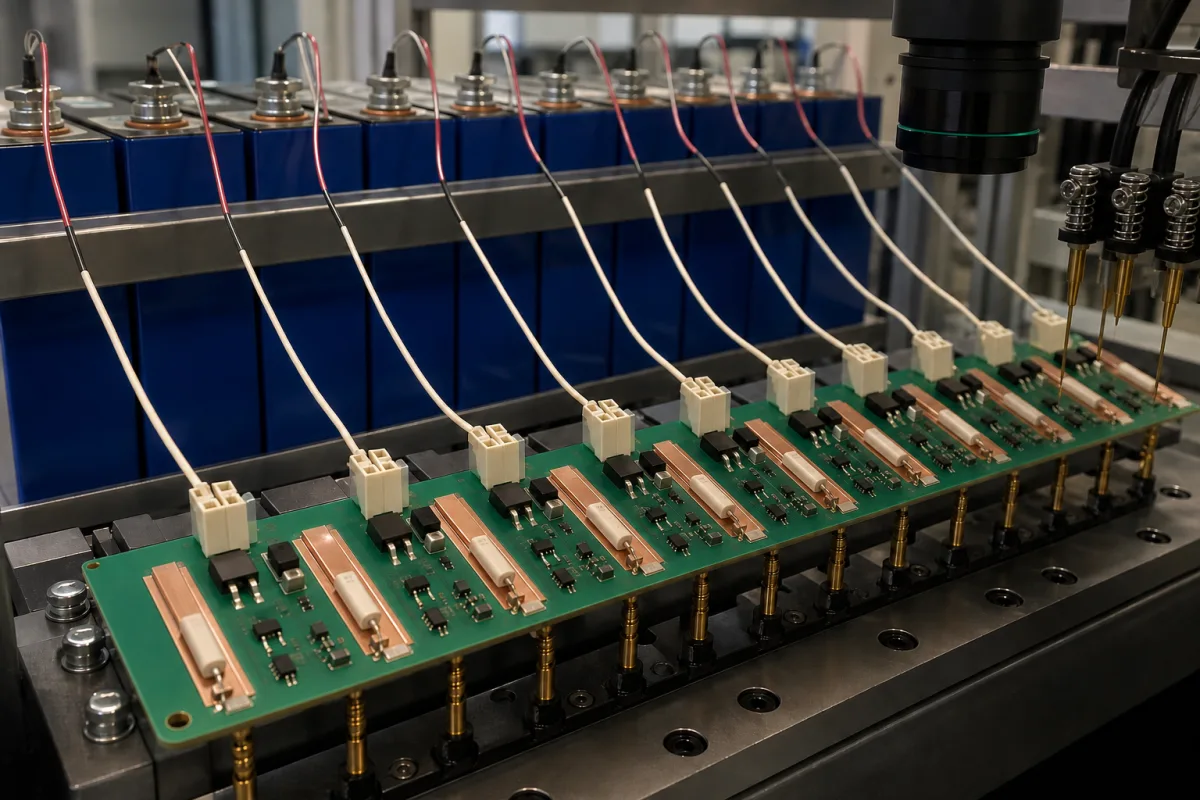
A canonical Cell Balancing Circuit is characterized by the integration of Balancing Controller IC and Balancing Resistor (for passive systems). In industrial production environments, manufacturers listed on CNFX commonly emphasize Semiconductor ICs (e.g., balancing controller) construction to support stable, high-cycle operation across diverse manufacturing scenarios.

An electronic circuit within a Battery Management System (BMS) that equalizes the voltage or state of charge among individual battery cells in a series-connected pack.
Product Specifications

Technical details and manufacturing context for Cell Balancing Circuit

Definition
The Cell Balancing Circuit is a critical component of a Battery Management System (BMS) responsible for maintaining uniformity across all cells in a battery pack. It actively monitors individual cell voltages and, when imbalances are detected, redistributes energy from higher-charged cells to lower-charged cells (passive balancing) or transfers energy between cells (active balancing). This process maximizes the usable capacity of the entire pack, prevents overcharging or over-discharging of individual cells, extends overall battery life, and enhances safety by mitigating risks associated with cell voltage divergence.
Working Principle
The circuit continuously monitors the voltage of each cell in the series string. When a predefined voltage difference threshold is exceeded, the balancing mechanism is activated. In passive balancing, it typically dissipates excess energy from higher-voltage cells as heat through resistors (bleeding resistors). In active balancing, it uses capacitors, inductors, or transformers to shuttle energy from higher-charged cells to lower-charged cells or to the entire pack, resulting in higher efficiency.
Common Materials
Semiconductor ICs (e.g., balancing controller), MOSFETs or transistors, Resistors (for passive balancing), Capacitors/Inductors (for active balancing), Printed Circuit Board (PCB)
Technical Parameters
  • Balancing current threshold; the voltage difference between the highest and lowest cell that triggers the balancing action. (mV) Standard Spec
Components / BOM
  • Balancing Controller IC
    The core integrated circuit that monitors cell voltages, makes balancing decisions, and controls the switching elements.
    Material: Semiconductor (Silicon)
  • Balancing Resistor (for passive systems)
    Dissipates excess energy from higher-charged cells as heat to equalize cell voltages.
    Material: Metal alloy or ceramic
  • Switching MOSFET
    Electronically connects the balancing resistor or active balancing components to the target cell under the controller's command.
    Material: Semiconductor (Silicon)
  • Energy Storage/Transfer Element (for active systems)
    Capacitor or inductor used to temporarily store and transfer energy between cells during active balancing.
    Material: Dielectric material (capacitor) or magnetic core with copper winding (inductor)
Engineering Reasoning
2.5-4.2 V per cell, 1-100 mA balancing current
Cell voltage differential exceeding 0.3 V sustained for >60 seconds
Design Rationale: Electrochemical degradation due to lithium plating at >4.25 V cell potential, causing internal short circuits through dendrite formation
Risk Mitigation (FMEA)
Trigger MOSFET gate oxide breakdown at >20 V gate-source voltage
Mode: Continuous balancing current flow regardless of cell voltage differential
Strategy: Zener diode clamping at 18 V gate-source with 100 Ω series resistance
Trigger Thermal runaway in balancing resistor at >125°C junction temperature
Mode: Open-circuit failure of balancing path with 0 Ω resistance short
Strategy: Positive temperature coefficient thermistor in series with 2.2 Ω balancing resistor

Industry Taxonomies & Aliases

Commonly used trade names and technical identifiers for Cell Balancing Circuit.

Applied To / Applications

This component is essential for the following industrial systems and equipment:

Industrial Ecosystem & Supply Chain DNA

Complementary Systems
Downstream Applications
Specialized Tooling

Application Fit & Sizing Matrix

Operational Limits
pressure: Atmospheric (sealed enclosure typical)
other spec: Cell voltage range: 2.5V to 4.5V per cell, Balancing current: 100mA to 2A typical
temperature: -40°C to +85°C (operational), -55°C to +125°C (storage)
Media Compatibility
✓ Lithium-ion battery packs ✓ Lithium-polymer battery packs ✓ Lithium iron phosphate (LiFePO4) battery packs
Unsuitable: Lead-acid battery systems (different voltage characteristics and balancing requirements)
Sizing Data Required
  • Number of series-connected cells in battery pack
  • Maximum cell voltage imbalance tolerance
  • Required balancing current capacity

Reliability & Engineering Risk Analysis

Failure Mode & Root Cause
Thermal runaway
Cause: Uneven cell voltage distribution leading to localized overheating, often due to aging cells, poor thermal management, or faulty voltage sensing components.
Balancing circuit component failure
Cause: Overheating or electrical stress on MOSFETs, resistors, or capacitors, typically from continuous high-current balancing, voltage spikes, or inadequate heat dissipation.
Maintenance Indicators
  • Abnormal temperature rise in specific battery cells or balancing components detected via thermal imaging or sensors
  • Persistent voltage imbalance warnings or alarms from the battery management system (BMS) despite normal operating conditions
Engineering Tips
  • Implement predictive maintenance using continuous monitoring of cell voltage differentials and temperature gradients to trigger balancing only when necessary, reducing circuit stress
  • Ensure robust thermal management with dedicated cooling for balancing components and periodic calibration of voltage sensing circuits to maintain measurement accuracy

Compliance & Manufacturing Standards

Reference Standards
ISO 26262:2018 (Functional Safety for Road Vehicles) IEC 62133-2:2017 (Safety of Secondary Cells and Batteries) UL 1642 (Standard for Lithium Batteries)
Manufacturing Precision
  • Cell Voltage Matching: +/- 5mV
  • Current Sensing Accuracy: +/- 1%
Quality Inspection
  • Thermal Cycling Test (-40°C to +85°C)
  • Insulation Resistance Test (≥100 MΩ at 500VDC)

Factories Producing Cell Balancing Circuit

Verified manufacturers with capability to produce this product in China

✓ 93% Supplier Capability Match Found

P Procurement Specialist from Germany Feb 28, 2026
★★★★★
"Impressive build quality. Especially the technical reliability is very stable during long-term operation."
Technical Specifications Verified
T Technical Director from Brazil Feb 25, 2026
★★★★★
"As a professional in the Computer, Electronic and Optical Product Manufacturing sector, I confirm this Cell Balancing Circuit meets all ISO standards."
Technical Specifications Verified
P Project Engineer from Canada Feb 22, 2026
★★★★★
"Standard OEM quality for Computer, Electronic and Optical Product Manufacturing applications. The Cell Balancing Circuit arrived with full certification."
Technical Specifications Verified
Verification Protocol

“Feedback is collected from verified sourcing managers during RFQ (Request for Quote) and factory evaluation processes on CNFX. These reports represent historical performance data and technical audit summaries from our B2B manufacturing network.”

10 sourcing managers are analyzing this specification now. Last inquiry for Cell Balancing Circuit from USA (1h ago).

Supply Chain Compatible Machinery & Devices

Modular Industrial Edge Computing Device

Rugged computing platform for industrial data processing at the network edge

Explore Specs →
Industrial Smart Camera Module

Embedded vision system for industrial automation and quality inspection.

Explore Specs →
Industrial Wireless Power Transfer Module

Wireless power transfer module for industrial equipment applications

Explore Specs →
Industrial Smart Sensor Module

Modular industrial sensor with embedded processing and wireless connectivity

Explore Specs →

Frequently Asked Questions

What is the difference between passive and active cell balancing circuits?

Passive balancing dissipates excess energy as heat through resistors, while active balancing transfers energy between cells using capacitors/inductors for higher efficiency.

How does a cell balancing circuit extend battery pack lifespan?

By equalizing voltage/charge across cells, it prevents overcharging/over-discharging of individual cells, reducing capacity degradation and thermal stress.

What are key considerations when selecting balancing controller ICs?

Consider balancing current capacity, number of supported cells, communication interfaces (I2C/SPI), integration with BMS, and protection features like over-temperature detection.

Can I contact factories directly on CNFX?

CNFX is an open directory, not a transaction platform. Each factory profile provides direct contact information and production details to help you initiate direct inquiries with Chinese suppliers.

Get Quote for Cell Balancing Circuit

Request technical pricing, lead times, or customized specifications for Cell Balancing Circuit directly from verified manufacturing units.

Your business information is encrypted and only shared with verified Cell Balancing Circuit suppliers.

Thank you! Your message has been sent. We'll respond within 1–3 business days.

Need to Manufacture Cell Balancing Circuit?

Connect with verified factories specializing in this product category

Add Your Factory Contact Us
Previous Product
CCD Detector Array
Next Product
Cell Housing Assembly