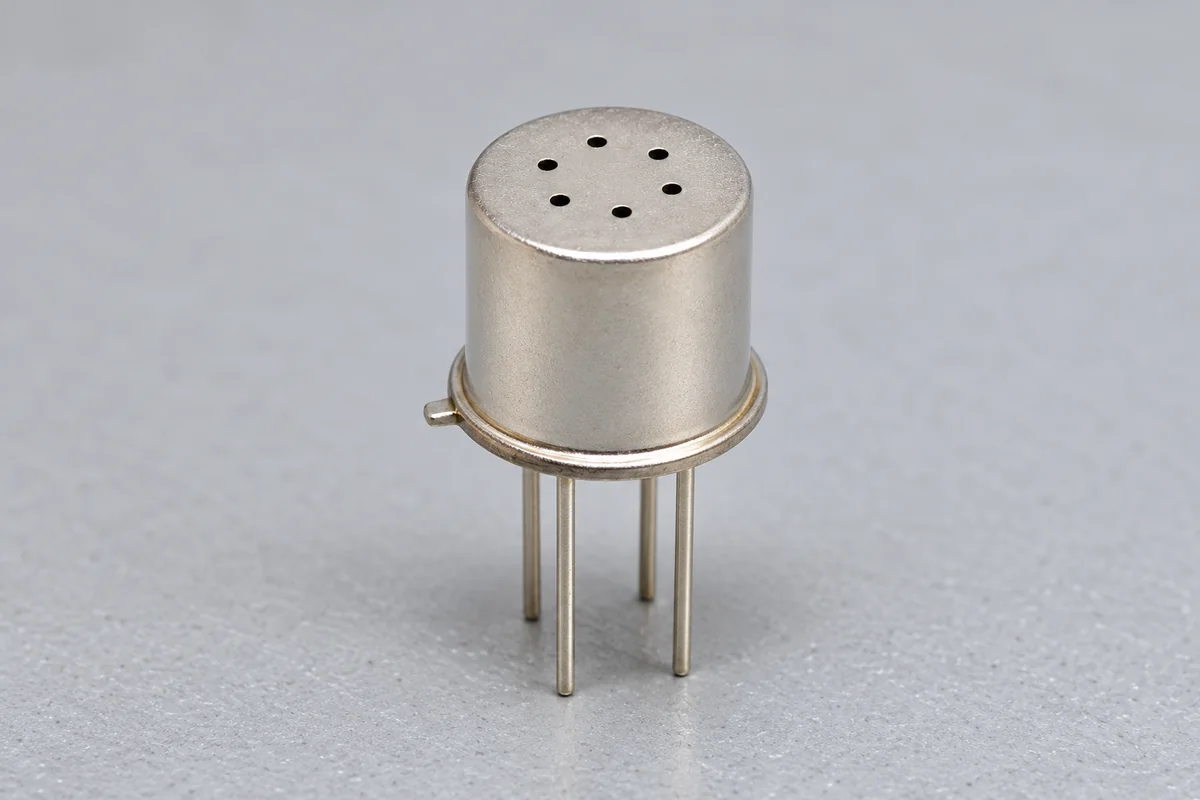
Gas sensor element and module · Sensing principle (metal-oxide, electrochemical, NDIR), range, sensitivity, response time, cross-sensitivity, power, output, life
A gas sensor turns the presence or concentration of a target gas into an electrical signal for a detector, alarm or control. Ask three things first: which sensing principle suits the target gas and range, how the sensor responds to other gases, temperature and humidity, and what power, output signal and service life the design must accept.
Gas sensing elements and sensor modules for industrial, safety, HVAC and air-quality products: metal-oxide semiconductor, electrochemical and non-dispersive infrared (NDIR) types. Complete fixed or portable gas detectors, oxygen analysers (see oxygen analyzer), sensor housings on their own and particulate sensors are outside this page.
CNFX editorial research · Sources checked October 12, 2026 · 4 sources
Choose the sensing principle for the gas and range
Figaro describes its TGS2600 as a metal-oxide semiconductor (MOS) layer on an alumina substrate with an integrated heater; conductivity rises with gas concentration and a simple circuit with a load resistor converts it to an output. It is sensitive to low levels of air contaminants such as hydrogen and carbon monoxide (Figaro: "The sensor can detect hydrogen at a level of several ppm."), and its resistance also changes with temperature and humidity. [1]
Winsen's ME3-CO is an electrochemical carbon monoxide sensor with a linear current output of 0.070 ±0.015 µA/ppm over 0–1,000 ppm, but its datasheet lists responses to other gases: 200 ppm H2 reads as 100 ppm, 100 ppm C2H4 as 100 ppm, 35 ppm NO as 9 ppm and 5 ppm NO2 as 2 ppm, while 100 ppm H2S and 20 ppm SO2 read 0. Winsen warns ME sensors must not be fully encapsulated in resin, immersed in pure oxygen or used in corrosive gas, and should avoid organic solvents, coatings and oils. [2]
Winsen describes its MH-Z19B as a non-dispersive infrared (NDIR) CO2 module with good selectivity, no oxygen dependence and long life, with built-in temperature compensation and UART and PWM outputs. [3]
Give the supplier the target gas and range, background gases that may interfere, required resolution and accuracy, response time, temperature, humidity and pressure range, supply voltage and power budget, output signal, mounting and housing, calibration and life requirements, and any safety certification needed for the end product.
02
Read range, response, power, output and life from the datasheet
Figaro's TGS2600-B00 lists a TO-5 metal can, a typical range of 1–30 ppm H2, heater and circuit voltage 5.0 ±0.2 V DC, heater current 42 ±4 mA and heater power 210 mW, sensor resistance 10–90 kΩ in air, a sensitivity ratio of 0.3–0.6 at 10 ppm H2, standard test conditions of 20 ±2 °C and 65 ±5% RH, and a preheating period of 2 days or longer before test. [1]
Winsen's ME3-CO lists a maximum detecting concentration of 2,000 ppm, 0.5 ppm resolution, T90 under 20 s, a 10 Ω recommended load, repeatability under 2%, stability under 5% per month, zero drift of 10 ppm from −20 to 40 °C, storage −20 to 50 °C and 15–90% RH, pressure of standard atmosphere ±10% and an anticipated life of 3 years in air. [2]
Winsen's MH-Z19B lists 4.5–5.5 V DC, average current under 60 mA and peak 150 mA at 5 V, 3.3 V interface level, CO2 ranges of 400–2,000 or 400–5,000 ppm, 3-minute preheat, T90 under 120 s, 0–50 °C and 0–90% RH non-condensing, 33 × 20 × 9 mm, 5 g and a lifespan over 5 years. [3]
Editorial calculation: 42 mA × 5.0 V = 210 mW, matching Figaro's heater power; the MH-Z19B's average under 60 mA at 5 V is under 0.3 W; at 0.070 µA/ppm the ME3-CO gives about 70 µA at its 1,000 ppm full range. [1][3][2]
A smaller CO2 sensor shows a different packaging route. Sensirion's SCD4x datasheet (version 1.3, September 2022) describes a photoacoustic NDIR sensor measuring 10.1 × 10.1 × 6.5 mm, reflow-solderable, with an output range of 0–40,000 ppm, a 2.4–5.5 V supply, I2C output and a built-in humidity and temperature sensor for compensation. The SCD41 is specified at ±(40 ppm + 5% of reading) over 400–5,000 ppm and the SCD40 at ±(50 ppm + 5%) over 400–2,000 ppm, with typical repeatability of ±10 ppm, a typical τ63 response of 60 s, additional drift of ±(5 ppm + 0.5% of reading) per year with automatic self-calibration, and average current below 0.4 mA at 5 V with one measurement every 5 minutes. [4] Editorial calculation: at 1,000 ppm the SCD41 tolerance is ±90 ppm; its 0.66 cm³ body is about a ninth of the MH-Z19B's 33 × 20 × 9 mm (5.9 cm³). [4][3]
03
Compare what suppliers offer
The suppliers linked to this page list gas sensors, sensor modules or gas sensor assemblies; their cards link to the pages reviewed.
Ask any supplier for the datasheet of the exact model with range, sensitivity and tolerance, cross-sensitivity table, response and recovery time, temperature and humidity effects, zero drift and stability, warm-up time, supply and power, output, dimensions, expected life, calibration method and certificates.
04
Trace what each part does
This is a functional reference built from the sources cited; it is not one maker's specification.
Part
Role
Fix in the order
Sensing element
MOS layer, electrochemical cell or IR path. [1][2][3]
Fill the specification fields with values for your order
A gas sensor quotation needs values for your product. The table explains each field, gives published values where a reviewed source states them, and says what to obtain from the supplier.
Field
What it means and published values
Ask the supplier for
Measurement Range (ppm)
e.g. 1–30 H2 (MOS); 0–1,000 CO; 400–5,000 CO2. [1][2][3]
Range; maximum.
Accuracy (% of reading)
Not stated; repeatability <2% (ME3-CO); ±(40 ppm + 5% of reading) (SCD41). [2][4]
Accuracy statement.
Response Time (s)
T90 <20 s (CO); <120 s (CO2); τ63 60 s typical (photoacoustic CO2). [2][3][4]
Explore company information and manufacturing capabilities, then discuss the scope of your project with a relevant supplier.
Share this page
Compiled and source-reviewed by the CNFX editorial team.
Published product pages show what a company offers, not tested performance. Confirm the legal seller, factory and scope for your order. How we source and review
· Page last updated 13 October 2026
Buyer questions
Do gas sensors react to other gases?
Yes. Winsen's ME3-CO datasheet lists 200 ppm H2 reading as 100 ppm CO and 100 ppm C2H4 as 100 ppm. [2]
How long does an NDIR CO2 sensor last?
Winsen lists a lifespan over 5 years for its MH-Z19B, against 3 years in air for its ME3-CO electrochemical sensor. [3][2]
How much power does a metal-oxide gas sensor use?
Figaro lists 210 mW heater power at 5.0 V for the TGS2600. [1]
How accurate are small NDIR CO2 sensors?
One photoacoustic NDIR sensor lists ±(40 ppm + 5% of reading) over 400–5,000 ppm, ±10 ppm repeatability and ±(5 ppm + 0.5%) yearly drift with self-calibration, in a 10.1 × 10.1 × 6.5 mm package. [4]
Sources and what still needs a direct check
Sources checked 2026-10-12. Figaro Engineering and Zhengzhou Winsen Electronics make gas sensors and publish datasheets.