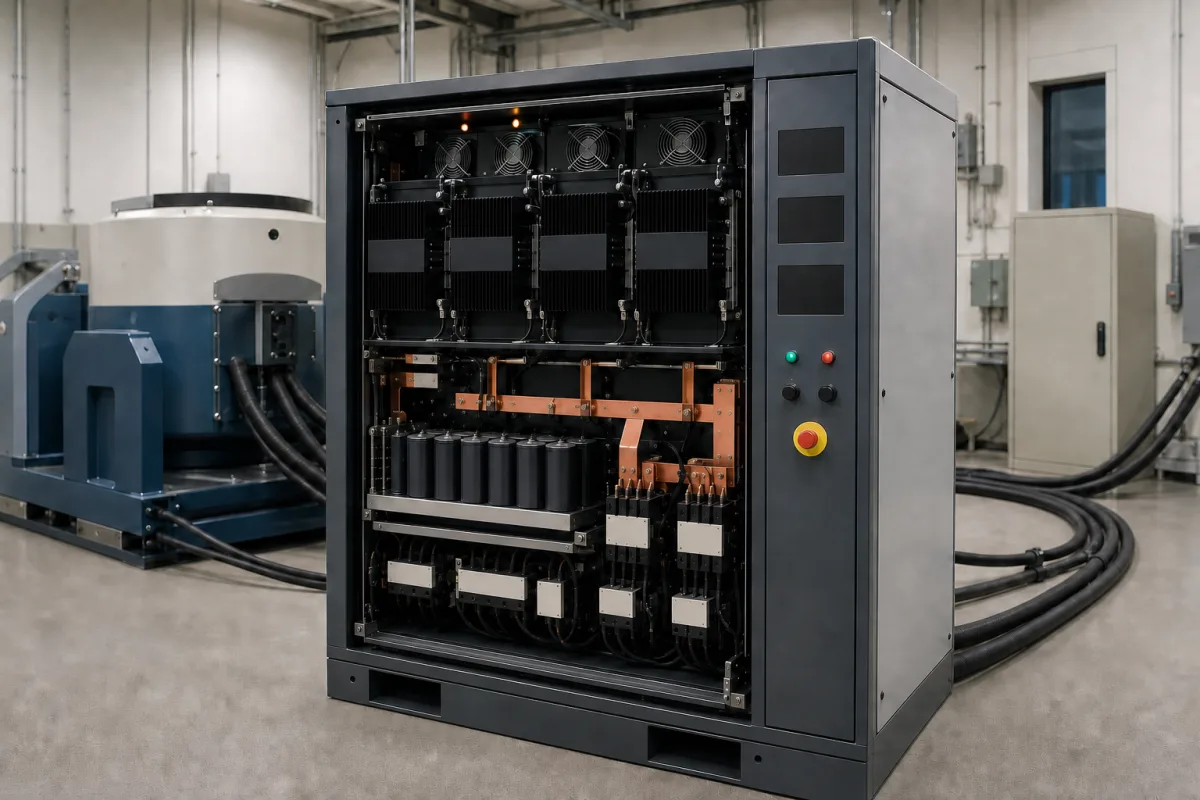
Shaker power amplifier for electrodynamic vibration test systems
Vibration test systems · kVA rating and shaker force, output voltage and current, bandwidth, noise and distortion, mains and cooling
A shaker power amplifier is the high-current amplifier in an electrodynamic vibration test system: it takes the drive signal from the vibration controller and delivers the armature current that makes the shaker move, while interlocks protect the shaker. Ask three things first: what kVA rating and output current the amplifier gives and what sine, random and shock force that produces on your shaker, what bandwidth, noise and distortion it achieves into the shaker load, and what mains supply, cooling and floor space it needs.
Linear and switching power amplifiers built to drive electrodynamic shakers and vibration exciters in vibration test systems, including modular kVA amplifier cabinets and small amplifiers for modal exciters. Foundry vibration compaction tables are covered on the Vibration table for foundry sand compaction page; audio, public-address, RF and microwave power amplifiers, amplifier ICs and the shakers and controllers themselves are outside this page.
CNFX editorial research · Sources checked October 12, 2026 · 3 sources
Match the amplifier kVA to the force your shaker must produce
Brüel & Kjær's system data for its V830 and V850 shakers lists the SPA-K amplifier from 8 to 32 kVA in 8 kVA increments, with a rated output of 100 V rms (sine) and 80 A rms continuous (sine and random) per 8 kVA increment, plus 240 A per increment for 100 ms as transient current. [1] The same document rates each shaker by amplifier: a V850-240 gives 7.1 kN sine force (peak) with the SPA8K and 14.2 kN with the SPA16K, and a V850-440 reaches 22.2 kN sine with the SPA32K. [1]
Editorial calculation: 100 V rms × 80 A rms = 8,000 VA, which matches the 8 kVA module step; going from SPA8K to SPA16K on the V850-240 raises sine force by 14.2 ÷ 7.1 = 2.0 times, but the same table shows the V830-185's sine force rising only from 6.8 to 8.9 kN, so ask the supplier for the force table of your exact shaker and amplifier pair rather than scaling from kVA. [1]
Brüel & Kjær's V8 system data lists the same SPA-K design from 40 to 56 kVA in 8 kVA increments for larger shakers. [2] ECON's amplifier page describes the amplifier's role the same way — amplifying the vibration controller's signal and sending it to the vibration generator — and lists its VSA-H series as all-digital IGBT amplifiers built from a standard 8 kVA power module, with a maximum instantaneous output of 3 times rated and parallel current-sharing unbalance below 1%. [3]
Give the supplier the shaker model or its armature rating, the sine, random and shock force and the displacement, velocity and acceleration you need, the payload and fixture mass, the test standards to be run, the controller in use, the mains voltage and frequency, the room cooling and ventilation, and any noise limit for the test area.
02
Check bandwidth, noise, distortion and efficiency
For the SPA-K, Brüel & Kjær lists a full-power bandwidth of 20 Hz to 3 kHz, a modulation range of dc to 10 kHz, a signal-to-noise ratio above 68 dB relative to 100 V rms output, total harmonic distortion given as a typical 0.5 to 0.8% at rated output into a rated resistive load, an input sensitivity of 1.0 V for 100 V rms output and a 10 kΩ nominal input impedance. Switching frequency is 150 kHz; efficiency is above 90%, not including the field power supply, and module efficiency is 93%. [1]
ECON lists its smaller VSA amplifiers for miniature shakers and exciters at up to 1,000 VA, 95% energy conversion efficiency and 0.1 Hz to 10,000 Hz, and its VSA-H modules with switching frequency up to 150 kHz and conversion efficiency above 95%. [3] Editorial note: the two makers state frequency range and efficiency on different bases — full-power bandwidth versus operating range, and with or without the field supply — so ask each supplier for bandwidth at rated output, the efficiency basis and the distortion measured into your shaker's load.
The system data also states what the installation must provide: an ambient working temperature of +5 to 30 °C, cabinet dimensions of 1870 × 537 × 825 mm (H × W × D), and, for a V850 system, a maximum input requirement of 26.0 kVA with the SPA8K up to 47.6 kVA with the SPA32K, including the amplifier, cooling fan and pneumatic pedestal box. [1]
03
Inside the amplifier cabinet: power modules, controls, interlocks and cooling
Part
Role
Fix in the order
Input stage
Takes the controller drive; 1.0 V for 100 V rms on SPA-K. [1]
Sensitivity and impedance.
Power modules
Switching stages in 8 kVA steps; IGBT devices in ECON's VSA-H. [1][3]
Module count and kVA.
Control electronics
MCU, DSP and FPGA in ECON's VSA-H; current sharing between modules. [3]
Architecture and display.
Protection and interlocks
Keeps output devices inside limits; links to shaker interlocks. [1]
Interlock list.
Field power supply
Supplies a field-coil shaker; outside SPA-K efficiency figure. [1]
ECON lists amplifiers sized to drive the shakers in its own vibration test systems.
ECON Technologies Co.,Ltd.
Manufacturing site to be confirmed for the order
Lists power amplifiers for driving shakers in its vibration test systems, from small VSA amplifiers for miniature exciters to modular IGBT VSA-H and VSA-D amplifiers.
Explore company information and manufacturing capabilities, then discuss the scope of your project with a relevant supplier.
Share this page
Compiled and source-reviewed by the CNFX editorial team.
Each manufacturer above links to the page on that company's own website where the product is listed, with the date we checked it. How we source and review
· Page last updated 13 October 2026
Buyer questions
How is a shaker amplifier rated?
In kVA; Brüel & Kjær's SPA-K comes in 8 kVA steps, each giving 80 A rms continuous at 100 V rms rated output. [1]
Does a bigger amplifier always give more shaker force?
Not in proportion: in Brüel & Kjær's table the V850-240 doubles from 7.1 to 14.2 kN with SPA16K, while the V830-185 rises only from 6.8 to 8.9 kN. [1]
What bandwidth does a shaker amplifier have?
Brüel & Kjær lists 20 Hz to 3 kHz at full power for the SPA-K; ECON lists 0.1 Hz to 10,000 Hz for its small VSA amplifiers. [1][3]
Sources and what still needs a direct check
Sources checked 2026-10-12. Brüel & Kjær's system data sheets describe its V830/V850 and V8 shaker systems with the SPA-K amplifier; ECON is a vibration test system maker describing its own amplifiers.