Editorial Technical Reference

LCD Panel

This page explains how LCD Panel is classified within Computer, Electronic and Optical Product Manufacturing. Technical values and manufacturer relationships are research references; confirm the current specification and supplier evidence for each order.

Technical Definition & Core Assembly

An LCD panel is a flat-panel component that serves as the fundamental image-producing element within display screen assemblies.
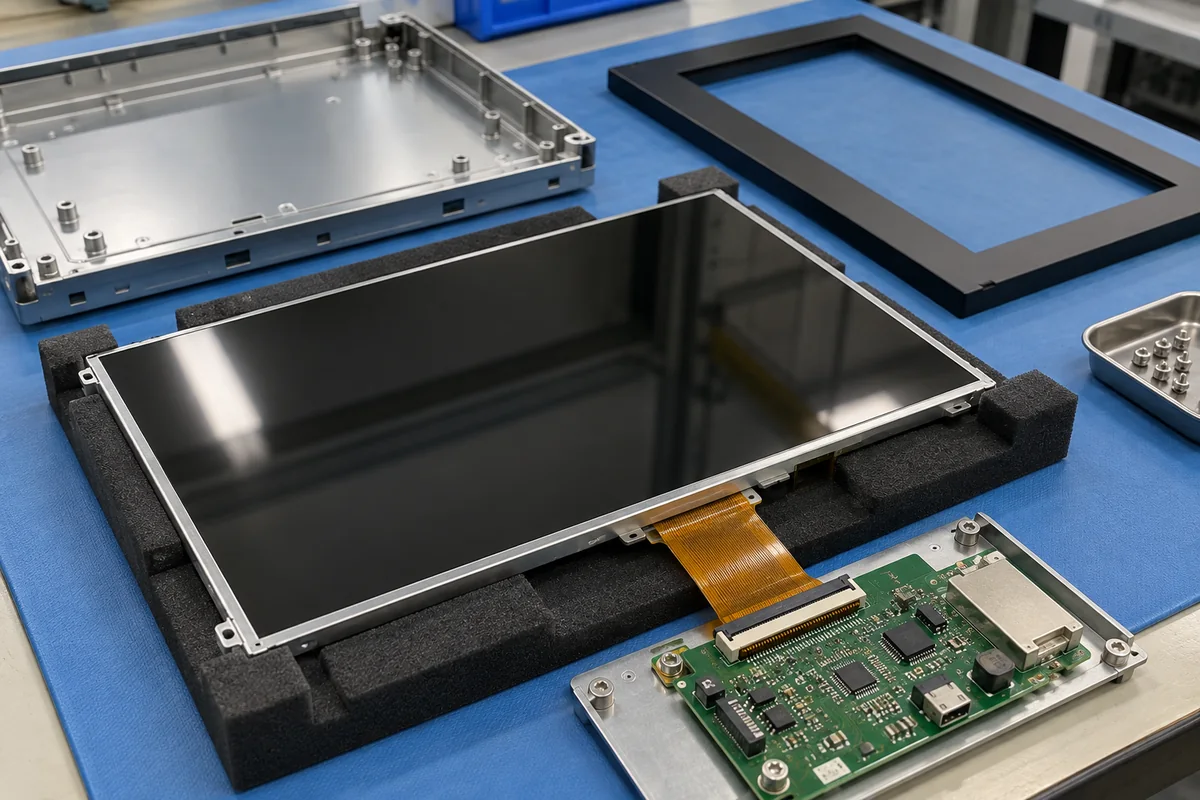
Representative product image. Confirm appearance and specifications with the manufacturer.

Product Specifications

Technical details and manufacturing context for LCD Panel

Definition
An LCD panel is a flat-panel component that serves as the fundamental image-producing element within display screen assemblies. It forms the visual interface in LCD displays by controlling light transmission through liquid crystal cells to create images. The panel consists of a glass substrate, liquid crystals, ITO electrodes, polarizing filters, and color filters. In operation, liquid crystals are sandwiched between polarizing filters and electrodes. When voltage is applied, the crystals align to control light transmission from a backlight, creating pixels that form images through color filters. This component is used in computer, electronic, and optical product manufacturing, particularly in monitors, televisions, and industrial displays. Key parameters include screen size (diagonal) ranging from 7 to 75 inches, resolution from 800×480 to 3840×2160 pixels, brightness from 250 to 1500 cd/m², contrast ratio from 1000:1 to 5000:1, viewing angle (horizontal/vertical) from 80/80 to 89/89 degrees, response time from 5 to 25 ms, operating temperature from -20 to 70 °C, storage temperature from -30 to 80 °C, operating humidity from 20 to 80 % RH, supply voltage from 3.3 to 12 V DC, power consumption from 1 to 50 W, interface options including LVDS, eDP, MIPI, and RGB, and weight from 0.1 to 10 kg. These values are typical ranges for industrial and consumer displays and must be verified for the specific model and application. The LCD panel is a component, not a complete display, and requires integration with a backlight, driver electronics, and housing. For procurement, confirm model-specific specifications and compliance with relevant standards with the legal manufacturer or supplier.
Working Principle
The LCD panel operates by using liquid crystals sandwiched between polarizing filters and electrodes. When voltage is applied, the crystals align to control light transmission from a backlight. This modulation creates pixels that form images through color filters. The backlight provides illumination, and the liquid crystal layer acts as a light valve, allowing varying amounts of light to pass through each pixel. Color filters (red, green, blue) combine to produce full-color images. The electrodes (ITO) apply the electric field to align the crystals. The polarizing filters ensure that only light of a specific orientation passes, enhancing contrast. The response time and viewing angle depend on the liquid crystal technology (e.g., TN or IPS).
Common Materials
Glass substrate, Liquid crystals, ITO electrodes, Polarizing filters, Color filters
Technical Parameters
ParameterTypical rangeNotes & selection driver
Screen Size (Diagonal)7–75 inchCommon range for industrial and consumer displays
Resolution800×480–3840×2160 pixelsFrom WVGA to 4K UHD
Brightness250–1500 cd/m²Higher for outdoor or sunlight-readable panels
Contrast Ratio1000:1–5000:1Typical for TN/IPS panels
Viewing Angle (Horizontal/Vertical)80/80–89/89 degreeIPS panels offer wider angles
Response Time5–25 msFaster for gaming or video
Operating Temperature-20–70 °CIndustrial grade may extend to -30–85
Storage Temperature-30–80 °CNon-operating limits
Operating Humidity20–80 % RHNon-condensing
Supply Voltage3.3–12 V DCTypical for LCD modules
Power Consumption1–50 WDepends on size and backlight
InterfaceLVDS, eDP, MIPI, RGBCommon digital interfaces
Weight0.1–10 kgVaries with size and glass thickness

Ranges are indicative industry figures for RFQ preparation, not a supplier commitment. Confirm every value and standard with the legal manufacturer before ordering.

Components / BOM
  • Glass Substrate Part
    Provides structural base and houses liquid crystal cells
    Material: Glass
  • Liquid Crystal Layer Part
    Controls light transmission to create images
    Material: Liquid crystals
  • Color Filter Part
    Creates RGB color pixels for full-color display
    Material: Colored resin/glass
  • Polarizing Filter Part
    Filters light waves to specific orientations for image control
    Material: Polarizing film
  • ITO Electrodes Part
    Apply voltage to control liquid crystal alignment
    Material: Indium Tin Oxide

Applied To / Applications

This component is essential for the following industrial systems and equipment:

Industrial Ecosystem & Supply Chain Structure

Complementary Systems
Downstream Applications
Specialized Tooling

Application Fit & Sizing Matrix

Operational Limits
pressure: Atmospheric pressure only (non-pressure rated)
other spec: Humidity: 10-90% RH (non-condensing), Vibration: ≤2G, Shock: ≤5G
temperature: -20°C to 70°C (operating), -30°C to 80°C (storage)
Media Compatibility
✓ Indoor office environments ✓ Consumer electronics housings ✓ Medical display enclosures
Unsuitable: Outdoor direct sunlight with UV exposure and moisture
Sizing Data Required
  • Screen diagonal size (inches/mm)
  • Resolution (pixels: e.g., 1920x1080)
  • Interface type (e.g., LVDS, eDP, MIPI)

Reliability & Engineering Risk Analysis

Failure Mode & Root Cause
Backlight Failure
Cause: Degradation of CCFL or LED components due to thermal stress, voltage spikes, or prolonged operation beyond design life, leading to dimming, flickering, or complete loss of illumination.
Liquid Crystal Degradation
Cause: Physical damage to the liquid crystal layer from pressure, impact, or exposure to extreme temperatures, resulting in dead pixels, image retention, or discoloration.
Maintenance Indicators
  • Flickering or intermittent display, indicating potential power supply or backlight instability.
  • Visible dark spots, lines, or discoloration on the screen, suggesting pixel or liquid crystal layer damage.
Engineering Tips
  • Implement controlled thermal management by ensuring adequate ventilation and avoiding exposure to direct sunlight or high ambient temperatures to reduce thermal stress on components.
  • Use voltage regulation and surge protection devices in the power supply circuit to prevent electrical overstress on backlight drivers and display controllers.

Indicative industry ranges for design and RFQ preparation. Confirm the exact figures and applicable standard with the manufacturer before specifying.

Compliance & Manufacturing Standards

Applicable Standards
ISO 9241-307: Ergonomics of human-system interaction - Part 307: Analysis and compliance test methods for electronic visual displays ANSI/UL 60950-1: Safety of Information Technology Equipment CE marking for compliance with EU directives including RoHS (Restriction of Hazardous Substances) and EMC (Electromagnetic Compatibility)

Quoted from the published standard.

Manufacturing Precision
  • Pixel pitch uniformity: +/- 0.001mm across panel
  • Surface flatness: ≤ 0.05mm deviation over entire active area
Quality Inspection
  • Dead pixel test using automated optical inspection (AOI) with uniform color display patterns
  • Backlight uniformity and color gamut verification using spectroradiometer measurements

Manufacturers of LCD Panel

Manufacturer profiles associated with LCD Panel.

Sourcing LCD Panel from China?
Tell us your specification and target quantity — we will match it against manufacturer records and come back with the factories that fit.
Request manufacturers We manufacture this

Manufacturer listings support early research and capability understanding. They are not certification, ranking, or transaction guarantees.

Technical documentation
Request current drawings, revision history, and a signed specification sheet.
Manufacturing capability
Verify equipment lists, process limits, capacity, and representative production evidence.
Inspection readiness
Confirm test methods, calibrated equipment, sampling plans, and traceable reports.
Supplier transparency
Check the legal entity, factory address, ownership, certifications, and direct contacts.

CNFX does not score or rank suppliers. Buyers must verify all claims and documents with the legal manufacturer before ordering.

Supply Chain Compatible Machinery & Devices

Industrial IoT Gateway

The Industrial IoT Gateway is a ruggedized edge computing device designed for industrial environments.

Explore Specs →
Modular Industrial Edge Computing Device

This modular industrial edge computing device is a ruggedized system designed for deployment in harsh industrial environments to perform real-time data processing, analytics, and control functions at the network edge.

Explore Specs →
Industrial Smart Camera Module

The Industrial Smart Camera Module is a compact, self-contained vision processing unit designed for integration into industrial machinery and production lines.

Explore Specs →
Surface Mount Resistor

Passive electronic component for current limiting and voltage division in circuits

Explore Specs →

Frequently Asked Questions

What is an LCD panel?

An LCD panel is the core display component that produces images in LCD screens. It controls light transmission through liquid crystal cells to create images, and is used as a part in display assemblies.

What are the typical screen sizes available?

The typical diagonal screen size ranges from 7 to 75 inches, depending on the application. Industrial and consumer displays commonly fall within this range.

What interfaces are commonly supported?

Common digital interfaces include LVDS, eDP, MIPI, and RGB. The specific interface depends on the panel model and must be confirmed with the manufacturer.

How should I verify the specifications for my application?

Always verify model-specific values such as resolution, brightness, temperature range, and interface with the legal manufacturer or supplier, as the listed ranges are typical and may not apply to every panel.

Data Basis

Editorial classification, named public sources where available, and source-reviewed manufacturer records.

Preliminary Technical Classification
This page supports structured research, RFQ preparation, and supplier evaluation. It does not replace buyer-led supplier qualification, standards review, or technical approval.
Buyer enquiry

Request manufacturing insight for LCD Panel

Ask for use case, specification boundaries, supplier type, and RFQ preparation information for this product.

Where it goes
Straight to the CNFX editorial desk, and to the manufacturer if this product is linked to a claimed profile. Nothing is broadcast to a supplier list.
Your details stay here
We do not sell or rent enquiry data, and we do not add you to a mailing list. Used only to answer this request.
No commission, no middleman
CNFX is a directory. We take no cut of any order and never negotiate on a supplier's behalf.
What we don't claim
A listing is not an endorsement. Qualify every supplier and verify every figure yourself before ordering.

Your business information is used only to process this request.

Thank you! Your message has been sent. We'll respond within 1–3 business days.
Sorry, we couldn't send your message. Please try again, or email us at contact@cnfx.com.

Need to Manufacture LCD Panel?

Compare manufacturer profiles with relevant product and process capability.

Previous Product
XY Positioning Stage
Last Product
Get QuotesChat