Industry-Verified Manufacturing Data (2026)

Display Screen

Based on aggregated insights from multiple verified factory profiles within the CNFX directory, the standard Display Screen used in the Machinery and Equipment Manufacturing sector typically supports operational capacities ranging from standard industrial configurations to heavy-duty production requirements.

Technical Definition & Core Assembly

A canonical Display Screen is characterized by the integration of LCD Panel and Backlight Unit. In industrial production environments, manufacturers listed on CNFX commonly emphasize Liquid Crystal Display (LCD) Panel construction to support stable, high-cycle operation across diverse manufacturing scenarios.

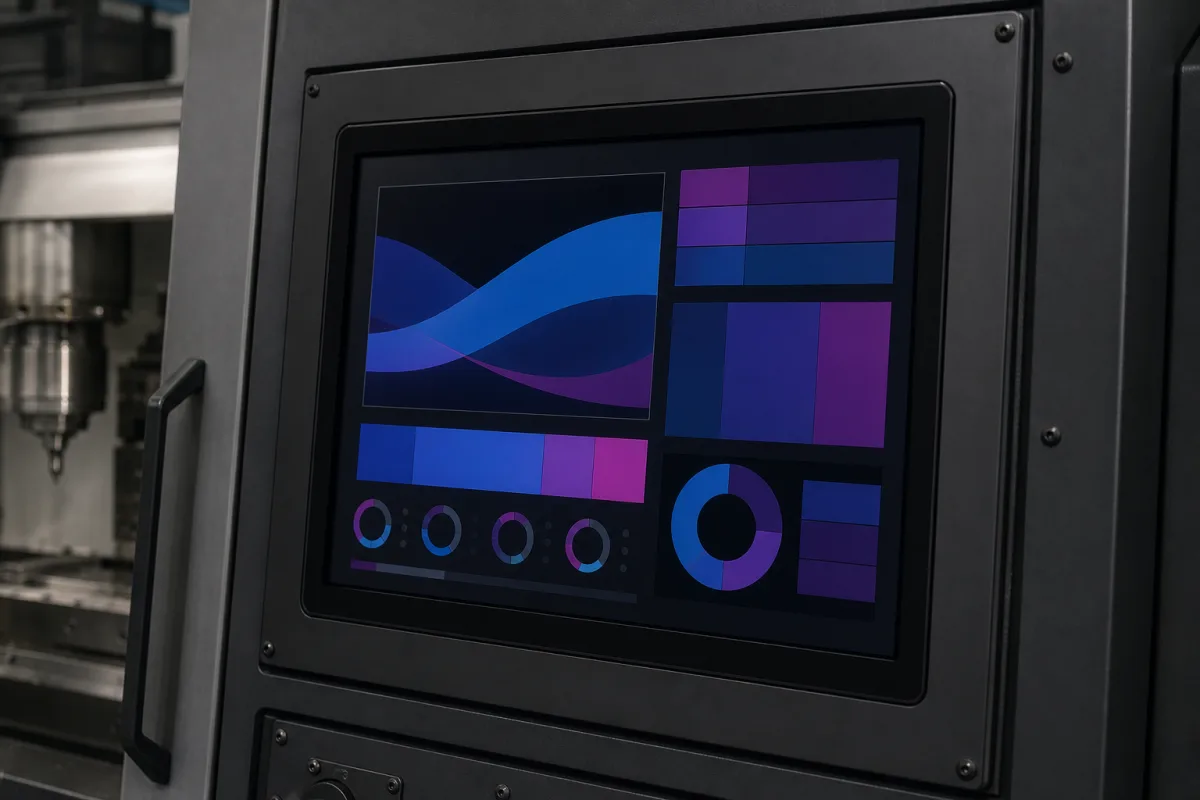
A visual output device that presents data, graphics, and interface elements to operators within an industrial control panel.
Product Specifications

Technical details and manufacturing context for Display Screen

Definition
The display screen is the primary visual interface component of an Operator Interface Panel (OIP), responsible for presenting real-time process data, system status, alarms, control graphics, and operator menus. It serves as the critical medium through which human operators monitor and interact with industrial machinery and automated systems.
Working Principle
The display screen receives electrical signals containing visual data from the panel's controller or PLC. It converts these signals into a visible image using its underlying technology (e.g., LCD, LED, or TFT). This allows operators to view process variables, navigate control interfaces, and respond to system prompts.
Common Materials
Liquid Crystal Display (LCD) Panel, Glass Substrate, Polarizing Filters, Backlight Unit (LED)
Technical Parameters
  • Screen diagonal size (inch) Customizable
Components / BOM
  • LCD Panel
    Generates the visual image by modulating light through liquid crystals
    Material: Glass, Liquid Crystals, Transparent Electrodes
  • Backlight Unit
    Provides uniform illumination behind the LCD panel
    Material: LED Array, Light Guide Plate, Reflector Sheet
  • Touch Sensor Layer
    Detects and transmits operator touch input to the controller
    Material: ITO-coated Glass or Film
  • Bezel/Front Frame
    Protects the screen edges and provides mounting structure
    Material: Stainless Steel or Industrial Plastic
Engineering Reasoning
0-70°C ambient temperature, 20-80% relative humidity non-condensing, 100-240V AC ±10%
85°C junction temperature for LCD backlight LEDs, 95% relative humidity with condensation, 275V AC sustained input
Design Rationale: Thermal degradation of organic LED materials above glass transition temperature, electrochemical migration between conductive traces under humid conditions, dielectric breakdown in power supply components exceeding 600V/mm
Risk Mitigation (FMEA)
Trigger Backlight LED current exceeding 20mA continuous at 3.3V forward bias
Mode: Luminance decay to <100 cd/m² within 1000 hours
Strategy: Constant current driver circuit with 18mA limit and thermal foldback at 80°C
Trigger ESD discharge exceeding ±8kV contact/±15kV air gap per IEC 61000-4-2
Mode: Gate oxide breakdown in display controller IC, resulting in stuck pixels
Strategy: TVS diodes with 5V clamping voltage at 10A surge and 1.5pF capacitance on all I/O lines

Industry Taxonomies & Aliases

Commonly used trade names and technical identifiers for Display Screen.

Applied To / Applications

This component is essential for the following industrial systems and equipment:

Industrial Ecosystem & Supply Chain DNA

Complementary Systems
Downstream Applications
Specialized Tooling

Application Fit & Sizing Matrix

Operational Limits
pressure: Atmospheric (0.1-1.0 bar), not pressure-rated for process environments
other spec: IP65/NEMA 4X ingress protection, 500-2000 cd/m² brightness, 50-85% humidity non-condensing
temperature: -20°C to +70°C (operating), -40°C to +85°C (storage)
Media Compatibility
✓ Control room air (filtered) ✓ Clean industrial atmospheres (ISO Class 8) ✓ Non-corrosive manufacturing environments
Unsuitable: Washdown areas with high-pressure chemical sprays
Sizing Data Required
  • Panel cutout dimensions (mm/in)
  • Required viewing distance/angle
  • Interface protocol (HDMI, VGA, DVI, etc.)

Reliability & Engineering Risk Analysis

Failure Mode & Root Cause
Pixel degradation
Cause: Prolonged exposure to high brightness and heat, leading to phosphor/OLED material deterioration and dead pixels
Backlight failure
Cause: LED/LCD backlight component aging, inverter circuit malfunction, or power supply instability causing complete or partial screen darkness
Maintenance Indicators
  • Flickering, dimming, or inconsistent brightness across screen sections
  • Visible dead pixels, color distortion, or screen artifacts during operation
Engineering Tips
  • Implement automatic brightness adjustment based on ambient light to reduce thermal stress and extend display component life
  • Establish regular pixel refresh cycles and screen-off periods during idle times to prevent image burn-in and component fatigue

Compliance & Manufacturing Standards

Reference Standards
ISO 9241-302: Ergonomics of human-system interaction - Part 302: Terminology for electronic visual displays ANSI/HFES 100-2007: Human Factors Engineering of Computer Workstations CE marking for electromagnetic compatibility (EMC) and low voltage directives
Manufacturing Precision
  • Pixel pitch uniformity: +/-0.001mm
  • Surface flatness: 0.05mm across entire display area
Quality Inspection
  • Color uniformity and gamma curve verification
  • Dead pixel and subpixel defect testing

Factories Producing Display Screen

Verified manufacturers with capability to produce this product in China

✓ 92% Supplier Capability Match Found

S Sourcing Manager from United States Jan 12, 2026
★★★★★
"Reliable performance in harsh Machinery and Equipment Manufacturing environments. No issues with the Display Screen so far."
Technical Specifications Verified
P Procurement Specialist from United Arab Emirates Jan 09, 2026
★★★★☆
"Testing the Display Screen now; the technical reliability results are within 1% of the laboratory datasheet. (Delivery took slightly longer than expected, but technical support was excellent.)"
Technical Specifications Verified
T Technical Director from Australia Jan 06, 2026
★★★★★
"Impressive build quality. Especially the technical reliability is very stable during long-term operation."
Technical Specifications Verified
Verification Protocol

“Feedback is collected from verified sourcing managers during RFQ (Request for Quote) and factory evaluation processes on CNFX. These reports represent historical performance data and technical audit summaries from our B2B manufacturing network.”

14 sourcing managers are analyzing this specification now. Last inquiry for Display Screen from Mexico (47m ago).

Supply Chain Compatible Machinery & Devices

Hydraulic Press

Industrial machine using hydraulic pressure to compress, form, or assemble materials

Explore Specs →
Heavy-Duty CNC Plasma Cutting Machine

Industrial machine for precision metal cutting using plasma arc technology

Explore Specs →
Automated Assembly Line System

Integrated production system for sequential component assembly operations

Explore Specs →
Automated Powder Coating System

Integrated industrial system for applying dry powder coatings to metal substrates.

Explore Specs →

Frequently Asked Questions

What makes this display screen suitable for industrial machinery environments?

This display screen is built with industrial-grade components including a durable LCD panel, LED backlight for consistent visibility, and robust construction to withstand vibrations, temperature variations, and continuous operation in manufacturing settings.

Can this display screen integrate with existing industrial control systems?

Yes, the display screen features standard industrial interfaces and mounting options compatible with most machinery control panels. The touch sensor layer supports common industrial protocols for seamless integration with PLCs and other control systems.

What maintenance is required for the display screen in manufacturing applications?

The display requires minimal maintenance due to its sealed construction and LED backlight technology. Regular cleaning of the glass surface and ensuring proper ventilation are typically sufficient for long-term reliability in industrial environments.

Can I contact factories directly on CNFX?

CNFX is an open directory, not a transaction platform. Each factory profile provides direct contact information and production details to help you initiate direct inquiries with Chinese suppliers.

Get Quote for Display Screen

Request technical pricing, lead times, or customized specifications for Display Screen directly from verified manufacturing units.

Your business information is encrypted and only shared with verified Display Screen suppliers.

Thank you! Your message has been sent. We'll respond within 1–3 business days.

Need to Manufacture Display Screen?

Connect with verified factories specializing in this product category

Add Your Factory Contact Us
Previous Product
Display Interface
Next Product
Display Unit