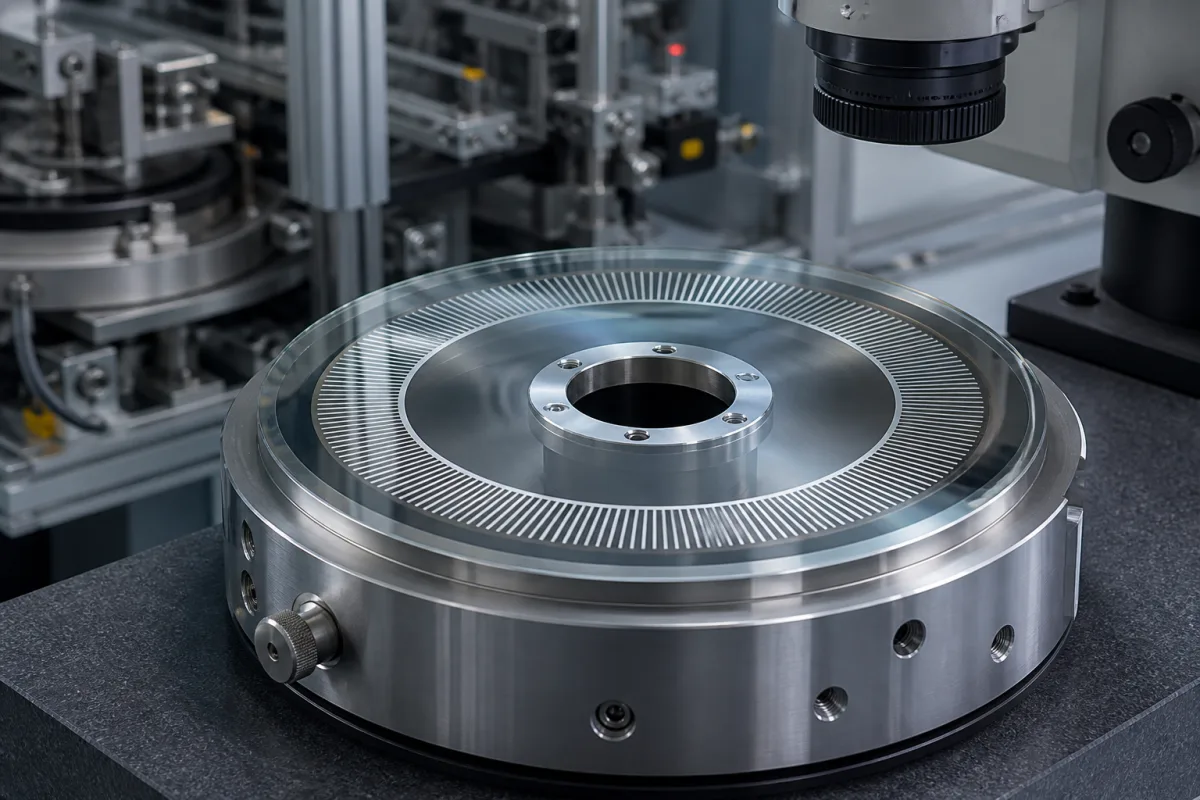
Rotary encoder discs (codewheels) · Glass, film and metal discs, counts per revolution and optical radius, temperature and speed limits, eccentricity, axial play and the position error they cause, and reliability testing
A rotary encoder disc, or codewheel, is the patterned glass, film or metal disc in an optical rotary encoder whose radial lines or slots interrupt light between an emitter and a detector as the shaft turns, producing the pulses from which angle and speed are calculated. Ask three things first: which material and line count (counts per revolution) at which optical radius the encoder module needs, what temperature, speed and humidity it must survive, and what hub, eccentricity and axial-play tolerances the assembly can hold.
Optical encoder discs and codewheels in glass, film and metal, with their hubs, for incremental and absolute rotary encoders. Complete rotary encoders (see high resolution encoder), linear scales (see encoder linear scale), magnetic encoder rings and resolvers are outside this page.
CNFX editorial research · Sources checked October 12, 2026 · 4 sources
Choose disc material, line count and optical radius
Avago Technologies' codewheel data sheet (HEDS, HEDM and HEDG series) offers glass, film and metal codewheels for its transmissive encoder modules, with resolutions from 96 to 1,024 counts per revolution (CPR) on an 11 mm optical radius and 500 to 2,048 CPR on a 23.36 mm optical radius. Metal discs are rated −40 to +100 °C and 30,000 rpm and reach 512 CPR on a 28 mm diameter; film discs −40 to +70 °C and 30,000 rpm and reach 1,024 CPR; glass discs −40 to +100 °C and 12,000 rpm and reach 1,024 CPR on 28 mm, at higher cost. [1]
It lists maximum count frequency of 100 kHz for metal and 200 kHz for film and glass discs, and worst-case position errors over a rotation of 40, 40 and 30 arc-minutes for the smaller metal, film and glass families and 20, 20 and 15 arc-minutes for the larger ones. Glass discs passed 1,000 h storage and 500 h rotation at 100 °C, 500 cycles of −40 to +100 °C and 500 h at 85 °C/85% RH with no failures in the samples tested. [1]
Editorial note: the count per revolution sets resolution, but accuracy depends on how well the disc pattern is centred on the shaft; ask for both CPR and the position-error specification with the hub and mounting you will use.
Give the supplier the encoder module or reader the disc must match, material (glass, film, metal), CPR and number of channels (incl. index), optical radius and outside diameter, hub bore and fixing, operating and storage temperature, humidity, maximum speed and acceleration, eccentricity and axial-play limits, position-error target, and quantities.
02
Hold eccentricity and axial play to control position error
The data sheet sets shaft eccentricity plus radial play at ±0.1 mm TIR for metal and ±0.04 mm TIR for film and glass discs, and shaft perpendicularity plus axial play at ±0.25 mm for metal and ±0.175 mm for film and glass. Avago Application Note 1108 explains that eccentricity comes from non-concentric etching, assembly tolerance of the disc on its hub, set-screw offset and shaft run-out, repeats once per revolution, and gives position error ΔP = (e / R_op) × sin A × 180/π × 60 arc-minutes, where e is total eccentricity and R_op the optical radius. [1][2]
Editorial calculation: with 0.04 mm eccentricity on an 11 mm optical radius, the peak position error is (0.04 / 11) × 180/π × 60 ≈ 12.5 arc-minutes; on a 23.36 mm radius it falls to about 5.9 arc-minutes, so a larger radius or a tighter hub fit reduces error more than adding lines. [2]
The application note also lists eccentricity and radial play, perpendicularity and axial play, velocity, temperature and code-wheel pattern defects as the factors that affect position accuracy, cycle uniformity, pulse width, phase and state width. [2]
03
Ask how the disc is centred on the hub, and what eccentricity the process achieves
A 2024 study by Tianjin University, the Institute of Semiconductors of the Chinese Academy of Sciences and Suzhou Inovance Technology measured how closely encoder gratings (discs) are centred on motor shafts during assembly. Of 50 discs, 25 were mounted by hand and 25 by an automated system that images an alignment ring on the rotating disc and pushes the disc into position. The automated system detected eccentricity within 2.8 s and finished a mounting in 25.1 s on average, with 2.1 pushes on average and a maximum of 5, leaving an average eccentricity of 3.8 µm. The authors report that "the most adept manual mounting workers" achieved 13.7 µm on average, and manual mounting took 30 to 40 s per disc. [4]
The authors checked their detector against an optical microscope on three mounted discs: 3.3 against 3.0 µm, 6.7 against 7.5 µm and 5.4 against 5.6 µm, and attribute the differences to the detector's 0.75 µm per pixel resolution, a 0.25 µm calculation error and the roundness of the alignment ring. They list a CCD-camera method from earlier work at 6.0 µm and 32.4 s. [4]
Editorial calculation: using the once-per-revolution error formula from Avago's application note, peak error = (e ÷ R) × (180/π) × 60 arc-minutes, on an assumed 11 mm optical radius 3.8 µm gives about 1.2 arc-minutes and 13.7 µm about 4.3 arc-minutes, against about 12.5 arc-minutes for the 0.04 mm limit in Avago's data sheet; on a 23.36 mm radius they fall to about 0.56 and 2.0 arc-minutes. Ask the supplier whether disc and hub come pre-centred, what eccentricity the assembly process holds and how it is measured, and whether an alignment ring is provided for centring at your plant. [4][2][1]
No manufacturer record has been reviewed for this product yet. Send your specification and CNFX will match it against manufacturer records.
05
Specify the hub, bore, set-screw torque and disc gap with the disc
US Digital's HUBDISK-2 datasheet describes a 2 in. diameter optical encoder disc mounted on a precision-machined aluminium hub, offered in 21 resolutions from 64 to 10,000 CPR (256 to 40,000 PPR). The disc is 0.007 in. thick Mylar film rated for -40 °C to +100 °C, with an outside diameter of 2 in. ± 0.010 in. The hub comes in 23 bore sizes from 2 mm to 1 in., held to the tolerances of the maker's technical bulletin TB1001, and is fixed by one or two set screws depending on bore size, with a hub set-screw torque of 2-3 in-lbs. [3]
Its drawings give an optical radius of 0.920 in. (23.37 mm) and a recommended disc gap of 0.020 in. +0.005/-0.010 in. (0.51 mm +0.13/-0.25 mm) from the detector side. Index availability depends on resolution: 64 CPR comes only without an index, 2,500 CPR and below with or without one, and 3,600 CPR and above only with an index. [3]
Editorial note: this film disc is rated to +100 °C, while the Avago film codewheels on this page are rated to +70 °C, so confirm the temperature rating of the exact film and coating offered rather than assuming one value per material. Ask for the bore tolerance document, set-screw torque, disc gap and index option in the quotation.
06
Trace the disc components
This is a functional reference built from the sources cited; it is not one maker's design.
Fill the specification fields with values for your encoder
An encoder disc quotation needs values for your encoder. The table explains each field, gives published values where a reviewed source states them, and says what to obtain from the supplier.
Explore company information and manufacturing capabilities, then discuss the scope of your project with a relevant supplier.
Share this page
Compiled and source-reviewed by the CNFX editorial team.
Published product pages show what a company offers, not tested performance. Confirm the legal seller, factory, test data and scope for your order. How we source and review
· Page last updated 13 October 2026
Buyer questions
Which encoder disc material handles the highest temperature?
In one data sheet, glass and metal discs are rated −40 to +100 °C and film discs −40 to +70 °C. [1]
How does eccentricity affect encoder accuracy?
It causes a once-per-revolution position error of (e / R) × sin A, converted to arc-minutes; 0.04 mm on an 11 mm radius gives about 12.5 arc-minutes peak. [2]
What resolutions are available?
One range offers 96 to 1,024 CPR on an 11 mm optical radius and 500 to 2,048 CPR on 23.36 mm. [1]
What mounting details should an encoder disc quotation include?
US Digital's HUBDISK-2 datasheet specifies the bore size and tolerance bulletin, a hub set-screw torque of 2-3 in-lbs and a recommended disc gap of 0.020 in. +0.005/-0.010 in. [3]
How closely can an encoder disc be centred on its shaft?
In a 2024 Tianjin University study, an automated mounting system left 3.8 µm average eccentricity in 25.1 s per disc, against 13.7 µm for the top manual workers in the study. [4]
Sources and what still needs a direct check
Sources checked 2026-10-12. Avago's data sheet and application note and US Digital's datasheet describe their own codewheels and are used here to show what an encoder disc specification covers; a 2024 Tianjin University study reports measured disc-centring results. Values for your disc must come from the supplier's drawings and tests.