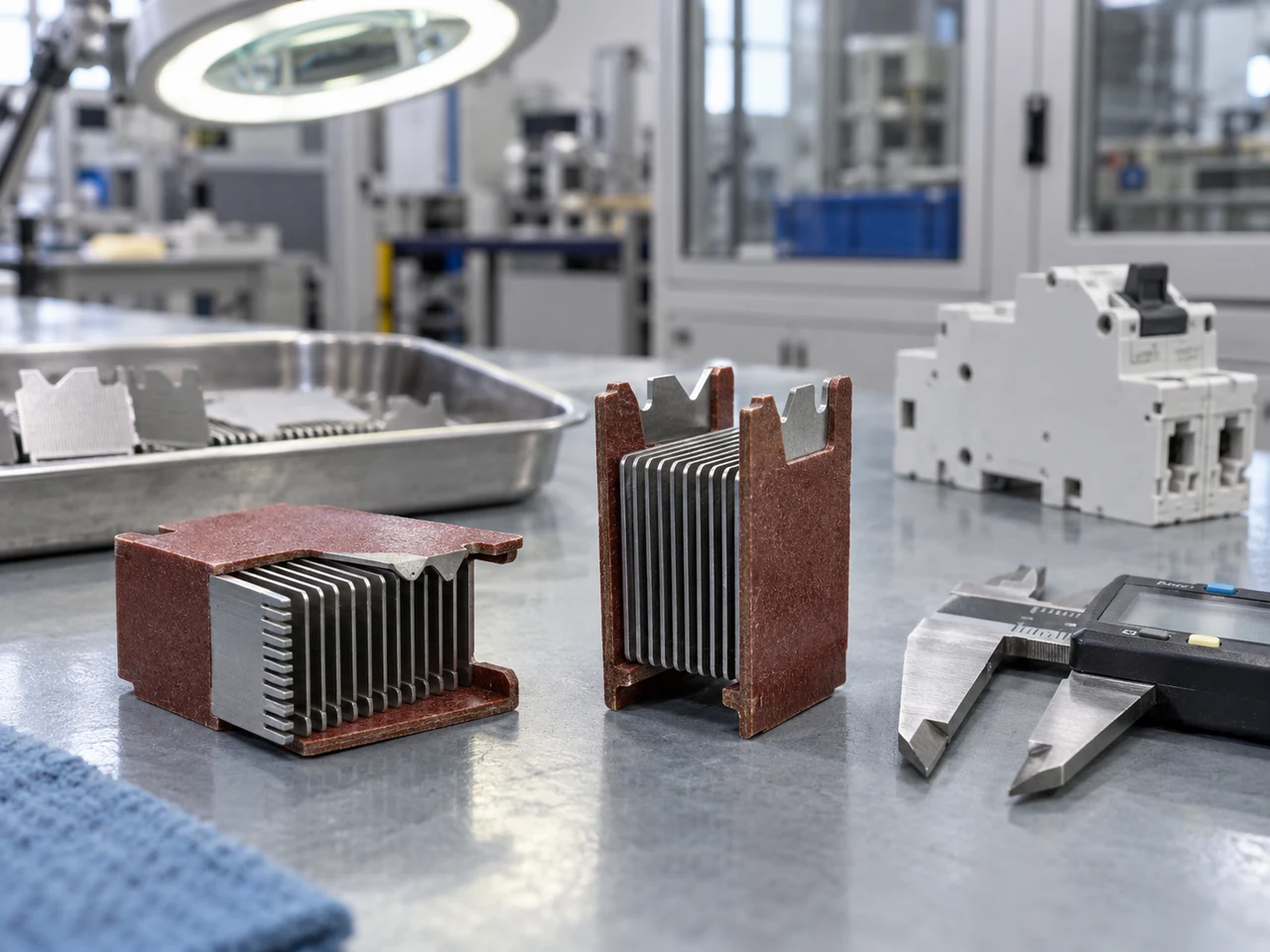
Match the plate stack to the breaker’s tested design. Compare the component drawing, material evidence and model-specific replacement instructions before selecting a chute.
CNFX editorial research · Sources checked October 12, 2026 · 5 sources
Follow the arc path without mixing breaker designs
In the air-break arrangement described by ABB, the main contacts separate before the arcing contacts. ABB writes that “The arcing contacts therefore carry most of the arc”, and their location and geometry direct it into the arc bundle. This K-Line explanation does not establish the contact sequence of every miniature breaker. [2]
Arc bundle
An arc runner plus nickel-plated steel arcing plates separated by air gaps [2]
Widening gaps
In ABB’s described assembly, the plate gaps widen towards the top. The longer arc becomes unsustainable at the voltage present. Do not transfer this geometry to a different plate-stack drawing. [2]
Condition matters
The arc runner must be clean, plates correctly oriented and gaps free of blockages [2]
Miniature breakers
Heking describes its MCB chute as guiding the arc along a set path, elongating and dispersing it during short-circuit breaking [1]
02
Identify the three functional parts in the breaker assembly
The arc path crosses more parts than the purchased chute may include. Use the assembly drawing to define the supply boundary. ABB’s labelled cutaway distinguishes the housing, plates, runner, baffles and contacts. [2]
Functional part / BOM reference
Role
Materials and supply boundary
Splitter plates
Guide and subdivide the arc path; their spacing and orientation are part of the design.
ABB identifies nickel-plated steel arcing plates. Heking’s selected MCB listing specifies nine 0.8 mm plates using a Q235 material description; no coating is named. Do not add copper or a plating option without the approved specification. [2][1]
Insulating support / housing
Supports the plate arrangement and forms insulating boundaries.
Heking shows a folded arc-blocking support; the translated material term needs confirmation. ABB’s moulded K-Line shells are a different construction. Neither source proves a universal ceramic, PTFE or thermoset housing for this entire category. [1][2]
Arc runner / horn
Leads the arc into the plate bundle in ABB’s illustrated breaker.
ABB identifies its function but does not specify a runner alloy in this guide. Heking’s stated two-part chute does not establish an included separate runner. Confirm whether it belongs to the breaker contact system or the ordered assembly. [2][1]
Functional roles are not quantities for a universal manufacturing BOM. For the selected Heking listing, its stated composition is one blocking support plus nine plates; the separate drawing callouts 1 and 2 identify parts, not a second plate-count specification. [1]
03
Specify plates and housing precisely
Heking’s “small circuit breaker44” listing publishes one blocking support and nine extinguishing plates, together with three embedded part/assembly drawings. The listing establishes a component example, not interchangeability with all MCBs. [1]
Housing materials differ
ABB’s K-Line guide compares historical housing materials. It lists MB4000 polyester thermoset impact strength at 7.0–7.5 ft-lb/in, versus 0.37 for the older asbestos-cement material, tensile strength at 5,000–8,000 psi and dielectric strength as 390+ VPM. These are that guide’s material-property figures, not the complete breaker’s withstand voltage or Heking’s properties. The document bears revision A dated 10.9.2020; its “current offering” wording is not confirmation of stock today. [2]
Drawings and samples first
Send the complete mating drawing and revision. Heking’s plate image calls out t0.8, a 50° notch and an overall width of 22.5 ±0.1, while its assembled front view labels 22.5 ±0.2. Keep part and assembly tolerances separate. The images have no visible unit/title block; request a controlled, dimensioned drawing before tooling. [1]
Obtain the original material designation, grade and thickness; the English wording does not establish a certified vulcanised-fibre grade.
Arc-extinguishing discs
9 discs, 0.8 mm, 'cold-rolled steel paperboard Q235' [1]
Confirm the controlled material designation, 0.8 mm thickness tolerance, burr limits and any coating. ABB’s nickel plating belongs to its own design, not this Heking part.
Request the exact breaker frame, AC/DC duty, voltage and breaking-test evidence; the listing provides no numerical current or fault rating.
The assembly view labels a 2.1 pitch and “2.1*8=16.8” across the stack. Pitch is not free air gap, and it is not the whole assembly width. Do not machine the stack from a website image or infer acceptance limits that the drawing does not state. [1]
04
Know which standard the finished breaker must pass
Choose the finished breaker’s standard and electrical duty before asking whether a replacement or new chute is covered. These are public scope summaries only; the full test clauses and an actual Heking breaker test report were not reviewed. [3][4]
A changed chute means a changed breaker
Ask the breaker manufacturer to identify the approved chute drawing, material and revision and whether its breaking-test evidence covers the proposed change. Matching an outline or quoting an IEC standard number does not supply that evidence. The public IEC scopes describe circuit-breakers, not a certified kA rating for the loose stack. [3][4]
Standard
Scope (public abstract)
IEC 60898-1:2015 + A1:2019
AC air-break circuit-breakers for household and similar installations at 50 Hz, 60 Hz or 50/60 Hz: up to 440 V between phases, 125 A and 25,000 A rated short-circuit capacity. These are scope limits, not Heking component ratings. [3]
IEC 60947-2:2024
Breakers for instructed/skilled persons on circuits whose rated voltage “does not exceed 1 000 V AC or 1 500 V DC”, including integrally fused breakers. The abstract also covers breakers rated at or below 1,000 V AC that additionally have one or more ratings above 1,000 V AC but not exceeding 1,500 V AC. [4]
05
Put electrical ratings on the breaker record and geometry on the chute record
The Heking listing does not publish a complete electrical or environmental rating table. The following fields separate evidence to request from values that are actually available; an empty model specification is not permission to substitute a category-wide number. [1]
Specification field
What the order needs to identify
Rated voltage · V
The host breaker’s AC/DC voltage, frequency where applicable and approved chute configuration. IEC scope maxima are not this assembly’s rating. [3][4]
Rated current · A
Breaker frame and current designation covered by the component approval. Heking says multiple ratings but supplies no numerical list here. [1]
Short-circuit breaking capacity · kA
The complete breaker’s test result and configuration at the stated voltage/duty. No standalone kA value is supplied for this Heking chute. [1][4]
Arc duration · ms
The measured interruption conditions, waveform and result for the selected breaker. No time is published in the component listing; do not equate it with a generic operating time. [1]
Dielectric withstand · kV
The assembly/breaker test voltage, duration, condition and result agreed for the qualification. ABB’s material VPM comparison is a different quantity. [2]
Impulse withstand · kV
Applicable breaker test requirement, waveform and verified result. No impulse value is given in this component source. [1]
Operating temperature · °C
Approved installed and storage limits for the selected material/breaker combination; not published in this listing. [1]
Material and coating
Original grade for the blocking support, the stated Q235 plate designation, coating if required, and material records tied to the drawing. [1]
Weight · g or kg
Mass of the supplied single assembly and any included hardware, separately from shipping mass. Not published here. [1]
Dimensions · controlled drawing units
Mating envelope, mounting features, plate thickness, pitch, gaps and tolerances. Check units and drawing revision; part dimensions and assembled dimensions differ. [1]
Humidity and condensation
The permitted service/storage conditions and associated qualification for the installed breaker. No percentage limit is established here. [1]
Ingress protection
Identify which complete enclosure or breaker assembly the IP declaration covers. An open plate stack is not evidence of a sealed, rated enclosure. No IP code is supplied in the listing. [1]
06
Use the K-Line chart only for the matching serviceable assembly
ABB’s K-Line inspection guide provides the following model-specific examples. Use qualified service personnel and the actual breaker’s isolation, access and service instructions. This chart does not authorise opening a sealed MCB or applying K-Line cleaning methods to a Heking component. [2]
Finding on the covered K-Line chute
ABB guide’s action
Minor soot or discoloration
Clean with denatured alcohol and a clean cloth; no replacement [2]
Non-through surface cracks, abrasions or indentations
ABB lists no replacement for these minor findings, but its size, flashover and mounting-damage criteria still apply. Ask ABB if severity is uncertain. [2]
Surface defects larger than 1/4 in square or with flashover potential
For the K-Line screw/poly-glass-retainer arrangement in this guide, maximum tightening torque is 35 lb-in for frames 225/600/800 and 75 lb-in for frames 1600/2000. These are maxima, not a universal torque range. Page 7 separately maps replacement assemblies 706775T13 and 706775T12 to named frames; verify the exact model and current part before ordering. Heking compatibility is not implied. [2]
07
Give the maker a breaker identity and a controlled drawing
Paste it into your enquiry below or into an email to a maker, then replace every bracket.
Purpose: new breaker assembly / manufacturer-approved service replacement [ ]
Breaker make, model, frame, poles and serial/revision [ ]
Electrical duty: AC/DC [ ]; voltage [ ]; frequency [ ]; rated current [ ]; breaking duty [ ]
Applicable breaker standard and edition [ ]; test report/configuration reference [ ]
Chute assembly drawing, revision and units [ ]; quantity [ ]
Included parts: plate stack / support / runner / retainer / fasteners [ ]
Plate grade, thickness and tolerance [ ]; pitch/gap [ ]; notch and burr requirements [ ]
Insulating support grade and original material designation [ ]; coating [ ]
Mating envelope, mounting, venting and inspection dimensions [ ]
Required material records, dimensional report and approved sample [ ]
Confirmation that this configuration is covered by the breaker qualification [ ]
For service: authorised replacement part and applicable maintenance instructions [ ]
Delivery country [ ]; date [ ]
This supplier publishes MCB, MCCB and ACB component categories. The specific listing reviewed here is an MCB chute; the ABB service examples above do not establish cross-brand replacement approval.
The selected MCB listing gives one blocking support, nine 0.8 mm extinguishing plates and separate component/assembly drawings. The material wording is ambiguous, and numeric breaker ratings or a qualification report are not provided. Request the original material specification and the exact approved breaker configuration.
Explore company information and manufacturing capabilities, then discuss the scope of your project with a relevant supplier.
Share this page
Compiled and source-reviewed by the CNFX editorial team.
The company’s own product and contact pages were checked. This does not verify customer approvals, certifications, factory capacity or the breaking performance of a completed breaker. How we source and review
· Page last updated 13 October 2026
Buyer questions
How does an arc chute work?
In ABB’s described K-Line arrangement, the contacts direct the arc towards an arc runner and plate bundle; widening gaps increase arc length until it cannot be sustained at the voltage present. Other breakers need their own verified geometry—this is not a universal plate-spacing prescription. [2]
Which standard covers household miniature circuit breakers?
The IEC 60898-1:2015+A1:2019 public scope covers household/similar AC air-break breakers at 50/60 Hz, up to 440 V between phases, 125 A and 25 kA rated short-circuit capacity. These are standard scope limits, not a rating for a loose arc chute. [3]
When should an arc chute be replaced?
For the covered K-Line assemblies, ABB calls for replacement for heavy residue, major erosion or holes, qualifying surface/shell damage, mounting defects and damaged or missing hardware. Follow the correct breaker manual; these limits do not authorise servicing a sealed miniature breaker. [2]
How many plates does an MCB arc chute have?
The number is design-specific. The selected Heking listing states nine 0.8 mm plates plus one blocking support. Its image labels 1 and 2 are part references, not a conflicting count of two plates; confirm the controlled assembly drawing. [1]
Sources and what still needs a direct check
Sources checked 2026-10-12. Standards bodies and regulations define the requirements; manufacturer pages show published ranges for those models only. CNFX does not certify products or suppliers.