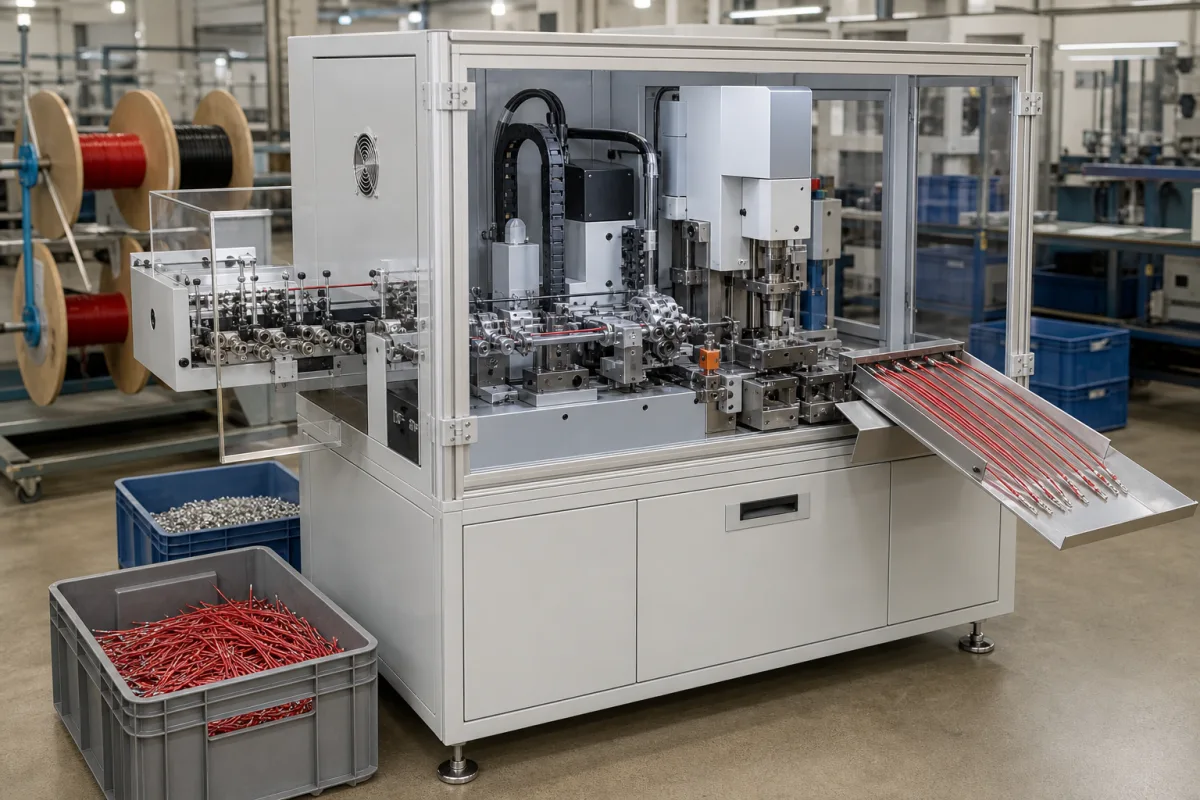
Automated wire stripping and termination machine for twisted and tinned wire ends
Solder-tinned wire ends · cut, strip, twist and tin machines for fine wires, length and strip tolerances, tinning length and solder temperature
An automated wire stripping and termination machine of this kind feeds wire from reels, cuts it to length, strips the insulation, twists the strands and dips the ends in molten solder, so each end is terminated by tinning rather than by a crimped terminal; combined models crimp a terminal on one end and tin the other. Ask three things first: the wire sizes and number of wires processed together, the cutting and stripping tolerances at your lengths, and the tinning length and solder temperature the machine can hold.
Automatic cut-strip-twist-tin machines and combined crimp-and-tin machines for single, twin and sheathed wires in electronics and appliance wiring. Cut-strip-crimp machines that terminate with crimped terminals are covered on the Automated wire harness crimping machine page. Hand strippers, solder pots sold alone, solder alloys and wire harness testers are outside this page.
CNFX editorial research · Sources checked October 12, 2026 · 4 sources
Check wire sizes, output rate and length tolerances
Kingsing's KS-W1143 series cuts, strips, twists and tin-solders AWG32 to AWG18 wire. The single-wire version takes 1–8 wires at once and lists 6,000–8,000 pieces an hour; the pair-twisting version 2,000–3,000 and the parallel-twin version 1,000–2,000. It cuts 10–600 mm to ±(0.2 + 0.2% × L) mm, strips 0–15 mm to ±0.05 mm and stores up to 200 programs. [1]
The KS-W1012 series covers AWG28 to AWG18 with the same output bands, cutting 15–1,000 mm to ±(0.5 + 0.2% × L) mm and stripping 0–7 mm to ±0.1 mm. [2] Bettertech's JWD-TC4-331 handles AWG32 to AWG14, cuts 30–9,999 mm to 0.2 mm + 0.00005 × L, crimps one end with 2 t capacity and tins the other, at up to 3,450 pieces an hour. [3]
Editorial calculation: on the KS-W1143, a 100 mm wire is held to ±(0.2 + 0.2) = ±0.4 mm and a 600 mm wire to ±(0.2 + 1.2) = ±1.4 mm; on the KS-W1012 a 1,000 mm wire is held to ±2.5 mm. At 8,000 pieces an hour the machine delivers one wire every 3,600 ÷ 8,000 = 0.45 s; at 3,450 an hour, every 1.04 s. [1][2][3]
Give the supplier the wire type and size (AWG or mm²), insulation material, single, twin, twisted-pair or sheathed construction, cut lengths, strip and tinning lengths at each end, terminal on the other end if any, solder alloy, hourly output, tolerances and inspection required.
02
Set the tinning length and solder temperature
Both Kingsing series tin a twisted length of 3–7 mm. [1][2] Bettertech's combined machine strips 0–15 mm for soldering at the tinned end, gives a tinning diameter of 1–1.6 mm and a soldering temperature setting of 20–400 °C, with tinning time adjustable on the touch screen and detection of faulty pieces. [3]
The solder alloy sets the temperature needed. SRA Soldering Products' SAC305 datasheet (96.5% Sn, 3% Ag, 0.5% Cu) gives a melting point of 221 °C and a wave soldering pot temperature of 265–270 °C. [4] Editorial note: ask the supplier at what pot temperature and dip time the machine was proven on your wire and alloy, because the 20–400 °C setting range is wider than any single alloy's working window.
Stores programs; sets lengths and tinning time. [1][3]
Program count and fault detection.
05
Wire gauge, strip and tinning length, cut tolerance and pot temperature for a strip-and-tin machine
Cycle time in this table is an editorial conversion from the published hourly output (0.45 s at 8,000 an hour), so ask for a timed run at your own cut length and wire count.
Solder setting 20–400 °C (JWD-TC4-331); SAC305 pot 265–270 °C. [3][4]
Pot temperature for your alloy.
Noise Level (dB(A))
Not stated in the reviewed sources.
Measured level.
06
Send the wire, end and output data together
Paste it into your enquiry below or into an email to a maker, then replace every bracket.
Wire: [type; size; insulation; single, twin, twisted or sheathed]
Lengths: [cut length; strip length; tinning length]
Ends: [tin both ends, or crimp one and tin one; terminal part number]
Solder: [alloy; flux; pot temperature]
Output: [pieces per hour; wires fed together]
Quality: [tolerances; fault detection; samples]
Compare wire stripping and tinning machine suppliers
3 companies list this product among what they make. Company figures are quoted from each
company's own website; every card states where the relationship came from.
Shenzhen KINGSING Technology Co., Ltd.
Manufacturing site to be confirmed for the order
Lists wire stripping and tinning machines, including stripping-twisting-tinning, sheathed cable stripping and tinning, and laser stripping and tinning models.
Explore company information and manufacturing capabilities, then discuss the scope of your project with a relevant supplier.
Share this page
Compiled and source-reviewed by the CNFX editorial team.
Each manufacturer above links to the page on that company's own website where the product is listed, with the date we checked it. How we source and review
· Page last updated 13 October 2026
Buyer questions
How fast can a machine strip and tin wires?
Kingsing lists 6,000–8,000 single wires an hour for its KS-W1143 and KS-W1012 series; Bettertech's crimp-and-tin machine lists up to 3,450 pieces an hour. [1][2][3]
What tinning length do wire tinning machines give?
Both Kingsing series tin a twisted length of 3–7 mm; Bettertech lists 0–15 mm at the soldered end. [1][3]
What solder temperature is used for SAC305?
SRA Soldering Products gives a 221 °C melting point and a 265–270 °C wave soldering pot temperature for its SAC305 alloy. [4]
Sources and what still needs a direct check
Sources checked 2026-10-12. Kingsing and Bettertech are listed suppliers publishing their own machine tables; SRA Soldering Products publishes the alloy datasheet. Values are maker statements.