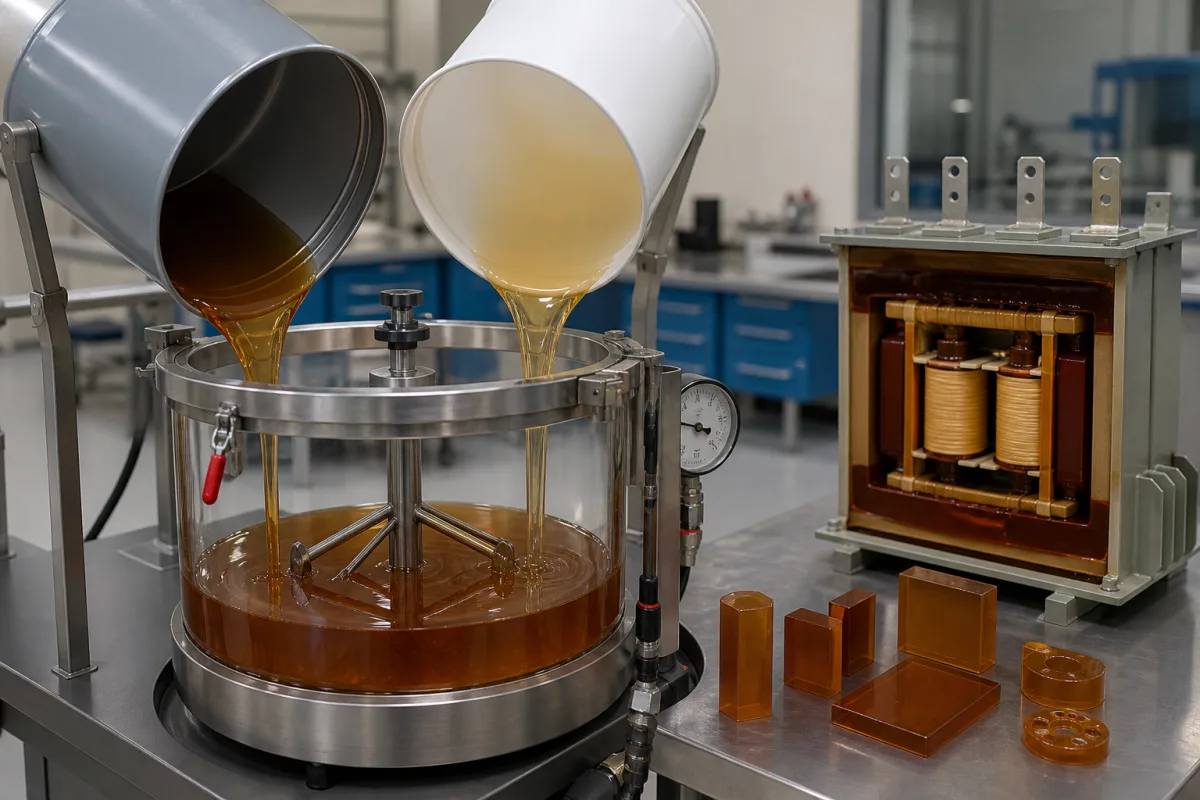
Epoxy casting systems · Mix ratio and viscosity, vacuum mixing and casting, gel and cure schedule, Tg, dielectric strength, thermal index
An electrical insulation epoxy resin compound is a two-part thermosetting system, a mineral-filled epoxy resin and a hardener, that is mixed, degassed and cast or pressure-gelled around conductors to form insulators, bushings, instrument transformers and resin-insulated coils. Ask three things first: what mix ratio, viscosity and temperatures the process needs, what gel, cure and post-cure schedule suits your part size, and what cured electrical, thermal and mechanical properties are guaranteed.
Filled epoxy casting and potting systems for electrical insulation: vacuum casting, automatic pressure gelation (APG) and potting of medium- and high-voltage components and transformers. Insulating varnishes, unfilled adhesives and moulding compounds are outside this page.
CNFX editorial research · Sources checked October 12, 2026 · 4 sources
Huntsman's data sheet for Araldite CW 229 / Aradur HW 229-1, a hot-curing two-component epoxy casting system with mechanically reinforcing fillers, recommends it for electrically insulating components and indoor medium- and high-voltage insulation, including SF6-insulated types. It mixes 100:100 by weight or 100:90 by volume; the mixed system has a specific gravity of 1.80–1.85 and viscosity of 25,000–35,000 cPs at 25 °C, 2,500–3,500 at 50 °C and 700–1,200 at 70 °C. [1]
For large vacuum castings it describes preheating resin, hardener and mould separately to 60–80 °C, mixing for about 30 minutes under 2–6 torr, and filling the preheated mould inside a vacuum chamber at 4–8 torr to avoid trapped air. For automatic pressure gelation, components are kept degassed at 50–60 °C and the mould is preheated to 140–160 °C, filled in 2–5 minutes and gelled under 1–3 atm for 7–15 minutes. [1]
Atul's Lapox technical data sheets describe two hot-curing anhydride systems for APG and conventional vacuum casting of post insulators, switchgear parts, bushings, instrument transformers and dry-type transformers: ARC-16/AH-118 (resin 100, pre-accelerated hardener 80, plasticiser up to 8, silica 320–350 parts by weight; 8-hour pot life for a 5 kg mix at 25 °C) and the Class-F system C-17/K-12 (resin 100, hardener 100, accelerator 1, plasticiser up to 20, silica up to 410 parts; pot life one day at 25 °C, 14 hours at 40 °C and 1.5 hours at 80 °C). Both call for blending at 60 °C under 0.5–5 mbar vacuum, pre-drying silica at 150 °C for 24 hours, and thorough degassing for high-voltage castings, warning that filler impurities and moisture can cause a strong exotherm, shrinkage and cracking. [2][3]
Editorial calculation: at the C-17 system's stated mix of 100 : 100 : 1 : 10 : 400, silica is about 65% of the mix by weight (400 ÷ 611), which is why filler drying and wetting dominate process quality. [3]
It warns that the resin should not be stored long above 30 °C or exposed above 100 °C for more than 2 hours, and that the hardener is moisture-sensitive, so part-used containers must be closed at once. [1]
Give the supplier the part type and size (bushing, insulator, instrument transformer, coil), process (vacuum casting, APG, potting), mixing and dispensing equipment, mould and component temperatures, required cured properties and test standards, colour, UL or other recognition, packaging and storage conditions.
02
Set the gel and cure schedule and check cured properties
The data sheet gives gel times (10 g) of 13–15 minutes at 130 °C and 8–9 minutes at 150 °C. For small, thin castings it suggests gelling for 4–6 hours at 80 °C or 2 hours at 100 °C, then post-curing for 2 hours at 140 °C or 10 hours at 130 °C; for very large parts it recommends a step or linear ramp from the mould temperature to 140 °C over 16–24 hours, a 4-hour post-cure at 140 °C and slow cooling to 100 °C or below before demoulding, to limit internal stress. [1]
The data sheet's cured properties (typ.) include tensile strength of 11,000–12,500 psi, flexural strength of 18,000–19,000 psi, Shore D 92–96, glass transition temperature 110–120 °C, 24-hour water absorption 0.020–0.025%, thermal conductivity 0.7–0.8 W/m·K and dielectric strength of 420–480 V/mil at 3 mm. The system is UL-recognised with a thermal index of 200 °C. [1]
Cured and filled, ARC-16 (10 hours at 140 °C) lists breakdown strength of 17–21 kV/mm (IEC 60243), loss factor 2–3%, dielectric constant 4, volume resistivity above 10¹⁵ Ω·cm, tracking resistance above 600 V (IEC 60112), tensile strength 75–85 MPa, flexural strength 130–150 MPa and Tg 100–110 °C. C-17 (6 hours at 80 °C plus 10 hours at 130 °C) lists 18–22 kV/mm, loss factor 1.5–2.0%, dielectric constant 3.8–4.2, above 10¹⁵ Ω·cm, above 600 V tracking, thermal conductivity 0.8–0.9 W/m·K, expansion of 31–36 × 10⁻⁶ K⁻¹, flexural strength 125–135 MPa, Tg 90–100 °C and 0.1–0.2% water absorption over 10 days. Atul notes that more plasticiser lowers the glass transition temperature. [2][3]
Editorial calculation: 420–480 V/mil equals about 16.5–18.9 kV/mm (1 V/mil ≈ 0.0394 kV/mm). Ask for Tg measured on parts cured with your own schedule. [1]
A Tianjin University review of large epoxy/Al₂O₃ insulators for gas-insulated switchgear (GIS) and lines (GIL) shows the size of the stresses a cure schedule must control. In a cited curing simulation of a tri-post insulator, stress at gelation (90 min) was low and concentrated near the insulator–sleeve bond, but by the end of curing (880 min) cure shrinkage and cooling raised the maximum first principal stress to 58.9 MPa; because the tensile strength of epoxy/Al₂O₃ is well below its compressive strength, the first principal stress is used against a maximum-tensile-stress criterion. Measured residual stresses it collects include tensile stress up to 13.2 MPa near the central cylinder and inserts of a 550 kV GIL tri-post insulator, 0.38 MPa and 0.12 MPa compressive at two checkpoints on a 252 kV GIS basin insulator, up to 5.8 MPa tensile near the flange of a 550 kV basin insulator, and up to 18.10 MPa tensile on a basin insulator where the pattern followed the pouring direction, attributed to alumina sedimentation, curing and cooling shrinkage. [4]
Editorial calculation: the cited simulation runs from gelation at 90 min to the end of curing at 880 min, 790 min or about 13 hours, shorter than the 16–24 hour ramp Huntsman suggests for very large castings; ask the supplier for a cure profile validated on a part of your size, not only gel times on a 10 g sample. [4][1]
03
A reinforced 100:100 system and two silica-filled anhydride systems, plus potting compounds
The reviewed data sheets cover a reinforced 100:100 system for indoor and SF6-insulated medium- and high-voltage parts (Araldite CW 229 / Aradur HW 229-1) and two silica-filled anhydride systems for APG and vacuum casting of insulators and transformers (Lapox ARC-16/AH-118 and Class-F C-17/K-12). [1][2][3]
Listings include casting epoxy resins, epoxy potting compounds for transformers and electronics, insulating paints and release agents.
04
Epoxy resin, hardener, filler, accelerator, pigment and release agent
Filler dominates the mix by weight: in Atul's C-17 system silica is 400 of 611 parts, about 65% (editorial calculation), so its drying and wetting matter as much as the resin grade. [3]
Dielectric strength, resistivity, Tg, pot life, CTI and cure time for a casting system order
Tg and cure time depend on your own schedule rather than the data sheet: Huntsman gives 110–120 °C (typ.) for its recommended cures, so ask for Tg measured on parts cured the way you will cure them. [1]
Field
What it means and published values
Ask the supplier for
Dielectric strength (kV/mm)
420–480 V/mil at 3 mm ≈ 16.5–18.9 kV/mm. [1] Also 17–21 and 18–22 kV/mm (IEC 60243). [2][3]
Value and test method.
Volume resistivity (Ω·cm)
Temperature-dependent curve in the data sheet. [1] E.g. above 10¹⁵ Ω·cm. [2]
1 company lists this product among what they make. Company figures are quoted from each
company's own website; every card states where the relationship came from.
Guilin Hongsheng New Material Technology Co., Ltd.
Manufacturing site to be confirmed for the order
Lists casting epoxy resins, transformer and electronic potting compounds and insulating paints.
Explore company information and manufacturing capabilities, then discuss the scope of your project with a relevant supplier.
Share this page
Compiled and source-reviewed by the CNFX editorial team.
Each manufacturer above links to the page on that company's own website where the product is listed, with the date we checked it. How we source and review
· Page last updated 13 October 2026
Buyer questions
How is an insulating epoxy casting degassed?
Huntsman's data sheet for CW 229 mixes preheated components for about 30 minutes under 2–6 torr and fills the mould in a vacuum chamber at 4–8 torr. [1]
Why cure large epoxy castings slowly?
The data sheet recommends an extended ramp cure for very large parts to limit internal stresses, then slow cooling before demoulding. [1]
What dielectric strength does a filled casting epoxy have?
CW 229 / HW 229-1 lists 420–480 V/mil at 3 mm, about 16.5–18.9 kV/mm. [1]
What dielectric strength do filled epoxy casting systems reach?
Published filled, cured systems list breakdown strengths of about 17–22 kV/mm under IEC 60243, with volume resistivity above 10¹⁵ Ω·cm. [2][3]
Why does the cure schedule matter for large epoxy insulators?
A Tianjin University review cites a simulation in which cure shrinkage and cooling raised the peak first principal stress in a tri-post insulator to 58.9 MPa by the end of curing, and measured residual tensile stresses up to 18.10 MPa on basin insulators. [4]
Sources and what still needs a direct check
Sources checked 2026-10-12. The figures come from Huntsman's and Atul's data sheets for their own casting systems (Huntsman's from a copy hosted by a distributor, which may not be the latest revision); other systems differ. The Tianjin University review collects residual-stress results on large GIS and GIL insulators.