Industry-Verified Manufacturing Data (2026)

Indicator Lights

Based on aggregated insights from multiple verified factory profiles within the CNFX directory, the standard Indicator Lights used in the Electrical Equipment Manufacturing sector typically supports operational capacities ranging from standard industrial configurations to heavy-duty production requirements.

Technical Definition & Core Assembly

A canonical Indicator Lights is characterized by the integration of LED Module and Lens. In industrial production environments, manufacturers listed on CNFX commonly emphasize LED (Light Emitting Diode) construction to support stable, high-cycle operation across diverse manufacturing scenarios.

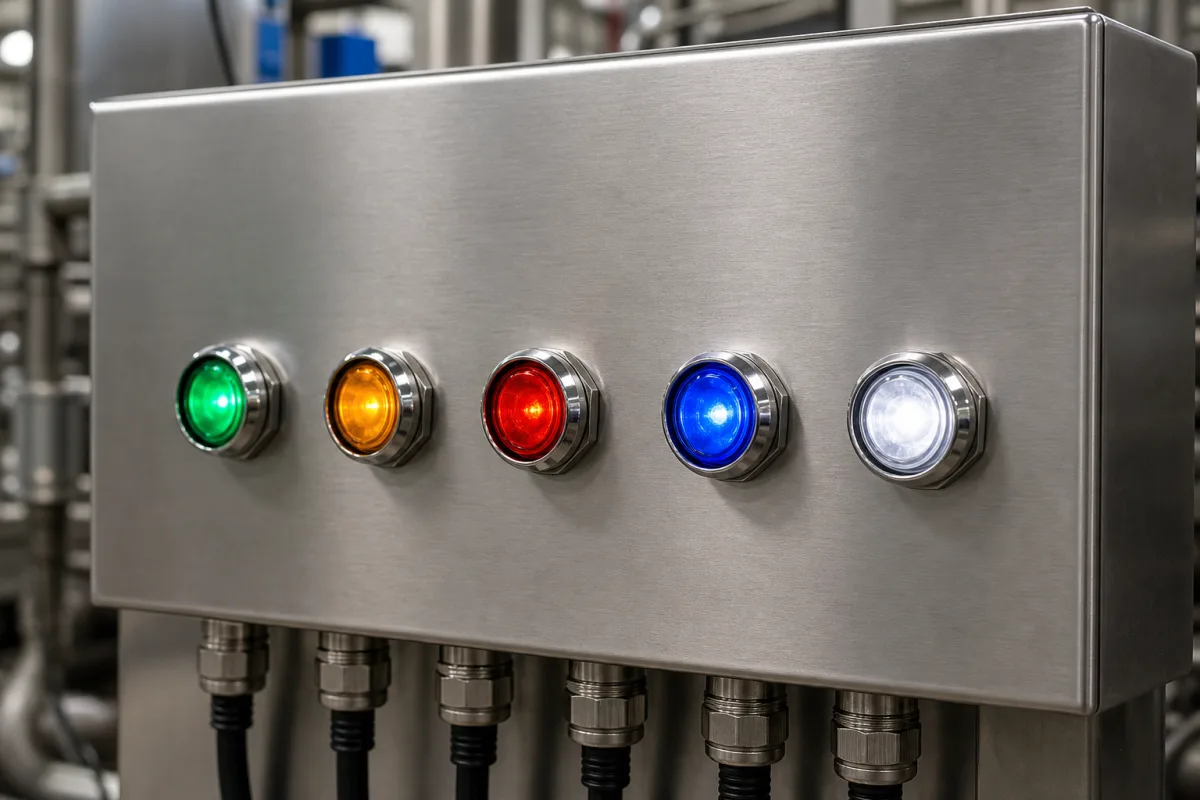
Visual signaling devices on control panels that display operational status, alerts, or system conditions.

Product Specifications

Technical details and manufacturing context for Indicator Lights

Definition
Indicator lights are essential visual components integrated into control panels across various industrial and electronic systems. They provide immediate, at-a-glance feedback about equipment status, process conditions, warnings, or faults. As part of a control panel, they enable operators to monitor system health, confirm command execution (e.g., power on, motor running), and identify issues requiring attention, thereby supporting safe and efficient operation.
Working Principle
Indicator lights operate by illuminating a light source (typically an LED, incandescent bulb, or neon lamp) when an electrical signal is received from the monitored circuit or control system. This signal is often triggered by a relay, sensor, or programmable logic controller (PLC) output. The light remains illuminated as long as the monitored condition is active, providing continuous visual indication.
Common Materials
LED (Light Emitting Diode), Polycarbonate or Acrylic Lens, ABS or Polyamide Housing, Copper Alloy Terminals
Technical Parameters
  • Lens diameter and panel cutout size (e.g., 22mm, 30mm). (mm) Customizable
Components / BOM
  • LED Module
    Emits light when powered.
    Material: Semiconductor (Gallium Arsenide, Gallium Phosphide)
  • Lens
    Diffuses and colors the light, provides protection.
    Material: Polycarbonate or Acrylic
  • Housing
    Mounts the light to the panel, contains terminals.
    Material: ABS Plastic or Polyamide
  • Terminals
    Electrical connection points.
    Material: Copper Alloy
Engineering Reasoning
2.0-5.0 VDC (LED forward voltage), 10-100 mA (current draw), -40°C to +85°C (ambient temperature)
LED junction temperature exceeding 125°C, forward current exceeding 150% of rated value (e.g., 150 mA for 100 mA rated LED), voltage transients exceeding ±20% of nominal voltage
Design Rationale: Thermal degradation of LED semiconductor junction due to excessive current density (Joule heating), electromigration in wire bonds at high temperatures, phosphor layer degradation above 85°C ambient temperature
Risk Mitigation (FMEA)
Trigger Voltage transient of 6.5 VDC (130% of 5V nominal) lasting >100 μs
Mode: LED catastrophic failure with open circuit, immediate loss of illumination
Strategy: Zener diode clamping at 5.6 VDC with 500 mW power rating, series current-limiting resistor sized for 120% of nominal current
Trigger Ambient temperature of 90°C sustained for >1000 hours
Mode: LED luminous flux degradation to <70% of initial output, color shift Δu'v' >0.007
Strategy: Thermal management with 15 K/W maximum thermal resistance path, derating current by 20% above 70°C ambient

Industry Taxonomies & Aliases

Commonly used trade names and technical identifiers for Indicator Lights.

Applied To / Applications

This component is essential for the following industrial systems and equipment:

Industrial Ecosystem & Supply Chain DNA

Complementary Systems
Downstream Applications
Specialized Tooling

Application Fit & Sizing Matrix

Operational Limits
pressure: Atmospheric (non-pressurized)
other spec: IP65/IP67 ingress protection rating
temperature: -40°C to +85°C
Media Compatibility
✓ Control panel enclosures ✓ Dry industrial environments ✓ Low-voltage electrical systems
Unsuitable: High-pressure washdown or submerged applications
Sizing Data Required
  • Panel cutout diameter (mm/inches)
  • Required voltage/current rating (V/A)
  • Mounting depth behind panel (mm/inches)

Reliability & Engineering Risk Analysis

Failure Mode & Root Cause
LED/Lamp Burnout
Cause: Excessive current, voltage spikes, or thermal stress from high ambient temperatures or poor heat dissipation, leading to semiconductor degradation or filament failure.
Intermittent Operation/Flickering
Cause: Loose electrical connections, solder joint fatigue due to vibration or thermal cycling, or failing power supply components (e.g., capacitors) causing unstable voltage.
Maintenance Indicators
  • Flickering or erratic illumination inconsistent with normal operation
  • Complete loss of illumination when the system indicates it should be active
Engineering Tips
  • Implement voltage regulation and surge protection in the power supply circuit to prevent electrical overstress on LEDs or lamps.
  • Use vibration-resistant mounting and conformal coating on PCBs to protect solder joints and connections from environmental stressors.

Compliance & Manufacturing Standards

Reference Standards
ISO 3864-1:2011 (Safety colours and safety signs) ANSI/UL 48:2019 (Electric Signs) DIN EN 60598-1:2015 (Luminaires - General requirements and tests)
Manufacturing Precision
  • Lens color chromaticity: +/- 0.01 CIE x,y coordinates
  • LED luminous intensity: +/- 15% of rated value
Quality Inspection
  • IP (Ingress Protection) rating test per IEC 60529
  • Photometric performance verification per IESNA LM-79

Factories Producing Indicator Lights

Verified manufacturers with capability to produce this product in China

✓ 92% Supplier Capability Match Found

S Sourcing Manager from United States Feb 17, 2026
★★★★★
"The Indicator Lights we sourced perfectly fits our Electrical Equipment Manufacturing production line requirements."
Technical Specifications Verified
P Procurement Specialist from United Arab Emirates Feb 14, 2026
★★★★☆
"Found 42+ suppliers for Indicator Lights on CNFX, but this spec remains the most cost-effective. (Delivery took slightly longer than expected, but technical support was excellent.)"
Technical Specifications Verified
T Technical Director from Australia Feb 11, 2026
★★★★★
"The technical documentation for this Indicator Lights is very thorough, especially regarding technical reliability."
Technical Specifications Verified
Verification Protocol

“Feedback is collected from verified sourcing managers during RFQ (Request for Quote) and factory evaluation processes on CNFX. These reports represent historical performance data and technical audit summaries from our B2B manufacturing network.”

5 sourcing managers are analyzing this specification now. Last inquiry for Indicator Lights from Germany (1h ago).

Supply Chain Compatible Machinery & Devices

Transformer Winding Machine

Industrial machine for winding copper wire onto transformer cores

Explore Specs →
Circuit Breaker Trip Unit

Protective control module for electrical circuit breakers

Explore Specs →
Circuit Breaker Arc Chute

Electrical component that extinguishes arcs in circuit breakers

Explore Specs →
Medium Voltage Switchgear Assembly Line

Automated production system for assembling medium voltage electrical switchgear.

Explore Specs →

Frequently Asked Questions

What are the main benefits of LED indicator lights for industrial control panels?

LED indicator lights offer superior energy efficiency, longer lifespan (typically 50,000+ hours), high brightness for clear visibility, and minimal heat generation compared to traditional incandescent bulbs, making them ideal for continuous operation in electrical equipment manufacturing.

How do I choose between polycarbonate and acrylic lenses for indicator lights?

Polycarbonate lenses provide higher impact resistance and better temperature tolerance (typically -40°C to 120°C), making them suitable for harsh industrial environments. Acrylic lenses offer excellent optical clarity and UV resistance at a lower cost, ideal for indoor applications with less physical stress.

What mounting options are available for panel indicator lights in electrical equipment?

Most industrial indicator lights feature standard panel-mount designs with snap-in or threaded nut installations, compatible with common panel cutouts (typically 22mm or 30mm). They include copper alloy terminals for secure wiring connections and come in various colors (red, green, amber, blue) for different status indications.

Can I contact factories directly on CNFX?

CNFX is an open directory, not a transaction platform. Each factory profile provides direct contact information and production details to help you initiate direct inquiries with Chinese suppliers.

Get Quote for Indicator Lights

Request technical pricing, lead times, or customized specifications for Indicator Lights directly from verified manufacturing units.

Your business information is encrypted and only shared with verified Indicator Lights suppliers.

Thank you! Your message has been sent. We'll respond within 1–3 business days.

Need to Manufacture Indicator Lights?

Connect with verified factories specializing in this product category

Add Your Factory Contact Us
Previous Product
IGBT Module
Next Product
Individual Capacitor Bank