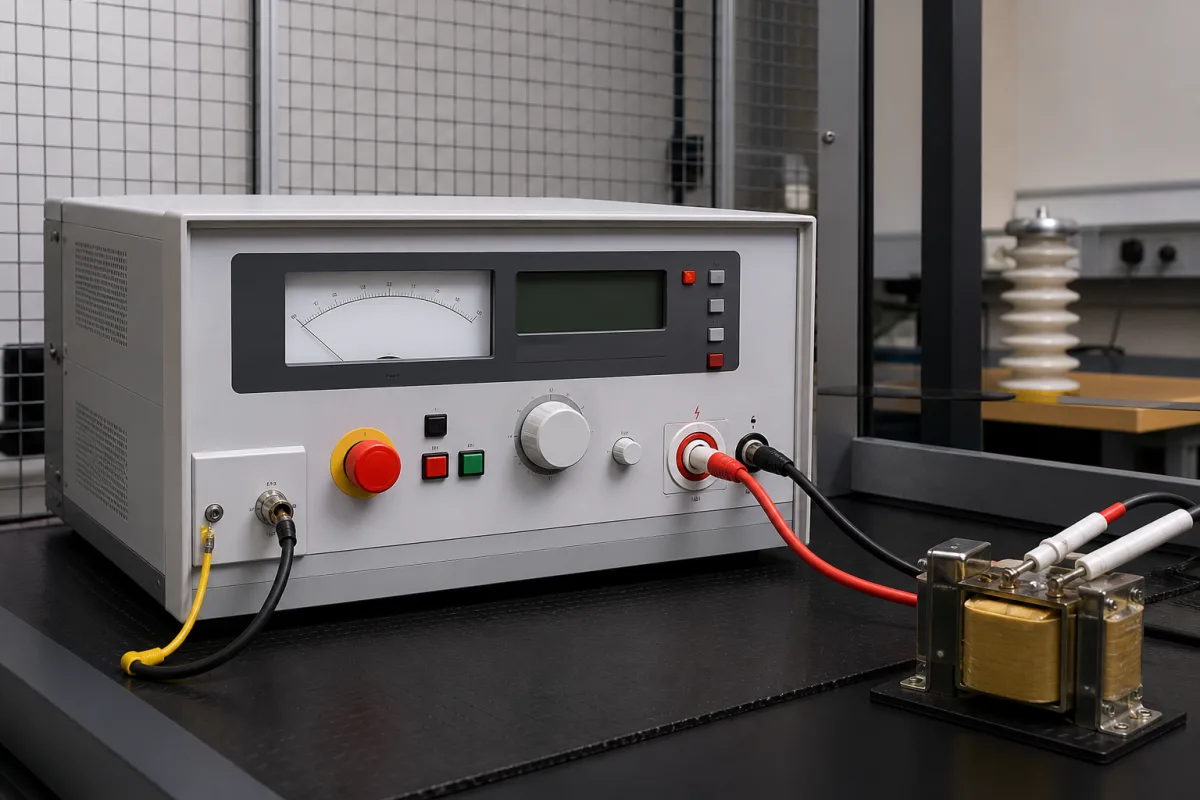
Hipot testers · Test voltage from working voltage, AC versus DC, test time and production shortcuts, leakage limits, tester capacity in VA
A dielectric strength (hipot) tester applies a high AC or DC voltage between parts that should be insulated from each other, such as a transformer's primary and secondary or a product's live parts and chassis, and fails the item if leakage current exceeds a set limit or breakdown occurs. Ask three things first: what test voltage, waveform and duration your product standard requires, what leakage current limit and capacity the tester needs for your load, and how operators are protected.
AC and DC hipot (dielectric withstand) testers and test systems for components, appliances and electrical equipment, including bench testers with insulation resistance functions. Field cable testers, transformer test benches and impulse generators are outside this page.
CNFX editorial research · Sources checked October 12, 2026 · 4 sources
Coilcraft's application note on hipot testing of magnetic components describes the hipot test as a dielectric withstand voltage test, applied between points meant to be isolated, that verifies insulation withstands more than the expected working voltage by a sufficient margin. It gives a general rule of thumb of twice the working voltage plus 1,000 V, 1,440 V for 220 V, and concludes: “Therefore, 1500 V is a common hipot test voltage”; test voltages must be set from the standards for the equipment type. [1]
It equates AC and DC test voltages by peak, Vdc = Vac(rms) × √2, and says “Test voltage duration is usually 60 seconds, however UL and other safety standards typically allow a duration of one or two seconds” for production-line testing if the voltage is raised by about 20%. Frequency, humidity, waveform, ramp time and duration can all affect results, so testing should be done with controlled humidity. [1] GW Instek notes that AC cannot charge a capacitive load so reactive current is constant, while DC charges it and causes an inrush that then decays. [2]
Editorial calculation: for 230 V working voltage the rule gives 2 × 230 + 1,000 = 1,460 V, so 1,500 V AC for 60 s; a 1–2 s production test at about 20% higher is roughly 1,800 V AC, and the DC equivalent of 1,500 V AC is about 2,120 V. Use your product standard's values where they differ.
A US federal rule shows how a product standard fixes these settings. The Consumer Product Safety Commission's requirements for electrically operated toys, 16 CFR 1505.6(e), require a toy to withstand without breakdown for 1 minute a 60 Hz, essentially sinusoidal 1,000 V applied between live parts and dead metal parts; where a toy has a low-voltage secondary winding, the test between high- and low-voltage windings is 1,000 V plus twice the rated voltage of the high-voltage winding. The voltage is raised rapidly and uniformly from zero and held for 1 minute, with the toy at its maximum operating temperature, and the rule allows 1,200 V for 1 second instead, in which case the toy need not be heated. The same section limits leakage current to 0.5 mA (2.5 mA for toys with heating elements other than lamps, from 5 seconds to 10 minutes after first energising) for toys supplied above 42.4 V peak, measured through a 1,500 Ω resistor at 110% of rated voltage before and after 48 hours' conditioning at 32 ± 2 °C and 90–95% relative humidity, followed by a repeated dielectric withstand test. [4]
Editorial calculation: 1,200 V is 20% above 1,000 V, the same production allowance Coilcraft describes for 1–2 s tests; for a 120 V toy transformer the winding-to-winding test is 1,000 + 2 × 120 = 1,240 V for 1 minute. A tester for this work needs an AC output to at least 1.24 kV at 60 Hz, a 1-second and a 60-second timer, and a ramp that can be set to rise from zero. [4][1]
Give the supplier the products and standards, test points, AC and/or DC test voltages, duration and ramp, leakage current limit, maximum load capacitance, insulation resistance and ground bond needs, fixtures and interlocks, automation and data recording, and power supply.
02
Set the leakage limit and size the tester
Coilcraft defines a hipot failure as leakage current exceeding a specified limit, rising rapidly out of control, or visible arcing, and says “Typical leakage current limits range from 0.5 to 20 mA”. For its transformers with functional insulation Coilcraft says “the hipot test is typically 1500 Vrms for one minute duration for primary winding to secondary winding isolation”, i.e. primary to secondary at 1,500 Vrms for one minute at 50 or 60 Hz, and winding to core at a lower voltage such as 500 Vrms. [1]
GW Instek distinguishes the insulation resistance test, a DC test at or below the rated voltage, from the hipot test, which stresses insulation beyond normal ratings with AC or DC. It rates a tester's capacity as maximum AC output voltage times maximum AC current, for example 5,000 V × 40 mA = 200 VA, and suggests checking the applicable standard before using the informal 2 × V + 1,000 V rule. [2]
Editorial calculation: testing at 1,500 V with a 20 mA trip limit needs at least 1,500 × 0.02 = 30 VA; capacitive loads draw reactive current under AC, so check the expected current of your product against the tester's maximum before choosing a model. [2]
GW Instek's product page for its GPT-9900 series shows how a bench safety tester is rated: a 500 VA output platform with AC withstanding to 5 kV at 100 mA, DC withstanding to 6 kV at 20 mA, insulation resistance at DC 50–1,000 V up to 50 GΩ, and ground bond to AC 32 A and 650 mΩ, with short-circuit current above 200 mA. It lists 1 µA current resolution and 2 V voltage setting resolution, adjustable test duration, ramp-up time and upper and lower limits, zero-crossing turn-on, RMS current measurement, a safety interlock and up to 100 stored test steps. [3]
Editorial calculation: 5 kV × 100 mA = 500 VA, matching the stated platform; at the earlier example of 1,500 V and 20 mA (30 VA) such a tester has about 16 times the capacity needed, while a 200 VA tester at 5 kV would be limited to 40 mA. [3]
03
AC withstand test systems from the listed maker
Sansion Power lists high-voltage AC dielectric withstand test systems; ask whether DC withstand and insulation resistance functions are included, as they are on the GW Instek GPT-9900 used as the example here. [3]
Listings include high-voltage AC dielectric withstand test systems alongside transformer and circuit breaker test equipment.
04
High-voltage source, leakage measurement, VA capacity and interlocks
Output capacity is voltage times current: GW Instek's GPT-9900 platform is rated 500 VA, from 5 kV × 100 mA. [2][3]
Protect operators; safety interlock input on one tester. [3]
Enclosure and interlocks.
05
Test voltage, ramp, leakage trip, duration and IR range for a hipot tester
Start from your product standard's test voltage: Coilcraft's rule of thumb (2 × working voltage + 1,000 V) gives 1,440 V for 220 V equipment, and the CPSC toy rule 16 CFR 1505.6 is one standard that sets its own dielectric and leakage values. [1][4]
Field
What it means and published values
Ask the supplier for
Maximum test voltage (kV)
Rule of thumb 2 × V + 1,000 V; e.g. AC 5 kV, DC 6 kV on one tester. [1][3]
AC and DC maximum.
Voltage ramp rate (kV/s)
Ramp time affects results; adjustable ramp-up on one tester. [1][3]
Ramp settings.
Test current limit (mA)
Coilcraft: “Typical leakage current limits range from 0.5 to 20 mA”; e.g. AC 100 mA, DC 20 mA maximum. [1][3]
1 company lists this product among what they make. Company figures are quoted from each
company's own website; every card states where the relationship came from.
Sansion Power Electric Co., Ltd.
Manufacturing site to be confirmed for the order
Lists high-voltage AC dielectric withstand test systems.
Explore company information and manufacturing capabilities, then discuss the scope of your project with a relevant supplier.
Share this page
Compiled and source-reviewed by the CNFX editorial team.
Each manufacturer above links to the page on that company's own website where the product is listed, with the date we checked it. How we source and review
· Page last updated 13 October 2026
Buyer questions
What voltage should a hipot test use?
Follow your product standard; Coilcraft's rule of thumb is twice the working voltage plus 1,000 V, which gives 1,440 V for 220 V, and it settles on 1,500 V as the test level. [1]
How are AC and DC hipot voltages related?
By peak: Vdc = Vac(rms) × √2, so 2 kV AC corresponds to about 2.83 kV DC. [1][2]
How long is a hipot test?
Coilcraft says duration “is usually 60 seconds”; it adds that UL and other standards allow 1–2 s in production if the voltage is raised by about 20%. [1]
What output does a bench hipot tester need?
Multiply test voltage by trip current: one 500 VA tester gives AC 5 kV at 100 mA and DC 6 kV at 20 mA. [3]
What dielectric strength test does US law set for electric toys?
16 CFR 1505.6 requires 1,000 V at 60 Hz for 1 minute between live and dead metal parts, or 1,200 V for 1 second, and leakage current of no more than 0.5 mA. [4]
Sources and what still needs a direct check
Sources checked 2026-10-12. Coilcraft is a magnetics maker explaining hipot testing of its own components; GW Instek is a test-instrument maker. Product standards set the actual test values. The US CPSC rule for electrically operated toys (16 CFR 1505.6) is one example of a product standard's dielectric and leakage values.