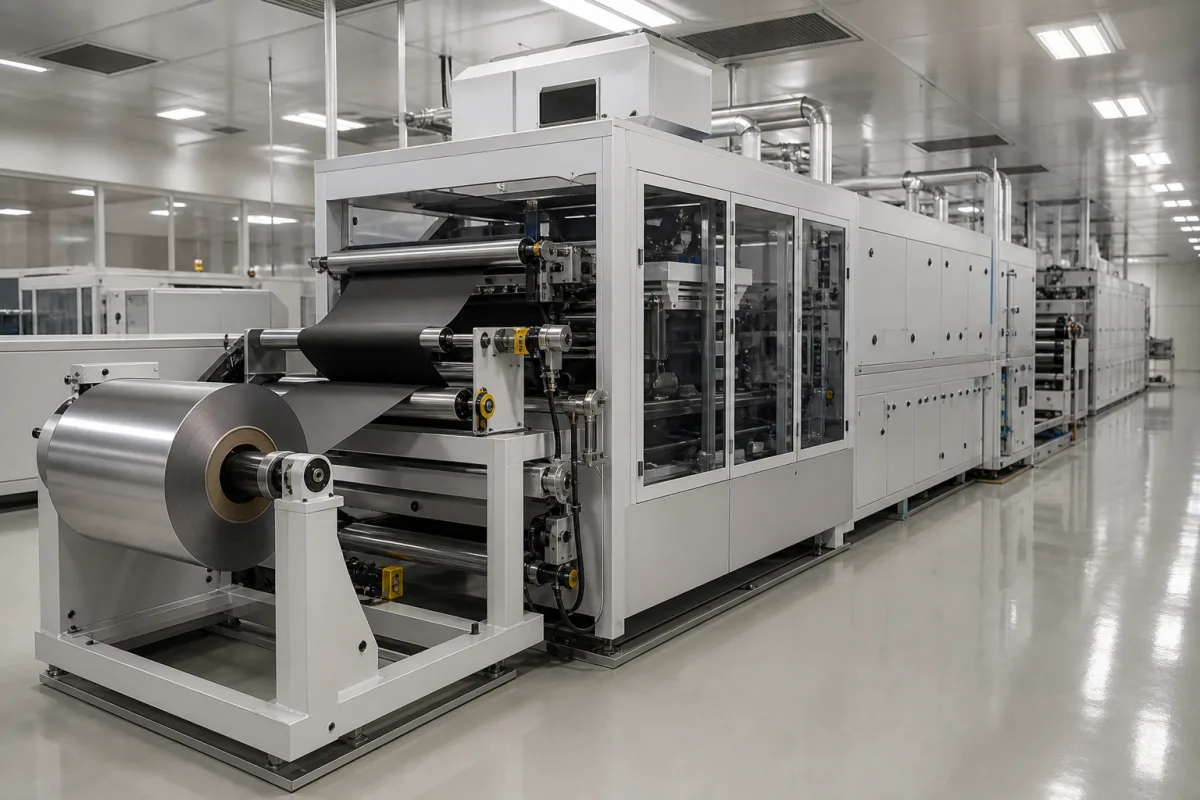
Wet electrode coating lines: web path, drying quality and measurement boundary
A wet electrode coating line handles current-collector foil, applies slurry and dries the coated web before downstream processing. Its width, coating mode, dryer and metrology must support the specified electrode; line speed alone does not establish drying completion, adhesion or annual battery output.
Roll-to-roll coating lines for lithium-ion battery electrodes: unwind and rewind, slot-die or comma-bar coating heads, dryers and integrated solvent recovery, from R&D to mass production. Slurry mixers, calenders, slitting machines (see battery electrode slitting machine) and dry-electrode processes are outside this page except where integrated.
CNFX editorial research · Sources checked October 18, 2026 · 4 sources
Identify the coating sides and the output-rating basis
The dated Dürr MEGTEC brochure distinguishes a second coating pass from simultaneous two-sided coating, with backing-roll and tensioned-web arrangements assigned by line and side. Specify the delivered web path, coating lanes and continuous/intermittent pattern; double-sided coating does not by itself identify one architecture. [1]
Its range table labels a capacity row “MW/a”. That printed heading is retained as source wording, not silently converted into an energy-output unit or used to calculate annual cell production. Ask the supplier to confirm the intended unit and the operating hours, electrode loading, cell design, utilisation and yield behind a production rating. [1]
The 2025 Hallemans review separates product properties such as coat weight, thickness, porosity and binder distribution from process settings such as web speed, coating slot and dryer temperatures. Specify the electrode acceptance properties as well as the requested equipment settings. [2]
02
Separate web transit time from drying performance
The Dürr GigaCoater column lists 40 m/min speed and a 40–48 m flotation dryer. These are the named brochure configuration’s entries, not a generic dryer-sizing rule for every slurry or coating weight. [1]
Editorial calculation: assuming 40–48 m is the effective coated-web path and the web moves continuously at 40 m/min without stops, path length divided by speed gives 60–72 s of transit. This is not manufacturer-published drying-completion time or measured production data. The required residual solvent, adhesion and binder distribution still need validation on the actual electrode. [1]
The brochure separately describes solvent-recovery and purification equipment. Define which exhaust streams are included, how recovery is measured, and the required outlet and recovered-solvent quality; a recovery percentage alone does not establish emissions compliance or suitability for reuse. [1]
03
Require coating adhesion evidence at the proposed drying conditions
Toyota’s historical electrode-manufacturing patent describes migration of binder away from the collector interface during rapid drying and proposes a particular interface-treatment arrangement. It identifies a drying/adhesion trade-off; it is not proof that an arbitrary coater includes the patented arrangement or obtains the same peel strength. [3]
Keep the proposed drying zone profile and the slurry/coating design with measured adhesion and residual-solvent results. A matching catalogue web speed from another maker is not evidence that two different coating and drying processes are equivalent. [3][2]
04
Confirm the offered line rather than transferring another maker’s data
The reviewed Xinyuren catalogue lists single-sided extrusion coating and a double-sided A/B fold-back arrangement without intermediate single-side rewinding. That offering must be identified on its own drawing and configuration. Dürr’s simultaneous-coating descriptions and specifications cannot be assigned to a different supplier’s line. [1]
Request the selected supplier’s process layout, coating head and support method for each side, dryer path, solvent system and acceptance trial. Identify which unwind/rewind, recovery, gauges and downstream stages are included. [1]
05
Keep batch-drying experiments separate from line-length calculations
Kumberg and colleagues studied specific water-based graphite anodes and simultaneous multilayer formulations. Their experimental section describes a batch impingement dryer with the foil held on a temperature-controlled plate, including motion under the nozzle array. This is not an industrial continuous flotation-dryer acceptance test. [4]
The study compares drying rates of 0.5 and 5 g·m⁻²·s⁻¹ and reports drying times of 134 and 14 s in the described comparison. Layer formulation and adhesion/electrochemical results remain part of that experiment. These times do not directly specify a production dryer for an unrelated slurry, loading and line. [4]
No dryer length is calculated by multiplying those laboratory times by another manufacturer’s web speed. Require drying and quality evidence for the actual coated electrode and continuous-line configuration. [4][1]
06
Distinguish the measured quantity from the instrument
The Hallemans review discusses laser thickness measurement, radiation methods for weight measurement and imaging or other sensing approaches. These measure different properties; a thickness reading does not directly establish coating mass, porosity or binder distribution without the appropriate model and calibration. [2]
Define the gauge’s measurand, calibration, foil/background contribution, cross-web sampling and how results feed the line control. The review distinguishes installed/proposed process sensing from laboratory characterization; not every listed technique is an included industrial inline instrument. [2]
07
Specify the electrode and the commissioned acceptance trial
Give the selected supplier the electrode chemistry/solvent, collector foil, coating width and lane/pattern, wet/dry loading, side arrangement and required quality. Obtain the proposed web path, dryer and solvent interfaces, controls and metrology with the delivered equipment scope. [1][2]
Agree the measured coat-weight/thickness distribution, adhesion, residual solvent and operating trial conditions. Separate catalogue speed, ideal transit arithmetic, laboratory drying studies and actual accepted production results in the guarantee. [2][4]
08
Send the electrode, scale and utility data together
Paste it into your enquiry below or into an email to a maker, then replace every bracket.
1 company lists this product among what they make. Company figures are quoted from each
company's own website; every card states where the relationship came from.
Shenzhen Xinyuren Technology Co., Ltd.
TBC
Official catalogue lists single-sided extrusion coaters and A/B fold-back double-sided coaters for lithium-ion electrodes. Confirm the exact web path, included dryer/recovery/gauges and acceptance results on the intended electrode.
Explore company information and manufacturing capabilities, then discuss the scope of your project with a relevant supplier.
Share this page
Compiled and source-reviewed by the CNFX editorial team.
Each manufacturer above links to the page on that company's own website where the product is listed, with the date we checked it. How we source and review
· Page last updated 13 October 2026
Buyer questions
Does path length divided by web speed prove an electrode is dry?
No. The calculation gives ideal transit under stated continuous-motion and effective-path assumptions. Drying completion and electrode quality require separate validation. [1]
Can a batch-drying paper determine the length of another supplier’s production dryer?
No. Keep its formulation, loading and batch heat/mass-transfer conditions with the experiment. Do not combine its drying times with an unrelated catalogue speed to specify a production line. [4][1]
Is the brochure’s MW/a row an unambiguous annual energy-production guarantee?
The row is labelled “MW/a”. Confirm the intended unit and production assumptions with the supplier; it is not converted here into another output unit or guaranteed cell production. [1]
Sources and evidence scope
Sources checked 2026-10-18. A dated original line brochure, a 2025 process-control review, a historical Toyota patent and the KIT multilayer-drying study. Their equipment and experiment boundaries remain separate; no cross-source production dryer or annual output is calculated.