This page explains how Lithium-Ion Battery Module Assembly and Testing System is classified within Manufacture of Batteries and Accumulators. Technical values and manufacturer relationships are research references; confirm the current specification and supplier evidence for each order.
Integrated production line for assembling battery cells into modules with comprehensive testing
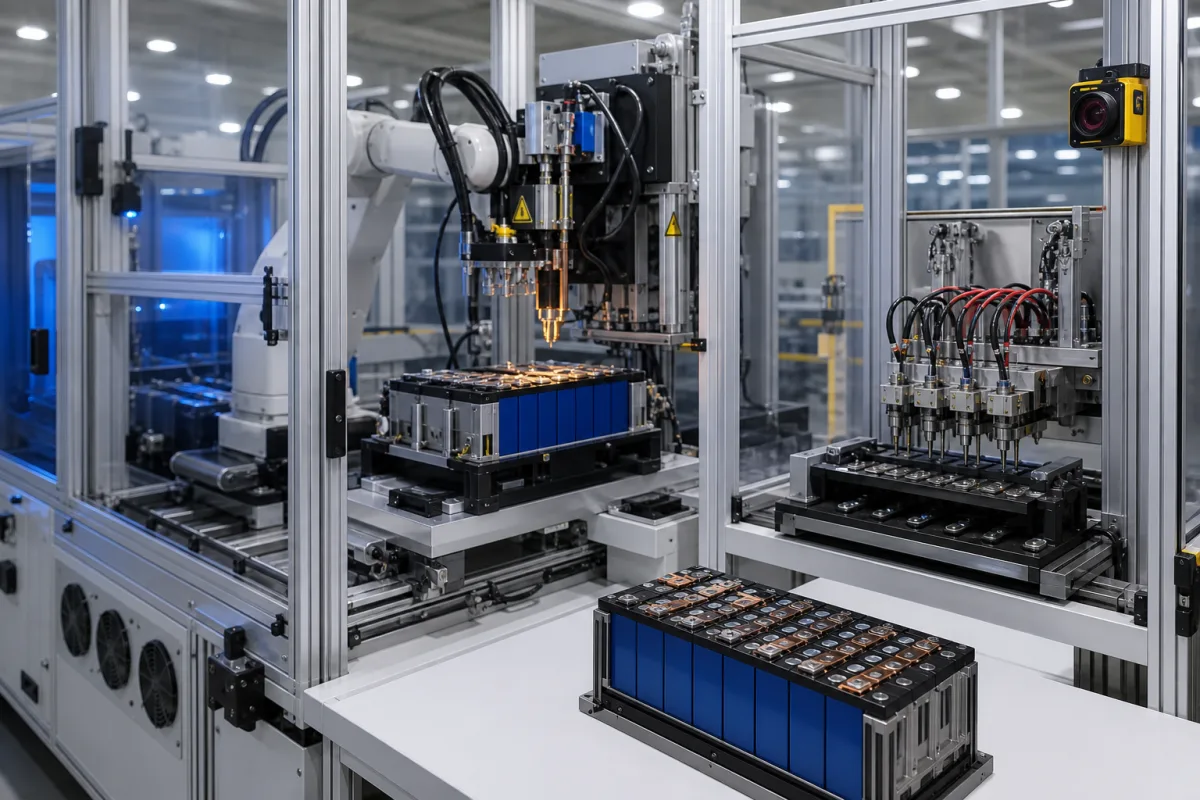
Technical details and manufacturing context for Lithium-Ion Battery Module Assembly and Testing System
| Parameter | Typical range | Notes & selection driver |
|---|---|---|
| Production RateRequired | 10–20 modules/hour | Maximum sustainable assembly output |
| Cell Compatibility RangeRequired | 18650–4680 mm | Supported cell dimensions (length x width x height) |
| System Power ConsumptionRequired | 45–75 kW | Average electrical power requirement during operation |
| Floor Space RequirementRequired | 300–500 m² | Minimum installation area including safety zones |
| Voltage Testing AccuracyRequired | ±0.05 % | Precision of electrical parameter measurement |
| Cycle TimeRequired | 3–6 seconds | Average time per module assembly cycle |
| Operating Temperature Range | 15–35 °C | Recommended ambient for stable testing |
| Relative Humidity Range | 30–70 % RH | Non-condensing environment required |
| IP Rating | IP54–IP65 | Protection against dust and water jetsIEC 60529 |
| Module Assembly Tolerance | ±0.1 mm | Positioning accuracy for busbar welding |
| Insulation Resistance Test Voltage | 500–1000 V DC | Applied between HV and groundIEC 62660-3 |
| System Weight | 15000–25000 kg | Total line weight including conveyors |
Ranges are indicative industry figures for RFQ preparation, not a supplier commitment. Confirm every value and standard with the legal manufacturer before ordering.
Commonly used trade names and technical identifiers for Lithium-Ion Battery Module Assembly and Testing System.
| pressure: | Atmospheric to 1.5 bar (assembly pressure), 0-10 bar (testing pressure) |
| other spec: | Humidity: 30-60% RH, Cleanroom Class: ISO 7 or better, Power: 380-480V 3-phase, 50/60Hz |
| temperature: | 15-30°C (operating environment), 0-50°C (storage) |
Indicative industry ranges for design and RFQ preparation. Confirm the exact figures and applicable standard with the manufacturer before specifying.
Quoted from the published standard.
Manufacturer profiles associated with Lithium-Ion Battery Module Assembly and Testing System.
Manufacturer listings support early research and capability understanding. They are not certification, ranking, or transaction guarantees.
A practical evidence checklist for RFQ preparation and supplier evaluation.
CNFX does not score or rank suppliers. Buyers must verify all claims and documents with the legal manufacturer before ordering.
The system is designed for a production rate of 10–20 modules per hour, depending on cell type and module configuration. This is a reference range; the actual rate must be confirmed with the manufacturer for specific setups.
The system supports cell dimensions ranging from 18650 to 4680 mm (length x width x height). This covers common cylindrical formats, but compatibility for specific cell sizes should be verified with the supplier.
The system includes testing stations for electrical performance, insulation resistance, and thermal management validation. Insulation resistance is tested at 500–1000 V DC per IEC 62660-3. Voltage testing accuracy is ±0.05%.
The system requires a floor space of 300–500 m² including safety zones, and operates in ambient temperatures of 15–35 °C with relative humidity 30–70% RH. The total system weight is 15000–25000 kg. These are reference values; consult the manufacturer for detailed installation guidelines.
Editorial classification, named public sources where available, and source-reviewed manufacturer records.
Ask for use case, specification boundaries, supplier type, and RFQ preparation information for this product.
Compare manufacturer profiles with relevant product and process capability.