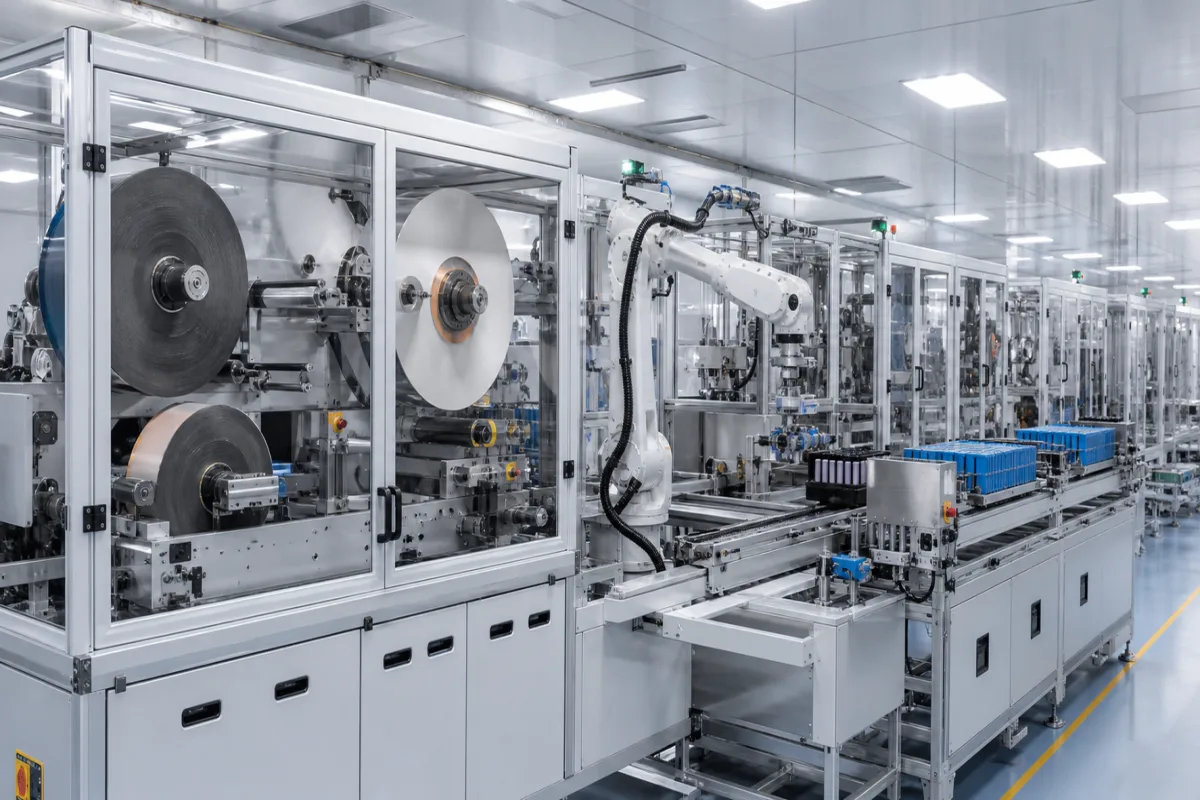
Cylindrical lithium-ion cell assembly line: from wound jelly roll to a grooved and crimp-sealed can
Cylindrical-cell assembly after the electrodes are made · jelly-roll winding, can insertion and tab welding, groove rolling, then crimp sealing of the cap, with rates counted in cells per minute
A cylindrical cell assembly line starts where electrode making stops. Coated, calendered and slit cathode and anode strips are wound with separator into a jelly roll, the roll goes into a can, its tabs are welded to the can bottom and to the cap, a ring groove is rolled near the open end, electrolyte is filled, and the rim is crimped over a gasketed cap. Line output is quoted in pieces per minute (PPM), and each machine is specified for a range of cell diameters and heights.
Assembly lines and their stations for cylindrical lithium-ion cells (18650, 21700, 46-series and similar): winders that form the jelly roll, can insertion and tab or bottom welding, groove rolling and crimp sealing, including lab-scale groovers and crimpers. Roll-to-roll electrode coating lines are covered on the Lithium-ion battery electrode coating machine page; Z-fold and sheet stacking for pouch and prismatic cells on the Electrode stacking machine for lithium-ion cells page; electrolyte dosing on the Electrolyte filling systems page; post-formation grading on the Battery cell sorting station page; electrode slitting on the Battery electrode slitting machine page, with its tension control on the Tension control system for lithium-ion battery electrode slitting and rewinding page; and electrolyte degassing on the Vacuum degassing chamber for lithium-ion battery electrolyte page. Module and pack assembly is outside this page.
CNFX editorial research · Sources checked October 12, 2026 · 4 sources
40 PPM at the 21700 winder, 260 PPM or more on a 4695 assembly line
Yinghe Technology's YHRCW-18/21-3 winder takes cells of φ18 to φ21 mm diameter and 40 to 70 mm height, with a winding pin hole of φ3.0 to φ4.2 mm and up to 4 tabs, and lists 40 PPM on 21700 cells with a qualification rate of 99.8% or more. In one machine it unwinds and edge-guides the cathode and anode strips, ultrasonically welds and tapes them, checks the surface by CCD, winds them with separator, then cuts, applies terminal tape, measures the diameter and runs a short-circuit test before loading the rolls into trays. [1]
Downstream, the same maker's YLZ150F-AAA line for 4695 cells (46 mm diameter, 80 to 150 mm height) quotes 260 PPM or more for a single line, a yield of 99.5% or more and a failure rate of 2% or less, in an envelope of 70,000 × 10,000 × 3,000 mm. Cells move between stations on magnetic-levitation carriers at up to 2 m/s; the can-insertion and pole penetration welding machine uses a turret rated up to 280 PPM, and the pole is laser-welded on the fly with laser utilisation over 80%. Yinghe adds that capacity varies with product size and process. [2]
Editorial calculation: 260 PPM × 60 = 15,600 cells per hour at the rated line speed; 40 PPM × 60 = 2,400 jelly rolls per hour from one winder. The two figures are for different formats (4695 against 21700), so they do not say how many winders a 4695 line needs; ask for the winder rate at your own cell size before sizing the winding stage.
Editorial calculation: the 4695 line occupies 70 m × 10 m = 700 m² of floor, before dry-room margins and access aisles. [2]
Give the cell format (diameter, height, tab design), target PPM per line, yield and failure-rate targets, and which stations the supplier includes (winding, insertion, welding, grooving, filling, sealing); ask for the slowest station's rate at your format.
02
Rolling the ring groove that seats the cap, and why the groove wall must stay thick
Panasonic's US 2009/0151863 describes the step between can filling and sealing: a ring-shaped groove is rolled into the can near its opening, the sealing plate sits on the ledge the groove forms inside the can, a gasket insulates it, and the rim is crimped inward. The positive lead from the wound electrode group is welded to the sealing plate before sealing. [3]
The patent's groover spins the can on a core fitted into its opening while a groove-forming roller is pushed in. A receiving die under the can is pushed up in step with the roller so that the thinnest part of the finished groove keeps 80% or more of the can's wall thickness, preventing the upper lip of the groove from thinning. Large-diameter cans are driven from the core side so that rotation at high speed, about 4,500 rpm in the example, does not twist or buckle them. [3]
Panasonic's point is changeover: earlier groovers handled one can diameter each, so every cell size needed its own machine. Adjusting the can's rotational speed with its diameter keeps the roller's push-in per unit of perimeter and time approximately constant, so one groover serves different can sizes while the tact time stays approximately the same. [3]
On the lab scale the same order applies. MTI's MSK-510M hydraulic crimper presses up to 5 t (gauge 0 to 3,500 psi, 0 to 250 kg/cm²) with a separate die set per format (CR123, 18650, 21700, 26650, 32650, AA, AAA); since October 2021 its 18650 and 21700 dies crimp in two steps, the second giving a wrinkle-free seal on a properly grooved case, and MTI states the case must first be grooved on its MSK-500 grooving machine. [4]
Ask for the groove depth and minimum groove wall thickness the groover holds on your can material and thickness, how format changeover works (core, roller, dies), and seal test results on crimped cells.
03
Stations between the jelly roll and the sealed can
Station
Published detail
Fix with the supplier
Winder
Unwind, edge guide, ultrasonic tab welding, taping, CCD check, winding with separator, diameter and short-circuit test; 40 PPM on 21700 [1]
Format range, tab count, pin hole size, PPM at your format
Can insertion and pole welding
Turret machine rated up to 280 PPM; on-the-fly laser welding of the pole [2]
Explore company information and manufacturing capabilities, then discuss the scope of your project with a relevant supplier.
Share this page
Compiled and source-reviewed by the CNFX editorial team.
Each manufacturer above links to the page on that company's own website where the product is listed, with the date we checked it. How we source and review
· Page last updated 13 October 2026
Buyer questions
How fast does a cylindrical cell winder run?
Yinghe lists its YHRCW-18/21-3 winder at 40 PPM on 21700 cells with a qualification rate of 99.8% or more. [1]
What output does a 4695 cylindrical assembly line reach?
Yinghe quotes 260 PPM or more for a single YLZ150F-AAA line with yield of 99.5% or more, in a 70 m × 10 m × 3 m envelope, noting capacity varies with product and process. [2]
Why is the can grooved before sealing?
The rolled groove forms an inner ledge for the gasketed cap; Panasonic's patent keeps the groove's thinnest wall at 80% or more of the can wall, and MTI requires grooving before its crimper can seal. [3][4]
Sources and what still needs a direct check
Sources checked 2026-10-12. Yinghe Technology's product pages give its own rated speeds and formats; Panasonic's patent application explains the grooving step from the cell maker's side; MTI's crimper page shows the lab-scale equivalent.