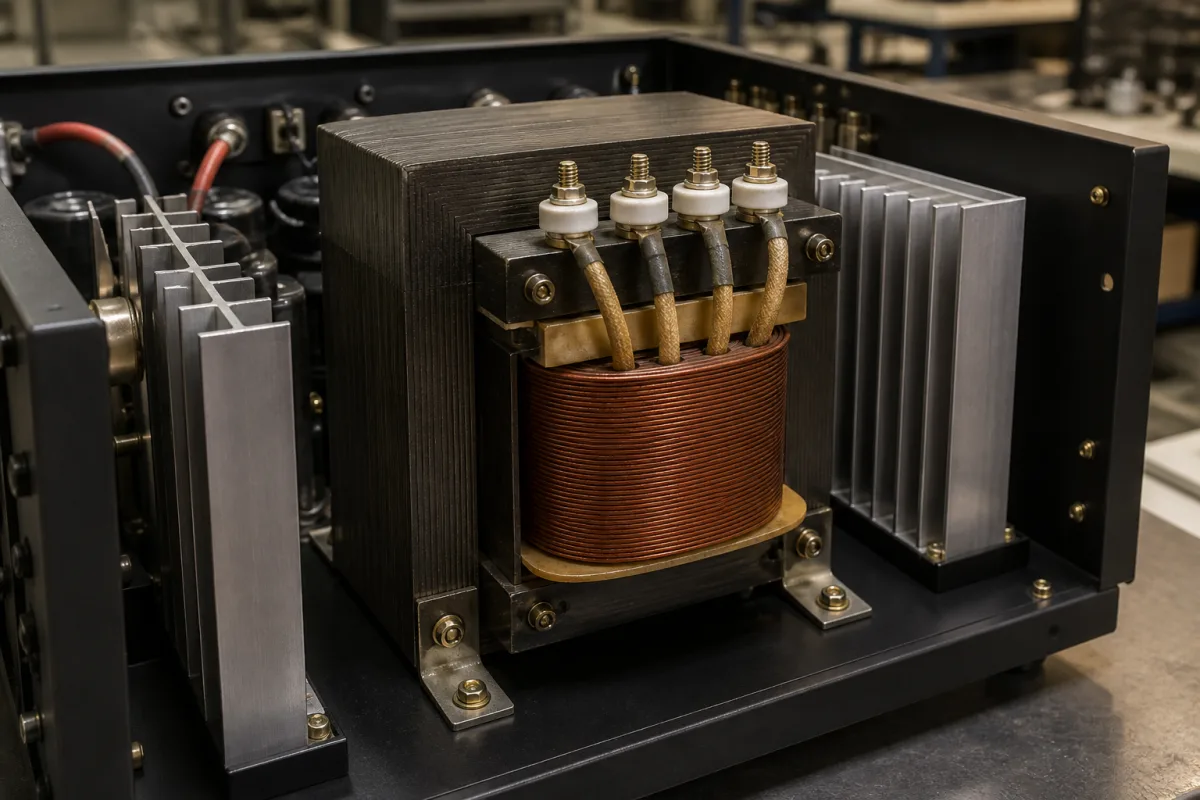
Audio output transformers for tube (valve) power amplifiers · primary (plate-to-plate) and secondary impedances, power rating, frequency response at full power, distortion, single-ended vs push-pull, ultra-linear taps, core lamination, hi-pot rating, temperature
An output transformer sits between a power amplifier's output stage — here, tube (valve) amplifiers — and the loudspeaker, matching the amplifier's high output impedance to the speaker's low impedance while isolating the speaker from the high-voltage circuit. Ask three things first: the primary impedance your output tubes need and the speaker impedances to drive; the power and frequency response at full power; and whether the stage is single-ended or push-pull, which changes the core design.
Audio output transformers for tube power amplifiers — single-ended and push-pull, hi-fi, guitar-amplifier and general-purpose types, with ultra-linear taps — including replacement units. Power and mains transformers (see power transformer), line and microphone audio transformers, isolation transformers, solid-state amplifier output networks and loudspeakers are outside this page except where compared.
CNFX editorial research · Sources checked October 12, 2026 · 4 sources
Hammond's 1750X, a replacement output transformer for a tube guitar amplifier, shows a typical specification: input (primary) impedance 1,700 Ω, output (secondary) impedances of 4, 8 and 16 Ω, 100 W output power, frequency response of 50 Hz–12 kHz (0/−1 dB referred to 1 kHz), distortion under 1% at 50 Hz, primary DC resistance of about 16–33 Ω, dielectric strength of 2,500 V RMS, and a temperature range of −40 to 105 °C. [2] DigiKey's overview of Hammond's range adds that its single-ended and push-pull hi-fi units are designed for triode or pentode operation with a 40% screen tap for ultra-linear use, at ratings stated at full power and rated plate current, and that the range runs from about 3 to 280 W. [1]
Editorial calculation: an ideal transformer's turns ratio is the square root of its impedance ratio, so the 1750X's 1,700 Ω primary into 8 Ω implies about 14.6:1, into 16 Ω about 10.3:1 and into 4 Ω about 20.6:1 — which is why each secondary tap suits only its rated speaker impedance. [2]
Give the supplier the amplifier topology (single-ended or push-pull), output tubes and their recommended load (primary impedance, plate-to-plate for push-pull), plate current and any DC in the primary, secondary impedances, power, frequency response required at full power, distortion target, ultra-linear tap need, mounting and shielding, dimensions, insulation test voltage, operating temperature, and quantity.
02
Compare frequency response, core and construction
The DigiKey overview stresses that Hammond's specifications are at full output power with −1 dB roll-off points, and warns that some makers quote frequency response at milliwatt levels, which inflates the figures — so response claims should be compared at full power. Hammond units are hi-pot tested at 2,000 V RMS; use EI laminations rather than toroidal cores, described as less able to handle tube imbalance; use M6 grain-oriented silicon steel for low loss and low bass distortion; set a factory core gap in single-ended units to avoid saturation at full rating; and use interleaved primary and secondary windings to extend high-frequency response. Its single-ended hi-fi line is rated at least 20 Hz–20 kHz at full power (±1 dB), with enclosed, shielded mounting. [1]
Editorial note: ask each supplier for frequency response and distortion measured at full rated power with the reference level stated, and for the core material and gap, so that quotes can be compared on the same basis.
03
Compare what suppliers offer
No manufacturer record has been reviewed for this product yet.
When requesting quotations, ask each supplier for impedance and power ratings, full-power response and distortion data, core material, hi-pot test voltage, mounting drawings and samples.
04
Ask for primary inductance, leakage inductance and winding resistance
Hammond's datasheet for its 1650N push-pull ultra-linear output transformer goes beyond impedance and power. For a 4300 Ω input impedance, 4, 8 and 16 Ω outputs and 60 W, it lists a primary inductance of 134 H with an impedance of 59 kΩ (measured at 60 Hz, 10.0 V open circuit), a primary leakage inductance of 7.72 mH (60 Hz, 10.0 V short circuit), primary DC resistance of 82.5 Ω and secondary DC resistances of 0.230 Ω and 0.370 Ω and a dielectric strength of 2000 Vrms. Its frequency response is 30 Hz to 30 kHz at full rated power, within ±1 dB referred to 1 kHz. [3]
The datasheet warns that, because of the interleaved windings, both secondary windings must be connected to meet specification, and that tube operating mode (push-pull, push-pull parallel, ultra-linear, class, B+, bias) changes the optimum plate-to-plate load, so tube makers' data sheets should be consulted first. It also names the instruments used and states that the results are typical, subject to normal manufacturing and electrical tolerances. [3]
Editorial calculation: the 59 kΩ primary impedance at 60 Hz is about 59,000 / 4300 ≈ 13.7 times the 4300 Ω rated load, and the 82.5 Ω primary resistance is about 82.5 / 4300 ≈ 1.9% of it. Editorial note: request these inductance and resistance values, with their test conditions, from every supplier so quotes can be compared on the same electrical basis, not on rated power alone.
05
Ask how and at what voltage the primary inductance was measured
Lundahl, a transformer maker, explains why buyers who check an output transformer with an LCR meter read a much lower primary inductance than the datasheet: "the core permeability is nonlinear", so a low test level puts the core far from its working point. Lundahl measures primary inductance at 50 Hz, with the primary windings in series, at the transformer's normal working voltage, using a variac and L = V ÷ (2πfI). Its note compares five methods on its LL1663/PP transformer. [4]
Hammond's 1650N datasheet on this page lists a primary inductance of 134 H "measured at 60 Hz, 10.0 V open circuit" [3]. Lundahl's table shows how far the result moves with test voltage on its own transformer [4], so two makers' inductance figures can only be compared when the frequency and voltage are stated. Ask each supplier for the test frequency, voltage and winding connection behind its primary inductance figure.
Lundahl notes that driving the low-voltage secondary from a signal generator and multiplying by the turns ratio squared gives a result close to the variac method while staying electrically safe, and that this works for output transformers but not for chokes [4]. The DigiKey overview warns in the same spirit that frequency response quoted at milliwatt levels flatters a transformer and should be compared at full power [1].
Editorial calculation: on Lundahl's figures the variac result (168 H) is about 4.6 times the primary-side LCR reading (36.8 H); at 50 Hz, 168 H is a reactance of about 52.8 kΩ (2π × 50 × 168). [4]
Method on Lundahl LL1663/PP
Stimulus
Measured primary inductance
LCR meter, Lp mode on primary
0.6 V, 100 Hz
36.8 H
LCR meter on secondary × N²
0.6 V, 100 Hz
102.8 H
Signal generator on primary, V and I
10 V, 50 Hz
118 H
Signal generator on secondary × N²
7.9 V, 50 Hz
167 H
Signal generator with 47 kΩ series resistor, phase
90 V, 50 Hz
135 H
Variac on primary, V and I
230 V, 50 Hz
168 H
Values are from Lundahl's application note on measuring primary inductance (text extracted from the PDF); the method uses mains voltage and the note warns of electric shock risk.
06
Trace the transformer
This is a functional reference built from the sources cited; it is not one maker's design.
Fill the specification fields with values for your project
An output transformer quotation needs values for your project. The table explains each field, gives published values where a reviewed source states them, and says what to obtain from the supplier.
Explore company information and manufacturing capabilities, then discuss the scope of your project with a relevant supplier.
Share this page
Compiled and source-reviewed by the CNFX editorial team.
Published product pages show what a company offers, not tested performance. Confirm the legal seller, factory and scope for your order. How we source and review
· Page last updated 13 October 2026
Buyer questions
How should output transformer frequency response be compared?
At full output power with stated roll-off points; DigiKey's Hammond overview warns that milliwatt-level figures inflate claims. [1]
What impedances does a guitar-amp output transformer have?
Hammond's 1750X lists 1,700 Ω primary and 4, 8 and 16 Ω secondary taps at 100 W. [2]
Why use EI laminations rather than toroids?
Hammond says toroidal cores handle tube imbalance poorly and cost more to make. [1]
Which electrical values besides impedance should an output transformer datasheet give?
Hammond's 1650N datasheet also lists primary inductance (134 H), primary leakage inductance (7.72 mH), primary and secondary DC resistance and dielectric strength, each with its test conditions. [3]
Why does my LCR meter read a lower primary inductance than the output transformer datasheet?
Lundahl explains that core permeability is nonlinear, so an LCR meter's low test level puts the core far from its working point; on its LL1663/PP the LCR reading was 36.8 H against 168 H measured with a variac at 230 V, 50 Hz. [4]
Sources and what still needs a direct check
Sources checked 2026-10-12. Both sources describe Hammond products: a DigiKey TechForum overview and a Hammond datasheet hosted by a parts retailer.