Editorial Technical Reference

Power Distribution Unit (PDU)

This page explains how Power Distribution Unit (PDU) is classified within Electrical Equipment Manufacturing. Technical values and manufacturer relationships are research references; confirm the current specification and supplier evidence for each order.

Technical Definition & Core Assembly

A device that distributes electrical power from a single source to multiple output circuits within a control cabinet.

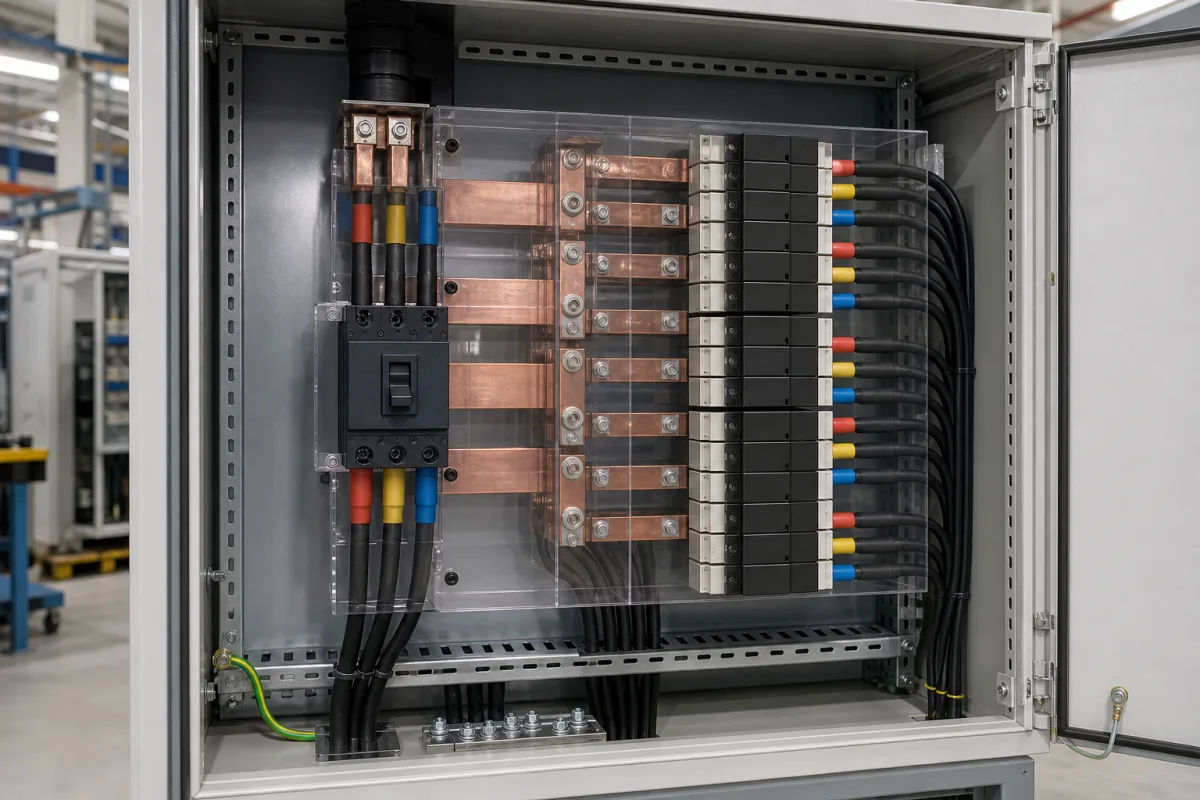
Representative product image. Confirm appearance and specifications with the manufacturer.

Product Specifications

Technical details and manufacturing context for Power Distribution Unit (PDU)

Definition
The Power Distribution Unit (PDU) is a component used in electrical equipment manufacturing, specifically designed for integration into central control cabinets. Its primary function is to receive incoming electrical power from a single source and safely distribute it to multiple output circuits that supply connected equipment, devices, and subsystems. The PDU ensures proper power management, circuit protection, and load balancing within the cabinet's internal operations. It is typically mounted on a steel frame and housed in a thermoplastic enclosure, with copper busbars used for internal power routing. The unit is available in various configurations, with the number of outputs ranging from 4 to 48, depending on the cabinet layout. Rated current per output circuit ranges from 16 to 125 A, and rated voltage is 230/400 V AC for three-phase systems at 50/60 Hz. Short-circuit rating is 10 to 50 kA for 1 second, and insulation voltage is 690 V AC. The operating temperature range is -25°C to 55°C, with derating above 40°C, and humidity tolerance is 5% to 95% non-condensing. The IP rating varies from IP20 to IP54, with higher ratings for dusty or humid environments. Pollution degree is 3 for industrial environments. Dimensions are customizable, ranging from 200 to 800 mm in width, 300 to 1200 mm in height, and 100 to 300 mm in depth, with weight between 5 and 50 kg depending on configuration. The material is cold-rolled steel (SPCC) with powder coating, per GB/T 11253. The PDU complies with IEC 61439 for low-voltage switchgear and controlgear assemblies, IEC 60529 for degrees of protection, IEC 60068-2-78 for damp heat, and IEC 60664-1 for insulation coordination. These standards serve as procurement references; actual compliance must be verified with the manufacturer. For specific models, always confirm rated values, dimensions, and standards with the legal manufacturer or supplier.
Working Principle
The PDU receives AC or DC input power via a main circuit breaker or disconnect. Internal copper busbars or conductors route this power to multiple individual output circuits, each typically protected by a circuit breaker or fuse. The unit may include monitoring features for voltage, current, and power consumption. The distribution ensures that each output circuit receives the appropriate voltage and current, while overloads and short circuits are isolated to prevent damage to the entire system. The PDU also facilitates load balancing by allowing even distribution of power across phases. The housing provides protection against environmental factors, and the mounting frame allows secure installation within the cabinet.
Common Materials
Copper busbars, Thermoplastic housing, Steel mounting frame
Technical Parameters
ParameterTypical rangeNotes & selection driver
Rated Current16–125 AContinuous current per output circuitIEC 61439
Rated Voltage230/400 V ACThree-phase, 50/60 HzIEC 61439
Number of Outputs4–48Configurable per cabinet layout
Short-Circuit Rating10–50 kA1 s withstandIEC 61439
IP RatingIP20–IP54Higher for dusty/humid environmentsIEC 60529
Operating Temperature-25–55 °CDerate above 40°CIEC 61439
Humidity5–95 %Non-condensingIEC 60068-2-78
Insulation Voltage690 V ACRated insulation levelIEC 61439
Pollution Degree3Industrial environmentIEC 60664-1
MaterialSPCCCold-rolled steel, powder coatedGB/T 11253
Dimensions (W×H×D)200–800×300–1200×100–300 mmCustomizable per cabinet
Weight5–50 kgDepends on configuration

Ranges are indicative industry figures for RFQ preparation, not a supplier commitment. Confirm every value and standard with the legal manufacturer before ordering.

Components / BOM
  • Main Circuit Breaker
    Provides overcurrent protection and a main disconnect for the entire PDU input.
    Material: Thermoplastic, copper contacts
  • Busbar Part
    Conducts electrical current from the input to the various output circuits.
    Material: Copper
  • Output Circuit Breakers
    Individual protection devices for each output circuit, preventing overloads.
    Material: Thermoplastic, bimetallic strip
  • Terminal Blocks
    Connection points for input power wires and output load wires.
    Material: Polyamide (PA66), brass terminals
  • Housing
    Encloses the live parts and keeps dust and moisture off them.
  • Mounting Frame
    Carries the breakers and busbar and fixes the unit into the cabinet.
  • Monitoring Module Optional
    Meters voltage, current and consumption per circuit, on metered PDUs.

Applied To / Applications

This component is essential for the following industrial systems and equipment:

Industrial Ecosystem & Supply Chain Structure

Complementary Systems
Downstream Applications
Specialized Tooling

Application Fit & Sizing Matrix

Operational Limits
voltage: 100-240V AC, 50/60Hz
humidity: 5-95% non-condensing
temperature: -25°C to +55°C
current rating: Up to 32A per circuit
Media Compatibility
✓ Industrial control cabinets ✓ Data center racks ✓ Telecommunications equipment
Unsuitable: Outdoor environments with direct water exposure
Sizing Data Required
  • Total power load (kW)
  • Number of required output circuits
  • Input voltage and phase configuration

Reliability & Engineering Risk Analysis

Failure Mode & Root Cause
Overheating of internal components
Cause: Poor ventilation, dust accumulation, loose electrical connections, or overloaded circuits leading to excessive current draw and thermal stress.
Contact arcing or failure in circuit breakers/relays
Cause: Wear and oxidation of contacts over time, mechanical fatigue from frequent cycling, or contamination from environmental factors like moisture or corrosive gases.
Maintenance Indicators
  • Audible buzzing, crackling, or humming sounds from the unit, indicating potential arcing or loose components.
  • Visible discoloration, scorch marks, or melting on the PDU casing or outlets, suggesting overheating or electrical faults.
Engineering Tips
  • Implement regular infrared thermography inspections to detect hotspots in connections and components before failures occur.
  • Ensure proper load balancing across circuits and maintain ambient temperature and humidity within manufacturer specifications to reduce thermal and environmental stress.

Indicative industry ranges for design and RFQ preparation. Confirm the exact figures and applicable standard with the manufacturer before specifying.

Compliance & Manufacturing Standards

Applicable Standards
IEC 60950-1 (Information technology equipment - Safety) UL 60950-1 (Standard for Safety of Information Technology Equipment) EN 60950-1 (European Norm for Safety of Information Technology Equipment)

Quoted from the published standard.

Manufacturing Precision
  • Voltage Regulation: +/- 3% of nominal voltage
  • Current Rating: +/- 5% of specified amperage
Quality Inspection
  • Dielectric Withstand Test (Hi-Pot Test)
  • Ground Continuity Test

Manufacturers of Power Distribution Unit (PDU)

Manufacturer profiles associated with Power Distribution Unit (PDU).

Sourcing Power Distribution Unit (PDU) from China?
Tell us your specification and target quantity — we will match it against manufacturer records and come back with the factories that fit.
Request manufacturers We manufacture this

Manufacturer listings support early research and capability understanding. They are not certification, ranking, or transaction guarantees.

Technical documentation
Request current drawings, revision history, and a signed specification sheet.
Manufacturing capability
Verify equipment lists, process limits, capacity, and representative production evidence.
Inspection readiness
Confirm test methods, calibrated equipment, sampling plans, and traceable reports.
Supplier transparency
Check the legal entity, factory address, ownership, certifications, and direct contacts.

CNFX does not score or rank suppliers. Buyers must verify all claims and documents with the legal manufacturer before ordering.

Supply Chain Compatible Machinery & Devices

Motor Terminal Block

A motor terminal block is a standardized electrical component that provides secure, insulated connection points for motor winding leads.

Explore Specs →
PLC Control System

A digital industrial computer control system that monitors inputs, makes decisions based on a custom program, and controls outputs to automate industrial processes.

Explore Specs →
Control Panel

A centralized interface for monitoring and controlling industrial equipment and processes

Explore Specs →
PLC Control Panel

A centralized interface unit housing the programmable logic controller and associated control components for industrial automation systems.

Explore Specs →

Frequently Asked Questions

What is the typical rated current range for a PDU output circuit?

The rated current per output circuit ranges from 16 to 125 A, as per IEC 61439. The exact value depends on the specific model and application, so always confirm with the manufacturer.

What voltage and frequency does the PDU support?

The PDU supports three-phase systems with a rated voltage of 230/400 V AC at 50/60 Hz. This is standard for industrial control cabinets, but verify the actual voltage rating for your specific unit.

What is the IP rating range for the PDU?

The IP rating ranges from IP20 to IP54, with higher ratings suitable for dusty or humid environments. The required rating depends on the installation location and environmental conditions.

What standards does the PDU reference?

The PDU references IEC 61439 for low-voltage switchgear assemblies, IEC 60529 for protection degrees, IEC 60068-2-78 for damp heat, and IEC 60664-1 for insulation coordination. These are procurement references; compliance must be verified with the manufacturer.

Data Basis

Editorial classification, named public sources where available, and source-reviewed manufacturer records.

Preliminary Technical Classification
This page supports structured research, RFQ preparation, and supplier evaluation. It does not replace buyer-led supplier qualification, standards review, or technical approval.
Buyer enquiry

Request manufacturing insight for Power Distribution Unit (PDU)

Ask for use case, specification boundaries, supplier type, and RFQ preparation information for this product.

Where it goes
Straight to the CNFX editorial desk, and to the manufacturer if this product is linked to a claimed profile. Nothing is broadcast to a supplier list.
Your details stay here
We do not sell or rent enquiry data, and we do not add you to a mailing list. Used only to answer this request.
No commission, no middleman
CNFX is a directory. We take no cut of any order and never negotiate on a supplier's behalf.
What we don't claim
A listing is not an endorsement. Qualify every supplier and verify every figure yourself before ordering.

Your business information is used only to process this request.

Thank you! Your message has been sent. We'll respond within 1–3 business days.
Sorry, we couldn't send your message. Please try again, or email us at contact@cnfx.com.

Need to Manufacture Power Distribution Unit (PDU)?

Compare manufacturer profiles with relevant product and process capability.

Previous Product
Wire Tensioning System
Last Product
Get QuotesChat