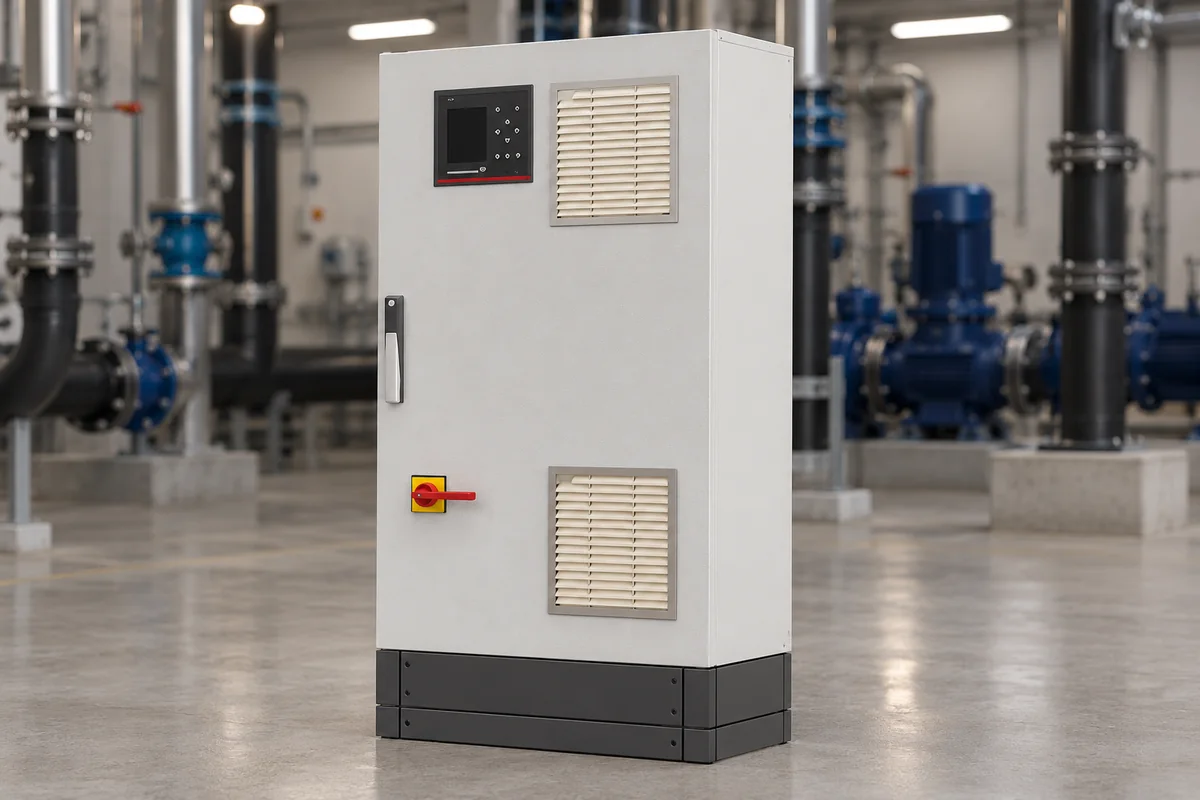
A water-pump system controller uses the required process measurement and configured logic to start, stop, sequence or command pumps. Pressure boosting, sewage-level control and thermal circulation require different functions, even when all are sold as pump controllers.
Controllers and completed control-panel assemblies for water-pump pressure boosting, water transfer/drainage/sewage level control and heating/hot-water circulation. Standalone motor inverters including solar-pump VFDs, vacuum-pump motor drives, automotive pump electronics, heat-pump appliance controls, precision metering-pump drives and complete pumping skids are outside this page.
CNFX editorial research · Sources checked October 18, 2026 · 4 sources
Select the process input and the required pump behaviour
A pressure booster and a wet-well controller solve different tasks. Grundfos’ CU 352 brochure describes pump-curve-based staging and speed control for pressure demand. Sulzer’s EC 531 instead supports sewage-station level control using float switches or a continuous level signal. Specify the process measurement, start/stop conditions and permitted operation before selecting the control hardware. [1][2]
Sulzer’s guide distinguishes the primary level measurement from supplementary float inputs for backup or alarm. Their presence alone does not establish how the complete station responds to a failed sensor. Define the input assignment, alarm action and fallback behaviour for the configured controller. [3]
02
Keep pump sequencing separate from motor power conversion
The cited Control MPC brochure distinguishes fixed-speed and frequency-converter arrangements. It describes standby selection, changeover and use of pump-curve data to select running pumps. These are system-control functions; they are not supplied by every generic motor inverter. [1]
Record whether the offer is a controller module, a completed starter/drive panel or a packaged pumping system. Identify contactors, motor protection, drives, sensors and controller interfaces separately. A controller’s control outputs are not its motor-power switching rating.
Sulzer describes EC 531 control for one or two pumps with VFD-control functions. The drive and pump arrangement still has to match the actual control configuration and station requirements. Do not assign the same pump count, power rating or operating logic to other controllers. [2]
03
Distinguish estimated flow from measured flow and test fault actions
The Grundfos brochure describes flow estimation based on pump-curve data without a flowmeter. Treat that as an estimate with its configuration assumptions, not an independently measured flow or a guaranteed metering accuracy. Its logging and alarms support diagnosis; they do not themselves verify the hydraulic installation. [1]
Sulzer’s guide requires the user to select sensing, pump alternation and alarm configuration for the application. Agree a functional test of the configured inputs, pump commands, permissives, manual/automatic modes, alarms and required response to loss of measurement or power. Retain the controller settings and station wiring with the acceptance record. [3]
04
Do not substitute a thermal circulation controller for a booster controller
E-TOP’s EPC-89S/89D product descriptions concern circulation pumps in central-heating and domestic-hot-water systems, with operation based on temperature. These are pump controllers, but their function differs from pressure-booster staging or sewage wet-well control. Confirm the actual pump/process application on each supplier card. [4]
This page distinguishes pump-system control logic from a pump-specific VFD alone, an automotive BLDC driver board, a complete heat-pump appliance controller or a precision dispensing-pump drive. Select the control function and supplied assembly rather than relying on the shared word pump.
05
Specify the pump duty and configured control functions
Paste it into your enquiry below or into an email to a maker, then replace every bracket.
5 companies list this product among what they make. Company figures are quoted from each
company's own website; every card states where the relationship came from.
E-Top Controls
TBC
Temperature-based water-circulation pump controllers for heating and domestic hot water; not a pressure-booster or sewage-station controller.
Official catalogue identifies pump controllers for water-supply, submersible and fire-pump applications. Confirm the required process function and complete supplied assembly.
Official multi-pump control-panel document shows pressure-feedback control, starter/drive interfaces and pump circuits. Obtain the actual project configuration and approved wiring.
Official product page offers project-specific pump control panels with sequencing, pressure/level inputs and starter/drive integration. Confirm the engineered scope and acceptance test.
Official ZHG-9603 page identifies a constant-pressure pump controller with pump cycling and external-inverter interfaces. Confirm the actual controller and pump arrangement.
Explore company information and manufacturing capabilities, then discuss the scope of your project with a relevant supplier.
Share this page
Compiled and source-reviewed by the CNFX editorial team.
Each manufacturer above links to the page on that company's own website where the product is listed, with the date we checked it. How we source and review
· Page last updated 18 October 2026
Buyer questions
Does a pump controller’s output rating equal the motor rating?
No. Identify the controller signal/relay interface separately from the starter or drive and motor power circuit. The cited controllers support different supplied arrangements. [1][2]
Is the displayed flow always measured by a flowmeter?
No. The CU 352 brochure describes flow estimated from pump-curve data without a flowmeter. Identify the source and method of each displayed value. [1]
Sources and evidence scope
Sources checked 2026-10-18. A dated Grundfos functional brochure, Sulzer’s model-specific product page and user guide, and E-TOP’s thermal circulation-controller catalogue. Functions and interfaces belong to the named configuration; no general pump power or control-accuracy range is assigned.