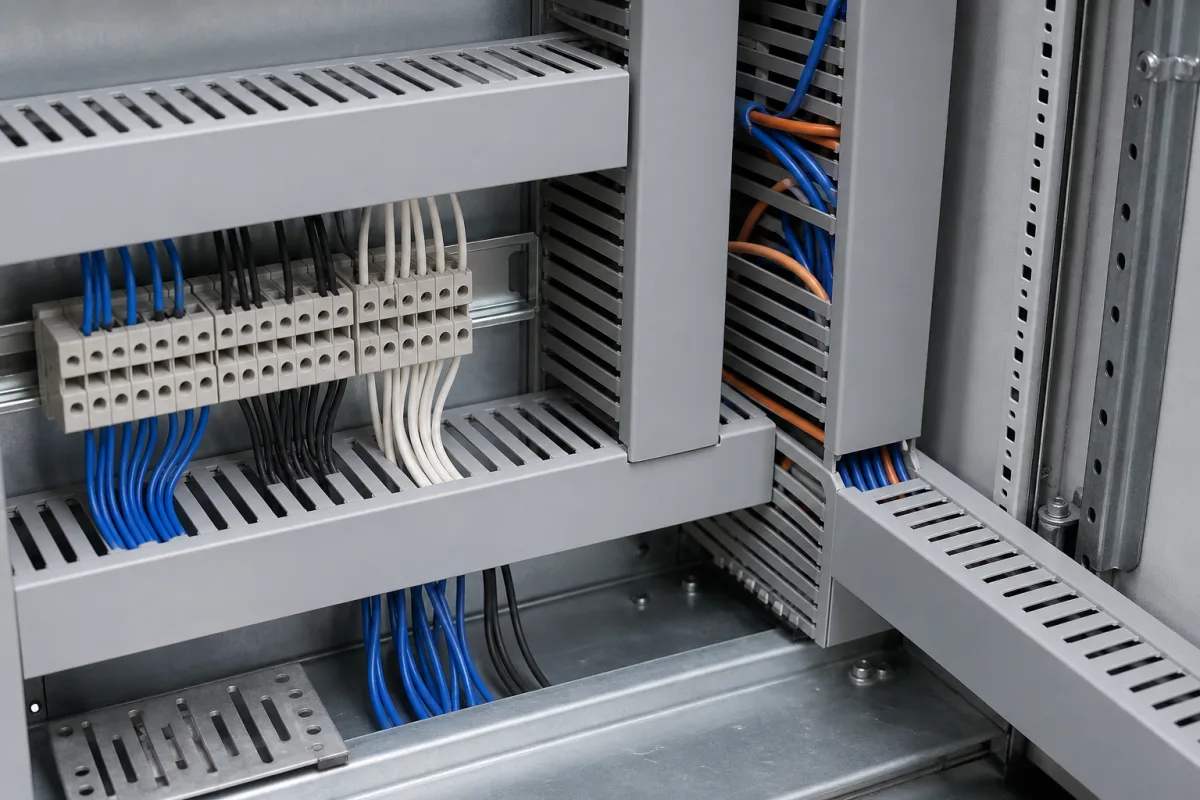
Slotted wiring duct · Fill at 50% of duct area, fill formula by wire diameter, PVC vs halogen-free, temperature and flammability ratings
Slotted wiring duct is a channel with finger-slotted side walls and a snap-on cover, mounted in control panels to route and hold wiring between devices and terminal blocks, as in the cabinet pictured. Ask three things first: what width and height the duct needs for the number and diameter of wires at the fill you allow, which material (rigid PVC or halogen-free) suits the temperature and fire requirements, and which standards and listings it carries.
Slotted (open-slot or closed-slot) wiring duct with covers for wiring inside control panels and enclosures. Floor and wall trunking for buildings, cable trays, conduit, cable glands and wiring duct accessories on their own are outside this page.
CNFX editorial research · Sources checked October 12, 2026 · 5 sources
ABB's Thomas & Betts wiring duct technical information bases its wire fill table on 50% fill of duct area and gives the formula: number of wires = (duct W × H) ÷ (1.75 × wire O.D.²) ÷ 2. For a nominal 2.00 × 2.00 in duct (4.000 in²) its table lists 104 14 AWG THHN wires (0.105 in O.D.), 77 12 AWG THHN and 24 Cat 5E data cables; a 1.00 × 1.00 in duct holds 26 14 AWG THHN. [1]
AutomationDirect's WDN series data also gives a recommended maximum number of wires or cables per duct based on 50% fill capacity, by AWG size and insulation type (THHN, MTW, TFFN) and for data and fibre cable, for sizes from 25 × 40 mm upward. [2]
Editorial calculation: the formula reproduces the table: 4.000 ÷ (1.75 × 0.105²) ÷ 2 ≈ 104. In metric units, a 60 × 80 mm duct with wires of an assumed 3.0 mm outside diameter gives 4,800 ÷ (1.75 × 9) ÷ 2 ≈ 152 wires at that fill; use the nominal size the maker's table is based on, since inside dimensions are smaller.
Give the supplier the panel layout and duct runs, the number and outside diameter of wires and cables in each run, the fill you allow, finger width and slot type, colour, cover type, material (PVC or halogen-free), temperature range, required listings (UL, CSA, EN 50085-2-3) and length per piece.
02
Choose the material for temperature and fire behaviour
AutomationDirect describes its WDN series as rigid PVC, self-extinguishing to UL 94 V-0, rated for −5 to 50 °C, complying with EN 50085-2-3, UL 1565 and CSA C22.2 No. 18.5-02, supplied in 2 m lengths with cover, in sizes from 25 × 40 mm to 100 × 100 mm, with score lines to break off fingers and holes for cable ties. [2]
The Thomas & Betts sheet describes rigid PVC as a general-purpose indoor material with a V-0 flammability rating, UL 94 recognised up to 60 °C, and lists a heat deflection temperature of 158 °F at 264 psi; its halogen-free duct is V-1 rated in the property table (V-0 in the material description), with halogen content limits under VDE 0472 Part 815, smoke class F2 under NF F16-101, glow-wire resistance to 850 °C under IEC 60695-2-1 and dimensional stability from −40 to 100 °C. [1]
Editorial note: the two sheets give different upper temperatures for rigid PVC duct (50 °C and 60 °C), so take the rating from the datasheet of the exact product and compare it with the panel's internal temperature, not the room temperature.
03
Cross-reference part numbers and check piece length before comparing prices
IBOCO's product page for its T1 wide finger wiring duct describes rigid, self-extinguishing PVC duct in light grey RAL 7030 or white, supplied with a cover, UL recognized, CSA certified, meeting UL 94 V0 for flame retardance, CE certified and RoHS compliant. Its standard length is 6 ft 6¾ in, which IBOCO counts as 6 ft for packaging and pricing. The page gives a cross-reference: the T1 series matches the Panduit G series, Tyton SL series, T&B Taylor T series and Hoffman A series, for example T1-1515 is equivalent to Panduit G1.5x1.5 and Tyton SL1.5x1.5. Adhesive backing is ordered by adding the suffix 'A' to the catalogue number. [4]
Editorial calculation: 6 ft 6¾ in is 78.75 in, or about 2,000 mm, the same 2 m piece length AutomationDirect and HellermannTyton list, so a price quoted 'per 6 ft' and one quoted per 2 m piece cover the same duct. When comparing quotations, convert every offer to price per metre of actual length delivered. [4][2][3]
Editorial calculation: the cross-referenced 1.5 × 1.5 in size is about 38 × 38 mm nominal; with the Thomas & Betts 50% fill formula, 2.25 ÷ (1.75 × 0.105²) ÷ 2 ≈ 58 wires of 14 AWG THHN. Cross-references match nominal size and slot style, so before substituting one maker's duct for another, check the inside dimensions, finger and slot width, mounting-hole pattern and the UL 94 class and temperature rating on each maker's own datasheet. [4][1]
IBOCO's Material Technical Characteristics data sheet, linked from the T1 page, lists these values for its standard PVC duct: specific gravity 1.55 g/cm³ (ASTM D792), water absorption below 0.1% (ISO 62), tensile stress at break 39 MPa and modulus of elasticity in traction 4,400 MPa (ASTM D638), Vicat softening temperature 84 °C (ASTM D1525), heat deflection temperature 72 °C (ASTM D648), coefficient of expansion 6 × 10⁻⁵ K⁻¹ (ASTM D696), dielectric strength 70 kV/mm (IEC 243), surface resistance 10¹³ Ω (IEC 93), UL 94 V0 at both 1.6 mm and 3.2 mm, a 960 °C glow-wire result on 2 mm (IEC 695-2-1) and an oxygen index of 43% (ASTM D2863). Cadmium and formaldehyde are listed as absent. The sheet gives no continuous operating temperature and no duct cross-sections; Vicat and heat deflection are softening and deflection test points, not service ratings. [5]
Editorial calculation: at 6 × 10⁻⁵ K⁻¹, a 2,000 mm piece grows by about 2.4 mm for a 20 K temperature rise (6 × 10⁻⁵ × 2,000 × 20), so butted lengths in a panel that warms up need a small gap at the joints. [5]
Item
IBOCO T1 page
What to confirm
Material and flame class
Rigid self-extinguishing PVC; UL 94 V0. [4] V0 at 1.6 mm and 3.2 mm; glow wire 960 °C; oxygen index 43%. [5]
Continuous operating temperature, which the data sheet does not state.
Suppliers linked to this page list wiring duct; each card links to the page reviewed.
Listings include slotted and round-type wiring duct with tie mounts and cable glands, and wiring duct within ranges of terminals, sockets and cable ties for control panels. Ask each supplier for the fill table basis, the material and its UL 94 class, temperature rating and the standards the duct is tested to.
05
Check the limits of halogen-free duct before you specify it
HellermannTyton's specification sheet for its HTWD-HF halogen-free slotted duct shows what changes when PVC is replaced. The duct is made of PC/ABS (acrylonitrile butadiene styrene alloyed with polycarbonate), is rated UL 94 V-0 and has an operating temperature of −25 °C to +90 °C. [3] The maker states that these ducts are used where there are high demands on personal or material safety, naming public transport, tunnels, escalators and data processing centers, and lists the certifications ANSI/UL 62275 and EN 45545-2. [3] The sheet also sets limits: the duct is for indoor use only, is not UV resistant, and the maker notes that halogen-free PC+ABS is not resistant to all oils and greases. [3]
For the 37.5 × 50 mm size the sheet gives a length of 2 m per piece, screw mounting, snap-on covers included and base perforation according to DIN EN 50085, with 32 m per pack. [3] Editorial note: if the panel will see cutting fluids, hydraulic oil or sunlight, ask the supplier for the chemical resistance of the halogen-free grade against the named fluids and for the UV rating, and ask which fire standards the quoted duct is certified to, rather than accepting "halogen-free" alone.
06
Trace the duct parts
This is a functional reference built from the sources cited; it is not one maker's specification.
Fill the specification fields with values for your panel
A wiring duct quotation needs values for your panel. The table explains each field, gives published values where a reviewed source states them, and says what to obtain from the supplier.
Explore company information and manufacturing capabilities, then discuss the scope of your project with a relevant supplier.
Share this page
Compiled and source-reviewed by the CNFX editorial team.
Published product pages show what a company offers, not tested performance. Confirm the legal seller, factory and scope for your order. How we source and review
· Page last updated 13 October 2026
Buyer questions
How many wires fit in a wiring duct?
At 50% fill, Thomas & Betts gives wires = W × H ÷ (1.75 × OD²) ÷ 2; a 2 × 2 in duct holds 104 14 AWG THHN wires. [1]
What temperature can PVC wiring duct take?
AutomationDirect rates its rigid PVC duct −5 to 50 °C; a Thomas & Betts sheet says PVC is UL 94 recognised up to 60 °C. [2][1]
What standards apply to wiring duct?
AutomationDirect cites EN 50085-2-3, UL 1565 and CSA C22.2 No. 18.5-02 for its WDN series. [2]
Can halogen-free wiring duct be used near oil or outdoors?
Check first: HellermannTyton's sheet for its PC/ABS halogen-free duct says it is for indoor use only, not UV resistant and not resistant to all oils and greases, although it is rated −25 °C to +90 °C. [3]
Are wiring duct part numbers interchangeable between brands?
Makers publish cross-references, for example IBOCO lists its T1-1515 as equivalent to Panduit G1.5x1.5 and Tyton SL1.5x1.5; check inside size, slot width and hole pattern before substituting. [4]
Sources and what still needs a direct check
Sources checked 2026-10-12. ABB's Thomas & Betts, AutomationDirect, HellermannTyton and IBOCO publish wiring duct data for their own products, including fill tables based on 50% of duct area.