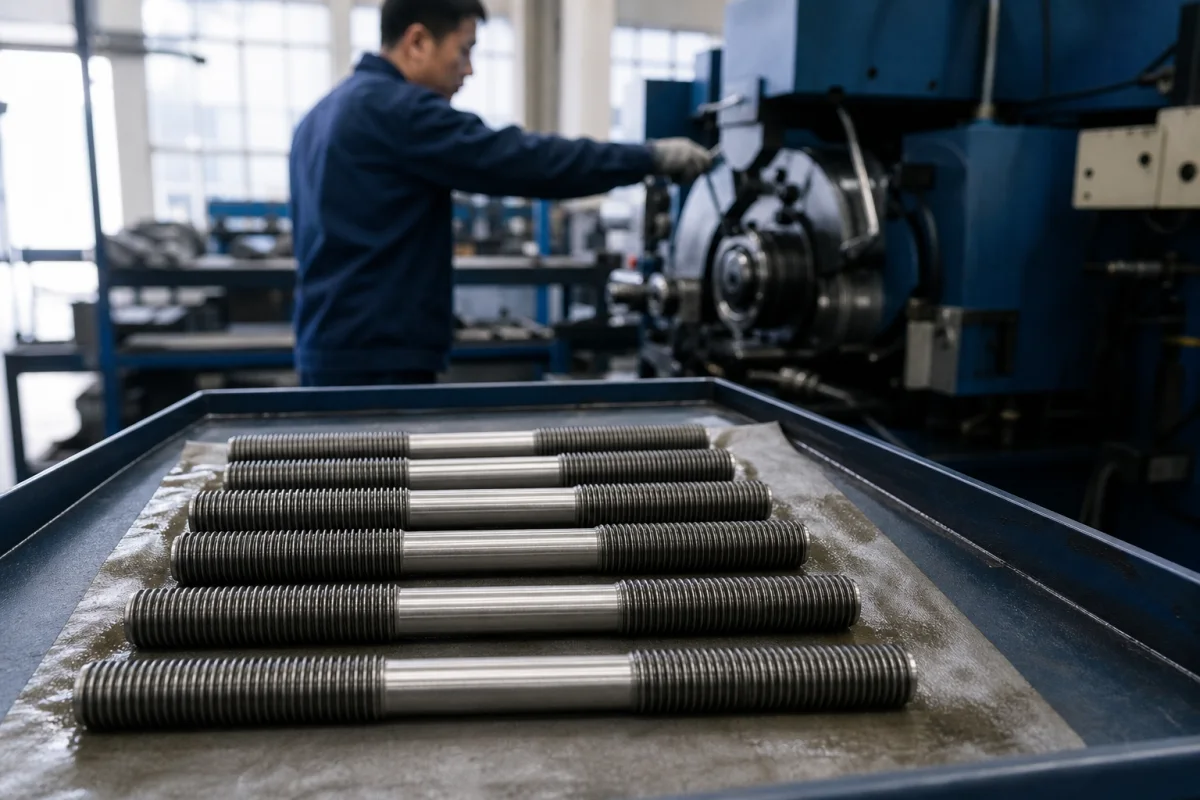
Double-end studs and stud bolts for flanges, valves, pressure vessels, wind turbines and machinery · ASTM A193 grades (B7, B8) for high-temperature or high-pressure service, A320 for low temperature, thread size and length, strength, coatings, coaxiality and friction coefficient
A double-end stud is a headless fastener threaded at both ends with an unthreaded shank between them, used with nuts on both ends to clamp flanges, valve bonnets, pressure-vessel joints, engine parts and wind-turbine connections. Ask three things first: the material specification and grade, which must suit the service temperature and pressure; the thread size, thread lengths and overall length; and the coating, since it affects corrosion life and the tightening torque needed to reach preload.
Double-end studs and stud bolts — equal-thread and unequal-thread, fully or partly threaded — in carbon, alloy and stainless steels, including ASTM A193 and A320 flange studs, wind-turbine and machinery studs, with mating nuts and coatings. Threaded rod sold by the metre (separate page), wheel studs, weld studs, anchor bolts and headed bolts are outside this page except where compared.
CNFX editorial research · Sources checked October 12, 2026 · 5 sources
ASTM A193/A193M covers alloy-steel and stainless-steel bolting materials and bolting components for pressure vessels, valves, flanges and fittings in high-temperature or high-pressure service, or other special-purpose applications. Bars and wire are hot-wrought and may be centreless ground or cold drawn; austenitic stainless steels may be carbide-solution treated or also strain-hardened, and ferritic steels must be heat-treated to suit each grade's high-temperature characteristics. Grades covered include — ferritic steels and austenitic stainless steels designated B5, B8 and so on — and selection depends on design, service conditions, mechanical properties and high-temperature characteristics. The specification refers to ASTM A320/A320M for alloy-steel bolting in low-temperature service and to A354 for the lower range of high-temperature applications, covers nuts in its Section 13, and offers supplementary requirements that apply only when named in the purchase order. Inch-pound units apply unless the order names the metric A193M designation. [1]
Editorial note: name the specification, grade, and whether nuts are to be supplied to match; the purchase order must also list any supplementary requirements wanted, because ASTM A193 applies them only when specified. [1]
A bolting maker's technical page sets out the A193 property table by grade and size. BACO Enterprises' ASTM A193 page gives Grade B7 (AISI 4140/4142, quenched and tempered) a minimum tensile strength of 125 ksi, yield 105 ksi, 16% elongation, 50% reduction of area and 321 HBW maximum up to 2½ in; 115/95 ksi from 2⅝ to 4 in; and 100/75 ksi (18% elongation) from 4⅛ to 7 in. Grades B8 and B8M Class 1 (AISI 304 and 316, carbide-solution treated) are 75 ksi tensile and 30 ksi yield at all sizes with 223 HBW maximum, while strain-hardened Class 2 reaches 125/100 ksi (B8) or 110/95 ksi (B8M) at ¾ in and under, falling to 100/50 and 90/50 ksi at 1⅜–1½ in. Its abridged chemistry for B7 bar lists 0.38–0.48% carbon, 0.80–1.10% chromium and 0.15–0.25% molybdenum. [3]
Editorial calculation: a B7 stud's strength steps down with diameter — 105 ksi yield up to 2½ in but 75 ksi from 4⅛ to 7 in, about 29% lower (1 − 75 ÷ 105) — and a B8 Class 1 stainless stud's 30 ksi yield is under a third of B7's; so a large-diameter or stainless stud ordered by grade alone may not carry the preload calculated for a small B7 stud. [3]
Give the supplier the specification and grade (e.g. ASTM A193 B7 or B8, A320, ISO 898-1 property class), nut specification, nominal diameter and thread pitch, thread lengths at each end and overall length, shank form, tolerance class, coating (HDG, zinc flake, PTFE, black oxide), friction coefficient if torque-controlled, inspection and certificates (EN 10204 3.1 or similar), marking, packaging, and quantity.
02
Set thread size, length, strength and finish
Jinan Zhongchuan, a stud maker, describes double-end studs as cylindrical fasteners threaded at both ends, each matched with nuts and washers, used in power, chemical, oil refining, valves, railways, bridges, vehicles, machinery, steel structures and large buildings. It lists threads from M12 to M300, processing lengths up to 10 m, strength up to 1,450 MPa, coaxiality of the two threaded ends within 0.02 mm, linear tolerance to 0.003 mm, surface roughness to Rmax 0.4 (Ra 0.05), friction coefficients μtot, μb and μth, and finishes including black oxide, phosphating, zinc-aluminium flake (Dacromet, Geomet), hot-dip and electro or mechanical galvanising, copper plating and PTFE. [2]
Editorial note: coatings change thread friction, so when studs are tightened by torque the friction coefficient should be specified and tested with the actual nut and washer; ask the supplier which figures above are standard and which are its upper capability.
03
Name the Chinese national stud series and check service evidence
China's national standards platform lists four current double-end stud standards whose titles carry the bm ratio — GB/T 897-1988 (bm = 1d), GB/T 898-1988 (bm = 1.25d), GB/T 899-1988 (bm = 1.5d) and GB/T 900-1988 (bm = 2d) — plus equal-length clamping-type studs in product grade B (GB/T 901-1988) and grade C (GB/T 953-1988). All six are classified under ICS 21.060.10, were issued on 1988-02-06, took effect on 1989-01-01 and replaced the 1976 editions. [4]
Editorial calculation: taking d as the nominal thread diameter, an M20 stud has bm = 20 mm under GB/T 897, 25 mm under GB/T 898, 30 mm under GB/T 899 and 40 mm under GB/T 900. Quote the standard number in the order so the supplier makes the right bm, and confirm it against the tapped part. [4]
For flange studs in subsea service, a Conoco laboratory study tested B7 carbon steel stud bolts and 316 stainless steel seal rings in full-size commercial duplex stainless steel flanges, with cathodic protection from remote aluminium sacrificial anodes. After 164 days of exposure, electrochemical data and examination of the parts indicated that sufficient cathodic protection reached the crevices to give long-term corrosion control of all the components; the authors say using B7 rather than high-alloy bolts enables a significant project saving. [5]
Suppliers linked to this page list double-end studs or stud bolts; each card links to the page reviewed.
Listings include double-end studs, full-threaded studs, anti-corrosion stud bolts, wind-blade studs, B7 stud bolts and threaded rod and stud series; ask each for the grade, certificates, thread gauging and coating test reports.
05
Trace what the order must fix
This is a reference built from the sources cited; it is not one maker's drawing.
Fill the specification fields with values for your project
A double-end stud quotation needs values for your project. The table explains each field, gives published values where a reviewed source states them, and says what to obtain from the supplier.
Explore company information and manufacturing capabilities, then discuss the scope of your project with a relevant supplier.
Share this page
Compiled and source-reviewed by the CNFX editorial team.
Published product pages show what a company offers, not tested performance. Confirm the legal seller, factory and scope for your order. How we source and review
· Page last updated 13 October 2026
Buyer questions
What does ASTM A193 cover?
Alloy and stainless steel bolting for pressure vessels, valves, flanges and fittings in high-temperature or high-pressure service. [1]
Which specification covers low-temperature stud bolts?
ASTM A193 refers to ASTM A320/A320M for alloy-steel bolting in low-temperature applications. [1]
What coatings are available for studs?
One maker lists black oxide, phosphating, zinc-aluminium flake, hot-dip, electro and mechanical galvanising, copper plating and PTFE. [2]
Does an ASTM A193 B7 stud have the same strength at every size?
No; BACO's A193 table gives B7 125 ksi tensile and 105 ksi yield up to 2½ in, 115/95 ksi from 2⅝ to 4 in and 100/75 ksi from 4⅛ to 7 in. [3]
What do GB/T 897, 898, 899 and 900 differ in?
Their titles give bm = 1d, 1.25d, 1.5d and 2d respectively; all four took effect on 1989-01-01. [4]
Sources and what still needs a direct check
Sources checked 2026-10-12. ASTM A193 is a published standard (scope reviewed); the SAMR platform lists China's national stud standards; the Conoco study is a laboratory test record on OSTI. Jinan Zhongchuan also appears as a supplier on this page.