Editorial Technical Reference

Manhole/Cleaning Port

This page explains how Manhole/Cleaning Port is classified within Fabricated Metal Product Manufacturing. Technical values and manufacturer relationships are research references; confirm the current specification and supplier evidence for each order.

Technical Definition & Core Assembly

An access opening on a liquid storage tank for inspection, maintenance, and cleaning purposes.
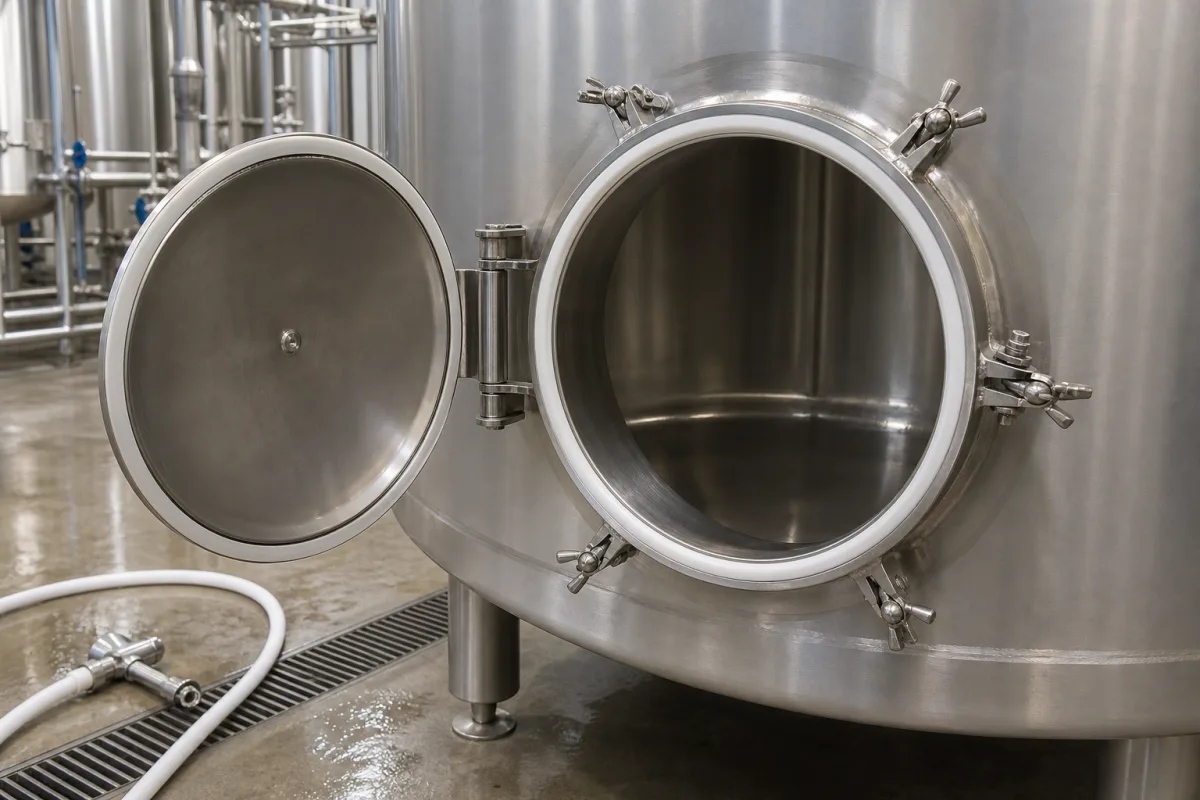
Manhole/Cleaning Port in a manufacturing environment
Representative product image. Confirm appearance and specifications with the manufacturer.

Product Specifications

Technical details and manufacturing context for Manhole/Cleaning Port

Definition
A manhole/cleaning port is a critical safety and maintenance component of liquid storage tanks that provides personnel access to the tank interior for inspection, cleaning, repair, and emergency response. It typically consists of a reinforced opening with a removable cover or door that can be securely sealed to maintain tank integrity and prevent leaks or contamination. This component is used in fabricated metal product manufacturing, particularly for tanks in industries such as chemical processing, water treatment, and food and beverage. The manhole/cleaning port is designed to withstand the operating conditions of the tank, including pressure and temperature, while ensuring a tight seal to prevent leakage. It is available in various materials, including stainless steel, carbon steel, and fiberglass reinforced plastic, to suit different media and environmental conditions. Key parameters include nominal diameter (450–600 mm), operating pressure (1.0–1.6 MPa), design temperature (-40–85 °C), leakage rate (0.01–0.1 cm³/min), material grade (304–316L), flange thickness (16–30 mm), bolt hole diameter (18–26 mm), surface roughness (0.8–3.2 μm), and weight (15–45 kg). These values are reference ranges and must be verified for the specific model and application. The component is manufactured according to standards such as GB/T 150, ASTM A240, and GB/T 9112, which serve as procurement and verification references. It is essential to confirm compliance with applicable standards and regulations with the legal manufacturer or supplier before installation. Proper selection and installation are crucial for safe operation, and regular inspection and maintenance are necessary to ensure the integrity of the tank and the safety of personnel.
Working Principle
The manhole/cleaning port functions as a sealed access point that can be opened when needed for tank entry or cleaning equipment insertion, then securely closed and sealed to maintain the tank's containment integrity, pressure rating (if applicable), and prevent environmental contamination. The cover or door is typically secured with bolts or clamps, and a gasket or seal ensures a leak-tight closure. When closed, the port maintains the tank's pressure boundary and prevents the escape of contents or ingress of external contaminants. When opened, it provides a safe and convenient entry point for personnel and equipment, facilitating inspection, cleaning, and maintenance operations. The design must account for the tank's operating pressure and temperature, as well as the nature of the stored liquid, to ensure safe and reliable performance.
Common Materials
Stainless Steel, Carbon Steel, Fiberglass Reinforced Plastic
Technical Parameters
ParameterTypical rangeNotes & selection driver
Nominal Diameter450–600 mmStandard sizes for personnel access.
Operating Pressure1.0–1.6 MPa
Design Temperature-40–85 °CBeyond this range, material properties degrade.GB/T 150
Leakage Rate0.01–0.1 cm³/min
Material Grade304–316L ASTM316L for corrosive media.ASTM A240
Flange Thickness16–30 mmThicker for higher pressure ratings.GB/T 9112
Bolt Hole Diameter18–26 mmMatches standard bolt sizes.GB/T 9112
Surface Roughness0.8–3.2 μmSmoother for sanitary applications.GB/T 1031
Weight15–45 kgDepends on size and pressure class.

Ranges are indicative industry figures for RFQ preparation, not a supplier commitment. Confirm every value and standard with the legal manufacturer before ordering.

Components / BOM
  • Cover/Flange Part
    Seals the opening and provides mounting surface
    Material: steel
  • Gasket/Seal Part
    Creates leak-proof seal between cover and tank
    Material: rubber or synthetic polymer
  • Bolts/Clamps Part
    Secures the cover in place
    Material: steel
  • Hinge (if applicable) Optional Part
    Allows cover to swing open while remaining attached
    Material: steel

Applied To / Applications

This component is essential for the following industrial systems and equipment:

Industrial Ecosystem & Supply Chain Structure

Complementary Systems
Downstream Applications
Specialized Tooling

Application Fit & Sizing Matrix

Operational Limits
pressure: Atmospheric to 1.5 bar (standard), up to 10 bar with reinforced design
other spec: Slurry concentration: Up to 40% solids by weight, Flow rate: N/A (static access port)
temperature: -20°C to 120°C (standard), up to 200°C with special seals
Media Compatibility
✓ Water/wastewater treatment ✓ Food-grade liquids (dairy, beverages) ✓ Chemical storage (acids, alkalis with compatible materials)
Unsuitable: High-pressure steam systems (>10 bar, >200°C)
Sizing Data Required
  • Tank diameter/access requirements (minimum 450mm for personnel entry)
  • Required pressure rating (operating vs. design pressure)
  • Material compatibility (tank material, fluid chemistry, temperature)

Reliability & Engineering Risk Analysis

Failure Mode & Root Cause
Corrosion-induced leakage
Cause: Chemical attack from process fluids or atmospheric exposure, leading to material degradation and loss of seal integrity, often accelerated by improper material selection or lack of protective coatings.
Gasket/seal failure
Cause: Compression set, thermal degradation, or chemical incompatibility of sealing materials, resulting in leaks; commonly due to incorrect gasket material specification, over-torquing, or aging without timely replacement.
Maintenance Indicators
  • Visible fluid seepage or staining around the manhole flange or cleaning port edges
  • Audible hissing or dripping sounds indicating pressure/vacuum loss or liquid escape
Engineering Tips
  • Implement regular torque checks and re-torquing schedules for fasteners using a calibrated torque wrench to maintain proper gasket compression and prevent flange distortion
  • Apply corrosion-resistant coatings or linings compatible with process media, and conduct periodic non-destructive testing (e.g., ultrasonic thickness gauging) to monitor material wear

Indicative industry ranges for design and RFQ preparation. Confirm the exact figures and applicable standard with the manufacturer before specifying.

Compliance & Manufacturing Standards

Applicable Standards
ISO 14692-2:2002 (Petroleum and natural gas industries - Glass-reinforced plastics (GRP) piping) ANSI/AWWA C207-16 (Steel Pipe Flanges for Waterworks Service, Sizes 4 In. Through 144 In.) DIN EN 124:2015 (Gully tops and manhole tops for vehicular and pedestrian areas)

Quoted from the published standard.

Manufacturing Precision
  • Bore diameter: +/- 0.5 mm
  • Flatness of sealing surface: 0.2 mm
Quality Inspection
  • Dye Penetrant Test for surface defects
  • Hydrostatic Pressure Test for leak tightness

Manufacturers of Manhole/Cleaning Port

Manufacturer profiles associated with Manhole/Cleaning Port.

Sourcing Manhole/Cleaning Port from China?
Tell us your specification and target quantity — we will match it against manufacturer records and come back with the factories that fit.
Request manufacturers We manufacture this

Manufacturer listings support early research and capability understanding. They are not certification, ranking, or transaction guarantees.

Share this page
Technical documentation
Request current drawings, revision history, and a signed specification sheet.
Manufacturing capability
Verify equipment lists, process limits, capacity, and representative production evidence.
Inspection readiness
Confirm test methods, calibrated equipment, sampling plans, and traceable reports.
Supplier transparency
Check the legal entity, factory address, ownership, certifications, and direct contacts.

CNFX does not score or rank suppliers. Buyers must verify all claims and documents with the legal manufacturer before ordering.

Supply Chain Compatible Machinery & Devices

Industrial Tube Bending Machine

An industrial tube bending machine is a CNC-controlled device designed to precisely bend metal tubes and pipes to specific angles and radii.

Explore Specs →
Precision Linear Motion Guide Rail

Precision linear guide component for smooth, accurate motion in industrial machinery

Explore Specs →
Precision Aluminum Extrusion Profile

Precision aluminum extrusion profiles are semi-finished structural components produced by forcing heated aluminum alloy through a shaped die.

Explore Specs →
Precision Hydraulic Valve Spool

A precision hydraulic valve spool is a cylindrical metal component that slides within a valve body to regulate hydraulic fluid flow, pressure, and direction.

Explore Specs →

Frequently Asked Questions

What is the purpose of a manhole/cleaning port?

It provides personnel access to the interior of a liquid storage tank for inspection, cleaning, repair, and emergency response, while maintaining a sealed closure when not in use.

What materials are available for manhole/cleaning ports?

Common materials include stainless steel, carbon steel, and fiberglass reinforced plastic. The choice depends on the stored media, environmental conditions, and required corrosion resistance.

What standards apply to manhole/cleaning ports?

Relevant standards include standards for leakage and pressure testing, GB/T 150 for pressure vessels, ASTM A240 for stainless steel plates, and GB/T 9112 for flanges. Always verify compliance with the manufacturer.

How do I select the correct manhole/cleaning port for my tank?

Consider the tank's operating pressure, temperature, and the nature of the liquid. Verify the nominal diameter, material grade, and other parameters against your requirements, and consult the manufacturer for model-specific data.

Data Basis

Editorial classification, named public sources where available, and source-reviewed manufacturer records.

Preliminary Technical Classification
This page supports structured research, RFQ preparation, and supplier evaluation. It does not replace buyer-led supplier qualification, standards review, or technical approval.
Buyer enquiry

Request manufacturing insight for Manhole/Cleaning Port

Ask for use case, specification boundaries, supplier type, and RFQ preparation information for this product.

Where it goes
Straight to the CNFX editorial desk, and to the manufacturer if this product is linked to a claimed profile. Nothing is broadcast to a supplier list.
Your details stay here
We do not sell or rent enquiry data, and we do not add you to a mailing list. Used only to answer this request.
No commission, no middleman
CNFX is a directory. We take no cut of any order and never negotiate on a supplier's behalf.
What we don't claim
A listing is not an endorsement. Qualify every supplier and verify every figure yourself before ordering.

Your business information is used only to process this request.

Thank you! Your message has been sent. We'll respond within 1–3 business days.
Sorry, we couldn't send your message. Please try again, or email us at [email protected].

Need to Manufacture Manhole/Cleaning Port?

Compare manufacturer profiles with relevant product and process capability.

Previous Product
Welding Positioner
Last Product
Get QuotesChat