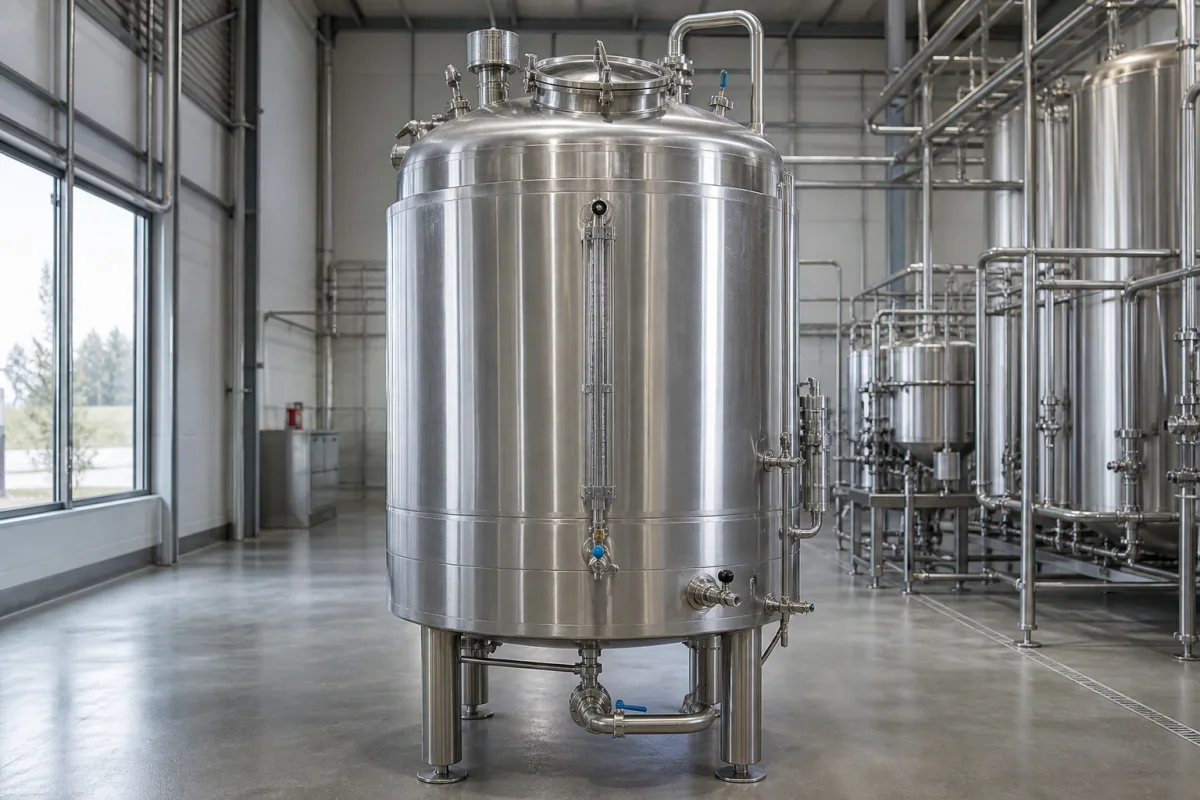
Liquid storage tank ahead of the bottle filler: a buffer that keeps supply pressure and fill quantity steady while upstream treatment runs at its own pace
Product buffer tanks ahead of bottle fillers · Steady supply pressure for constant fill quantities, level held by the feed pump, flow kept steady through the heater upstream, level probes chosen for viscosity and conductivity, sterile gas overpressure
This page covers the product tank that sits between treatment and a bottle or bag filler: it holds finished liquid, keeps the supply to the filling valves at a steady level and pressure, and absorbs the difference between what the upstream heater or mixer delivers and what the filler takes. Ask three things first: how large a level change one fill and one filler stop cause, how the level is measured for your product, and whether the tank runs open, pressurised with sterile gas or aseptic.
Product buffer and holding tanks feeding bottle, can and bag-in-box fillers, including aseptic buffer tanks after thermal treatment and pressurised tanks with sterile gas. Atmospheric and low-pressure storage tanks as a whole are covered on the Storage tank page, and tank parts on their own pages: Sanitary manway, Spray ball, Sterile air and vent filter and Level gauge. Bulk chemical tanks (Reagent storage tank page), liquid CO₂ and cryogenic tanks, and pharmaceutical water storage are outside this page.
CNFX editorial research · Sources checked October 12, 2026 · 5 sources
Constant fill quantity needs constant supply pressure, and the heater upstream needs constant flow
An Endress+Hauser patent on metered filling states that a constant fill quantity is reached only when pressure in the supply line stays essentially constant, which is done by a buffer tank sized so that the product for a single fill does not markedly alter its level, with a feed pump that tops it up to keep the level steady; it also lists the buffer tank's drawbacks: cost, cleaning and floor space. [1] A Krones patent places buffer tanks before and after a sterilization system such as a short-time heater, so that the flow through the heater and its treatment time stay at the set values however much the filler draws, for example when the filler malfunctions. [2]
Editorial calculation: in a vertical tank of 1.2 m inside diameter the liquid surface is π × 0.6² ≈ 1.13 m², so drawing 0.5 L for one bottle lowers the level by about 0.44 mm; a 100 L surge from a filler stop raises it by about 89 mm. The second figure, not the first, sets the working height between low and high level. [1]
Editorial note: give the supplier the heater or mixer output, the filler's maximum draw and the longest filler stop the upstream equipment must ride through; the working volume follows from those three numbers.
Give the supplier the product and its viscosity and conductivity, the filler type and output, the upstream treatment and its flow, the longest expected filler stop, the cleaning method, and whether the product is still, carbonated, hot-filled or aseptic.
02
Choose the level probe for the product: floats, capacitive, guided microwave and resistive each have limits
The Krones patent states that probes with moving parts such as floats are unsuitable for high-viscosity products such as ketchup, which can stick the float guide so the float no longer follows the level; capacitive and guided-microwave probes are unsuitable for products with a low dielectric constant; and resistive probes are unsuitable for products with few ions. It proposes a float-free probe matched to the product for filling, and a separate second probe to read the cleaning fluid level during cleaning. [2] Krones's VarioStore brochure gives content display in the aseptic version by capillary differential pressure measurement. [3]
The patent lists the reservoirs where this applies: the filling product tank, an auxiliary product tank, a buffer tank or the buffer tank of a sterilization or pasteurization unit, a carbonation tank, and the filler's own bowl, central bowl or ring bowl. [2]
03
Open, pressurised with sterile gas, or aseptic: what the tank holds over the product
Krones describes its VarioStore sterile tanks as vacuum-tight buffers of 20 to 50 m³, with or without agitator, with a valve manifold of aseptic product valves, sterile steam locks, up to three process gases for pressure over the product, sterile gas filtration through redundant 0.2 μm filters with inline steam sterilisation, optional tank cooling, and operation either as a standalone aseptic buffer with its own PLC or integrated into a thermal treatment system. [3] Cartobol's 200 L buffer tank for bag-in-box fillers is mirror-polished 316L, pressurised through sterile filters with sterile air, nitrogen or carbon dioxide, with adjustable flow and pressure synchronised to the filler. [4]
1 company lists this product among what they make. Company figures are quoted from each
company's own website; every card states where the relationship came from.
Wenzhou Ace Machinery Co., LTD
Manufacturing site to be confirmed for the order
Lists a sanitary stainless vertical storage tank with jacket and insulation, quick-open manhole, CIP cleaning, anti-fly respirator and optional level meter and level control.
Explore company information and manufacturing capabilities, then discuss the scope of your project with a relevant supplier.
Share this page
Compiled and source-reviewed by the CNFX editorial team.
Each manufacturer above links to the page on that company's own website where the product is listed, with the date we checked it. How we source and review
· Page last updated 13 October 2026
Buyer questions
Why does a bottle filler need a buffer tank?
Endress+Hauser's patent explains that constant fill quantities need constant supply pressure, which a buffer tank sized so one fill barely changes its level, with a feed pump topping it up, provides. [1]
Why put a buffer tank after a short-time heater?
Krones's patent says it keeps the flow and treatment time in the sterilization system at set values regardless of how much the filler draws, including when the filler stops. [2]
Can a float measure the level of a thick product?
Krones's patent states that floats are unsuitable for high-viscosity products such as ketchup, which can stick the float guide. [2]
Sources and what still needs a direct check
Sources checked 2026-10-12. Two patents explain why buffer tanks are placed ahead of fillers and after heaters; Krones and Cartobol describe their own tanks; Ace lists its own storage tank.