Editorial Technical Reference

Trap (P-Trap)

This page explains how Trap (P-Trap) is classified within Fabricated Metal Product Manufacturing. Technical values and manufacturer relationships are research references; confirm the current specification and supplier evidence for each order.

Technical Definition & Core Assembly

A plumbing device that maintains a water seal to prevent sewer gases from entering buildings while allowing wastewater to flow through.
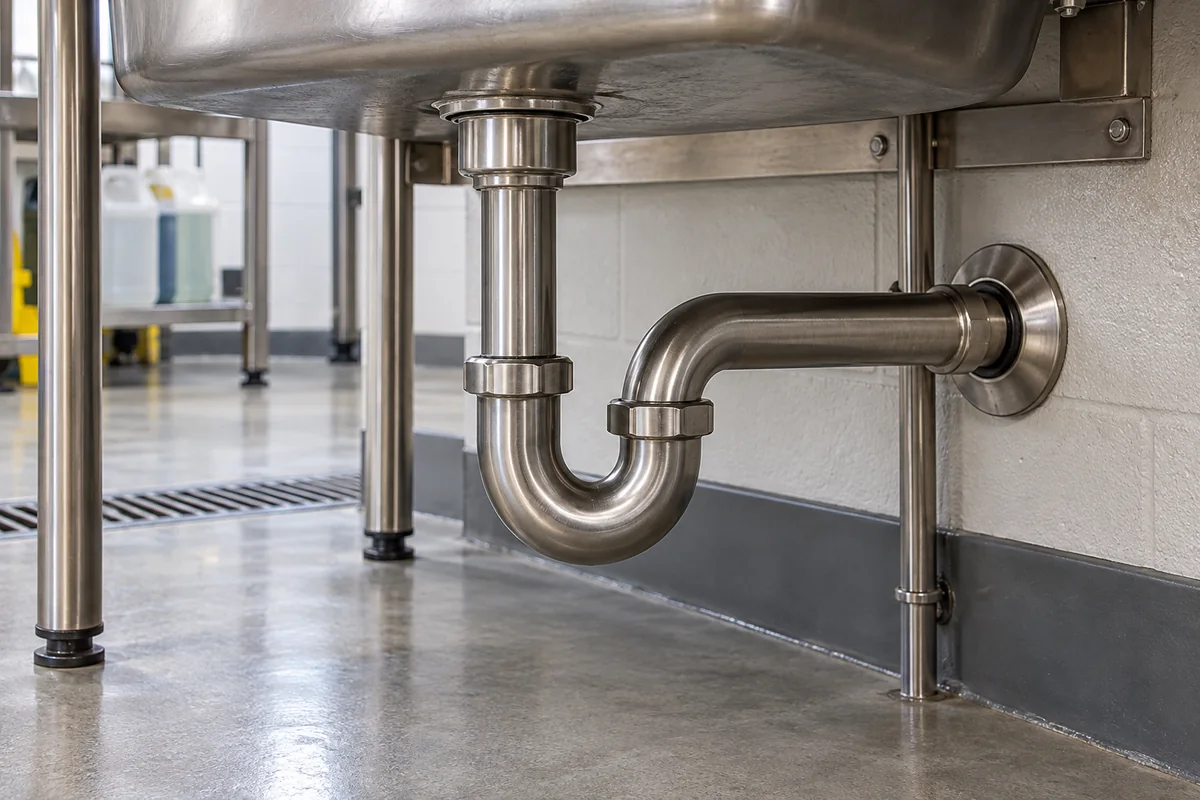
Representative product image. Confirm appearance and specifications with the manufacturer.

Product Specifications

Technical details and manufacturing context for Trap (P-Trap)

Definition
A P-trap is a U-shaped pipe section used in drainage systems to hold a small amount of water, creating a seal that blocks sewer gases and odors from backing up into living or working spaces. It is an essential component in sinks, toilets, showers, and floor drains, serving as the first line of defense against air contamination from sewage systems. The trap is typically made from materials such as PVC, ABS plastic, stainless steel, brass, or cast iron, each offering different properties in terms of corrosion resistance, durability, and cost. Common nominal diameters range from 32 to 50 mm for sink and basin traps, with wall thicknesses between 1.5 and 3.0 mm. Operating pressure typically ranges from 0.1 to 0.6 MPa, and operating temperature from -20°C to 95°C; sustained temperatures above 95°C may deform plastic traps. The water seal depth is critical, with a minimum of 50 mm to prevent siphonage, and typical depths range from 50 to 75 mm. Leakage rate must be zero under hydrostatic testing. For stainless steel traps, a common material grade is 304 per ASTM A240. Surface finish ranges from 0.8 to 1.6 µm Ra, and weight varies from 0.3 to 1.2 kg depending on material and size. Connections are typically threaded per ISO 228-1, with sizes from G1/2 to G2. These values are directory reference ranges and must be confirmed for the specific model and application with the legal manufacturer or supplier. Standards listed are for procurement and verification reference only, not proof of certification or compliance.
Working Principle
The P-trap operates on a simple hydraulic principle: after water flows through the drain, a portion remains in the curved section of the pipe, creating a water barrier that prevents gases from passing through while allowing liquids and solids to continue downstream. This water seal must be maintained to function properly. If the trap dries out, sewer gases can enter the building. The depth of the water seal, typically 50-75 mm, is designed to resist siphoning and maintain an effective barrier under normal drainage conditions.
Common Materials
PVC, ABS plastic, Stainless steel, Brass, Cast iron
Technical Parameters
ParameterTypical rangeNotes & selection driver
Nominal Diameter32–50 mmCommon sizes for sink and basin trapsISO 228-1
Wall Thickness1.5–3.0 mmAffects mechanical strength and durabilityISO 228-1
Operating Pressure0.1–0.6 MPaTypical for gravity drainage systems
Operating Temperature-20–95 °CSustained above 95°C may deform plastic traps
Water Seal Depth50–75 mmMinimum 50 mm to prevent siphonageEN 274
Leakage Rate0.0 L/minMust be zero under hydrostatic test
Material Grade304Stainless steel for corrosion resistanceASTM A240
Surface Finish0.8–1.6 µm RaSmoother finish reduces foulingISO 4287
Weight0.3–1.2 kgDepends on material and size
Connection TypeG1/2–G2 inchThreaded connections per ISO 228ISO 228-1

Ranges are indicative industry figures for RFQ preparation, not a supplier commitment. Confirm every value and standard with the legal manufacturer before ordering.

Components / BOM

Applied To / Applications

This component is essential for the following industrial systems and equipment:

Industrial Ecosystem & Supply Chain Structure

Complementary Systems
Downstream Applications
Specialized Tooling

Application Fit & Sizing Matrix

Operational Limits
pressure: Atmospheric to 10 psi (0.7 bar) - non-pressurized drainage system
flow rate: 0.5 to 25 GPM (1.9 to 94.6 LPM) typical residential/commercial
temperature: 0°C to 100°C (32°F to 212°F)
slurry concentration: Up to 5% solids by volume for standard designs
Media Compatibility
✓ Domestic wastewater (grey/black water) ✓ Commercial kitchen drainage (grease-laden) ✓ Laboratory sink drainage (chemical diluted)
Unsuitable: High-pressure steam lines (>15 psi) or corrosive chemical waste without specialized materials
Sizing Data Required
  • Pipe diameter (nominal size: 1.25", 1.5", 2", 3", etc.)
  • Fixture unit count (drainage load calculation)
  • Installation depth constraints (trap seal depth requirement)

Reliability & Engineering Risk Analysis

Failure Mode & Root Cause
Sediment accumulation and blockage
Cause: Insufficient flow velocity allows solids to settle in the trap's low point, combined with infrequent cleaning or improper installation that hinders drainage.
Corrosion and material degradation
Cause: Exposure to aggressive chemicals in the fluid, galvanic corrosion from dissimilar metals, or general atmospheric corrosion in humid environments without protective coatings.
Maintenance Indicators
  • Persistent foul odors emanating from the drain, indicating stagnant water and bacterial growth due to a dry or blocked trap.
  • Slow drainage or gurgling sounds from the fixture, signaling partial blockage or venting issues that compromise the trap's seal.
Engineering Tips
  • Implement a regular flushing schedule with hot water or mild cleaning solutions to prevent sediment buildup and maintain proper flow.
  • Ensure correct installation with adequate slope and support to avoid sagging, and use compatible materials resistant to the specific fluid chemistry to minimize corrosion.

Indicative industry ranges for design and RFQ preparation. Confirm the exact figures and applicable standard with the manufacturer before specifying.

Compliance & Manufacturing Standards

Applicable Standards
ISO 1127: Stainless steel tubes - Dimensions, tolerances and conventional masses per unit length ANSI/ASME A112.18.1/CSA B125.1: Plumbing supply fittings DIN 19560: Traps for sanitary appliances - Requirements and testing

Quoted from the published standard.

Manufacturing Precision
  • Wall thickness: +/-0.1mm
  • Overall height: +/-2mm
Quality Inspection
  • Leak test at 0.5 bar for 5 minutes
  • Dimensional verification against CAD model

Manufacturers of Trap (P-Trap)

Manufacturer profiles associated with Trap (P-Trap).

Sourcing Trap (P-Trap) from China?
Tell us your specification and target quantity — we will match it against manufacturer records and come back with the factories that fit.
Request manufacturers We manufacture this

Manufacturer listings support early research and capability understanding. They are not certification, ranking, or transaction guarantees.

Technical documentation
Request current drawings, revision history, and a signed specification sheet.
Manufacturing capability
Verify equipment lists, process limits, capacity, and representative production evidence.
Inspection readiness
Confirm test methods, calibrated equipment, sampling plans, and traceable reports.
Supplier transparency
Check the legal entity, factory address, ownership, certifications, and direct contacts.

CNFX does not score or rank suppliers. Buyers must verify all claims and documents with the legal manufacturer before ordering.

Supply Chain Compatible Machinery & Devices

Metal Plate Rolling Machine

A metal plate rolling machine is a standalone industrial device used in fabricated metal product manufacturing to form flat metal plates into curved sections, cylinders, or cones.

Explore Specs →
Hydraulic Cylinder Piston Rod

A hydraulic cylinder piston rod is a precision-machined, load-bearing component that converts hydraulic pressure into linear mechanical force.

Explore Specs →
Industrial Tube Bending Machine

An industrial tube bending machine is a CNC-controlled device designed to precisely bend metal tubes and pipes to specific angles and radii.

Explore Specs →
Precision Linear Motion Guide Rail

Precision linear guide component for smooth, accurate motion in industrial machinery

Explore Specs →

Frequently Asked Questions

What is the purpose of a P-trap?

A P-trap holds water to create a seal that prevents sewer gases and odors from entering a building through the drainage system, while allowing wastewater to flow through.

What materials are commonly used for P-traps?

Common materials include PVC, ABS plastic, stainless steel, brass, and cast iron. Each material offers different properties in terms of corrosion resistance, durability, and cost.

What is the minimum water seal depth for a P-trap?

The minimum water seal depth is 50 mm to prevent siphonage, with typical depths ranging from 50 to 75 mm as per EN 274.

How do I verify the specifications of a P-trap?

Always confirm model-specific values such as nominal diameter, wall thickness, operating pressure, temperature range, and material grade with the legal manufacturer or supplier, as the listed values are directory reference ranges.

Data Basis

Editorial classification, named public sources where available, and source-reviewed manufacturer records.

Preliminary Technical Classification
This page supports structured research, RFQ preparation, and supplier evaluation. It does not replace buyer-led supplier qualification, standards review, or technical approval.
Buyer enquiry

Request manufacturing insight for Trap (P-Trap)

Ask for use case, specification boundaries, supplier type, and RFQ preparation information for this product.

Where it goes
Straight to the CNFX editorial desk, and to the manufacturer if this product is linked to a claimed profile. Nothing is broadcast to a supplier list.
Your details stay here
We do not sell or rent enquiry data, and we do not add you to a mailing list. Used only to answer this request.
No commission, no middleman
CNFX is a directory. We take no cut of any order and never negotiate on a supplier's behalf.
What we don't claim
A listing is not an endorsement. Qualify every supplier and verify every figure yourself before ordering.

Your business information is used only to process this request.

Thank you! Your message has been sent. We'll respond within 1–3 business days.
Sorry, we couldn't send your message. Please try again, or email us at contact@cnfx.com.

Need to Manufacture Trap (P-Trap)?

Compare manufacturer profiles with relevant product and process capability.

Previous Product
Welding Positioner
Last Product
Get QuotesChat