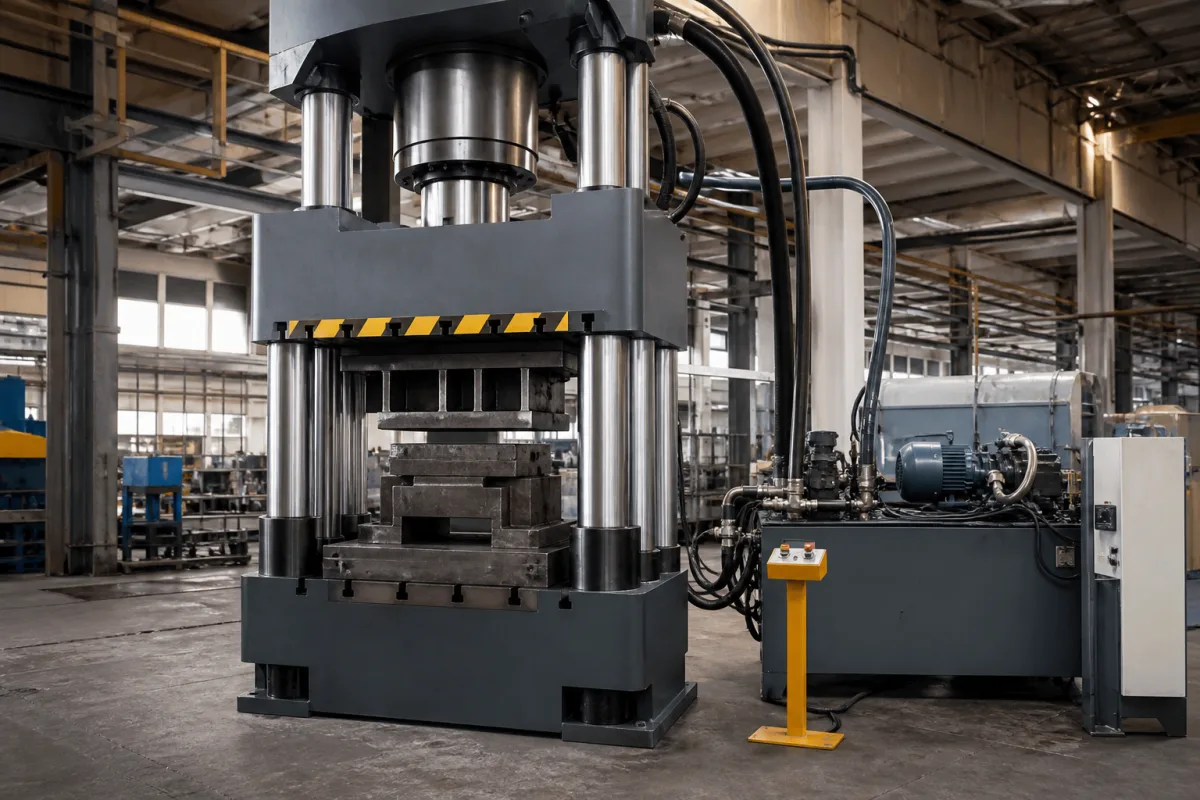
A hydraulic press can stop anywhere in its stroke and vary its force, which makes it flexible and, because operators load parts by hand, dangerous. Size the force and frame for the work, then design the guarding with the press: controls away from the die, safeguarding devices placed from measured stopping time, and energy isolation for die changes and servicing.
General-purpose hydraulic presses for forming, stamping, deep drawing, compacting, moulding and assembly, in C-frame, H-frame and four-column designs, including servo-hydraulic presses. Open-die forging presses and press brakes have their own pages.
CNFX editorial research · Sources checked October 12, 2026 · 7 sources
OSHA notes that there are "many varieties of hydraulic presses performing many different processes", that "hydraulic presses can normally be stopped at any point in their cycle and the force exerted by the dies can be varied", and that "operating speeds are normally slower than mechanical presses" and they "are normally not fully automated", so the operator is closely involved. [1]
As an editorial calculation from basic physics: press force equals system pressure times effective piston area. A 320 mm bore at 25 MPa gives about 25 × 10⁶ × π × 0.16² ≈ 2.0 MN, or about 205 tonnes-force. Ask the supplier for rated force at the stated pressure and the force available at each point of the stroke.
Frame choice follows access, tool size and force: Yihui and Goodsjack list C-frame presses with an open front, and Goodsjack four-column presses for larger tools. Yihui, for example, states that its C-frame design gives fully accessible working space, long stroke and enough opening height. [4][5]
Give the supplier the process, part and tool sizes, the force at each stage, required daylight and stroke, cycle time, and whether parts are loaded by hand, by robot or by feeder.
02
Specify approach, pressing and return speeds
Hydraulic press speeds are specified as a fast approach speed, a slower pressing speed and a return speed; Yihui notes that pressure, stroke and pressing time can be adjusted to the process, and that speeds are adjustable on its servo models but not on its non-servo machines. [4]
Ask the supplier for speeds at full force, the hydraulic power unit and motor rating, and whether a servo-hydraulic drive is offered and what it changes in energy use and noise.
03
Plan guarding and controls with the press
OSHA's machine guarding eTool says hydraulic presses need guards or devices to protect the operator and others from point-of-operation and nip-point hazards; guards must not create hazards and should be attached to the machine where possible; special hand tools can keep hands out of the die area; controls should be away from the die area and use dual palm buttons; foot pedals must be guarded; an emergency stop and a main disconnect are needed; and pump-motor sets should be enclosed. [1]
OSHA adds that, because "most hydraulic power presses and their associated control systems are similar to part-revolution mechanical power presses in that the slide can be stopped at any point in the cycle", presence-sensing devices may be used only on hydraulic presses properly designed and constructed to accommodate them. [3]
For presence-sensing and two-hand devices, OSHA's safety-distance page sets the distance from the device to the hazard using a hand-speed constant of 63 in/s multiplied by the stopping time, and notes that response times and the sensing device's minimum object sensitivity must also be added; stop-time measurement devices are used on hydraulic presses before installing safeguards. [2]
As an editorial calculation only: a measured stopping time of 0.2 s gives 63 × 0.2 ≈ 12.6 in (about 320 mm) before the additional factors are added.
04
Control hazardous energy for die changes and servicing
OSHA's amputation guidance explains that the lockout/tagout standard (29 CFR 1910.147) applies when employees are exposed to hazardous energy during servicing and maintenance, and describes a case in which a press helper cleaning chips between the dies was fatally crushed when the operator moved the slide. [3]
Ask the supplier how the slide is supported and stored energy (accumulators, raised slide) is released for die changes, which isolation points and die blocks are provided, and how setting mode limits speed and stroke.
05
Compare what suppliers build
Goodsjack, PDH and Zhengxi list C-frame, four-column, H-frame, servo, deep-drawing, powder-compacting and cold-extrusion hydraulic presses. [5][6][7]
Goodsjack lists C-frame, four-column, frame-rail, servo and warm and cold extrusion presses; PDH lists composite and deep-draw presses; Zhengxi lists forging and automotive beam-forming presses alongside servo-electric stamping machines. [5][6][7]
06
Main cylinder, hydraulic power unit, C, H or four-column frame, slide and bolster, and safeguarding
Part
Role
Fix in the order
Main cylinder
Converts pressure to force; bore and pressure set tonnage.
Bore, rated pressure and seals.
Hydraulic power unit
Pump, motor, valves and reservoir; should be enclosed. [1]
12 companies list this product among what they make. Company figures are quoted from each
company's own website; every card states where the relationship came from.
China GoodsJack Hydraulic Press Machinery Co., Ltd.
Manufacturing site to be confirmed for the order
Lists C-frame, four-column, frame-rail, servo, deep-drawing and cold-extrusion hydraulic presses.
Explore company information and manufacturing capabilities, then discuss the scope of your project with a relevant supplier.
Share this page
Compiled and source-reviewed by the CNFX editorial team.
Each manufacturer above links to the page on that company's own website where the product is listed, with the date we checked it. How we source and review
· Page last updated 13 October 2026
Buyer questions
Can a hydraulic press stop part-way through the stroke?
OSHA notes that "hydraulic presses can normally be stopped at any point in their cycle and the force exerted by the dies can be varied", unlike full-revolution mechanical presses. [1][3]
Can a light curtain be used on a hydraulic press?
OSHA says presence-sensing devices may be used only on hydraulic presses properly designed and built to accommodate them, placed at a safety distance based on measured stopping time. [3][2]
What controls should a hydraulic press have?
OSHA's eTool calls for controls away from the die area with dual palm buttons, guarded foot pedals, an accessible emergency stop and a main power disconnect. [1]
Sources and what still needs a direct check
Sources checked 2026-10-12. OSHA's machine guarding eTool and its amputation guidance (OSHA 3170) are US government sources; the safety-distance formula is written for presses of all types, not hydraulic presses alone. Supplier pages describe their own offers. EN ISO 16092-3 and ANSI B11.2 were not read for this page.