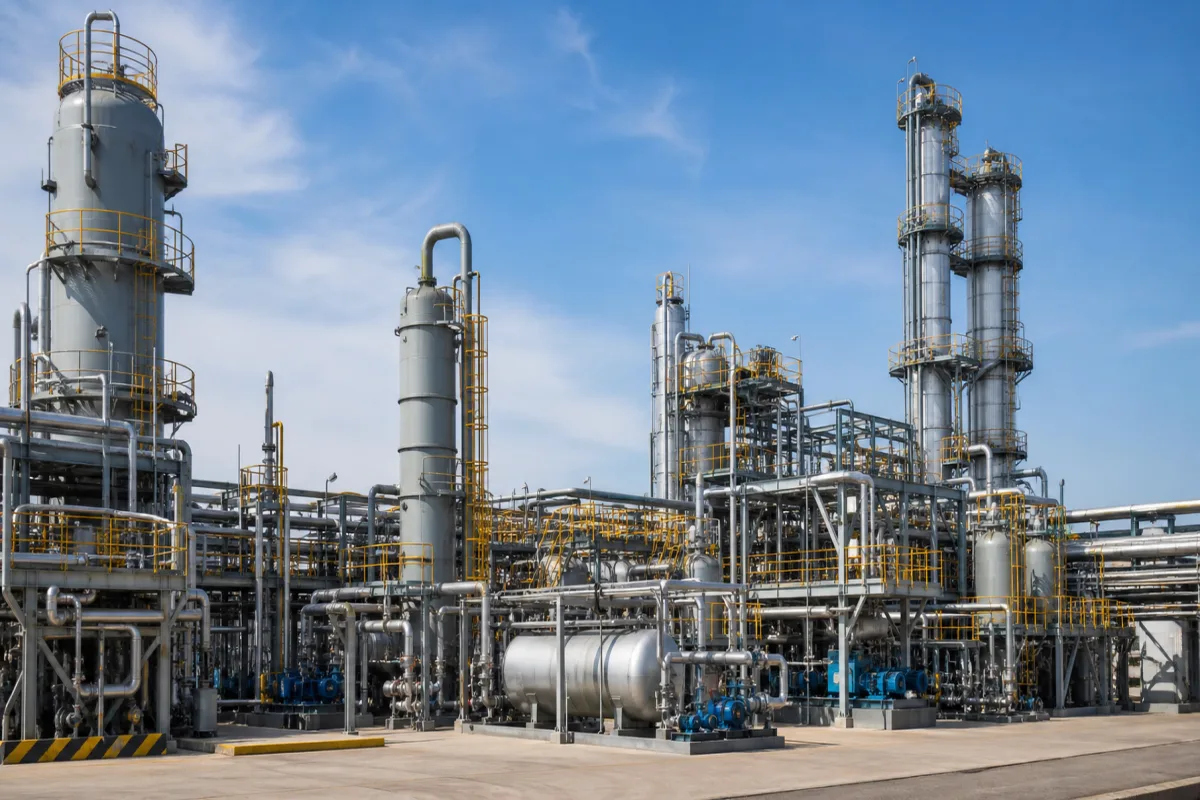
Nitric acid plants · ammonia oxidation over platinum–rhodium gauze, NO oxidation and absorption to 30–70% weak acid, single- and dual-pressure designs with power recovery, extractive distillation to 98–99% strong acid, and NOx tail-gas control by extended absorption or catalytic reduction
A nitric acid production and concentration system makes weak nitric acid by burning ammonia with air over a catalyst, oxidising the nitric oxide and absorbing it in water, and can then concentrate it to strong acid by extractive distillation. Ask three things first: what product strength and capacity the plant must deliver, which pressure scheme suits energy recovery and absorption, and how NOx in the absorber tail gas will meet the permit.
Weak nitric acid plants (ammonia oxidation, NO oxidation, absorption, bleaching, tail-gas treatment and power recovery) and high-strength nitric acid concentration units. Ammonia synthesis, ammonium nitrate and fertilizer finishing plants, and acid storage and loading alone are outside this page except where compared.
CNFX editorial research · Sources checked October 12, 2026 · 4 sources
EPA's AP-42 Section 8.8 explains that nearly all US nitric acid is made by high-temperature catalytic oxidation of ammonia in three steps. A 1:9 ammonia–air mixture is oxidised at 1,380–1,470 °F (up to 1,650 °F) over a catalyst, in AP-42's description, of 90% platinum and 10% rhodium gauze, giving nitric oxide in 93–98% yield; lower temperatures favour less useful nitrogen and nitrous oxide. After a waste heat boiler and platinum filter, the gas is cooled to 100 °F or less at up to 116 psia so that NO reacts with residual oxygen to NO₂, then absorbed counter-currently on sieve or bubble-cap trays with deionised water and secondary air, giving 55–65% acid in AP-42's description (range 30–70%) depending on temperature, pressure, stages and NOx concentration. Older plants run at one pressure, from atmospheric to 203 psia; because oxidation favours low pressure and absorption high pressure, newer dual-pressure plants oxidise at slightly negative to about 58 psia and absorb at 116–203 psia, bleach the acid with air, reheat the tail gas to about 392 °F and expand it in a power-recovery turbine that can drive the compressor. [1]
High-strength acid of 98–99% is made from weak acid by extractive distillation with a dehydrating agent, such as concentrated sulfuric acid: sulfuric acid and 55–65% nitric acid are fed to the top of a packed dehydrating column at about atmospheric pressure, 99% nitric acid vapour leaves the top to a bleacher and condenser, and recovered NOx returns to an absorption column as weak acid. [1]
Give the supplier the capacity (as 100% HNO₃ per day), product strength(s), single- or dual-pressure preference, ammonia and air supply conditions, catalyst and recovery-filter arrangement, steam export and power recovery targets, tail-gas NOx and N₂O limits and the control technology, concentration route and dehydrating agent, materials of construction, utilities, site and permitting constraints.
02
Control NOx in the absorber tail gas
AP-42 identifies the absorber tail gas as by far the largest NOx source; emissions rise with insufficient air, low absorber pressure, high cooler-condenser or absorber temperatures, excessively strong product, high throughput and faulty compressors or pumps. Extended absorption adds trays, raises absorber pressure, cools the weak acid or adds a tower; catalytic reduction heats the tail gas, mixes it with fuel such as natural gas or hydrogen and reduces NOx to nitrogen over a catalyst, can achieve greater reduction and allows heat recovery, though high fuel costs have reduced its use. Its emission factors (as 100% acid) are 57 lb NOx per ton uncontrolled from a weak-acid plant, 0.4 lb/ton with natural-gas catalytic reduction (99.1% control), 0.8 with hydrogen, 1.9 with single-stage extended absorption and 2.1 with dual-stage, and 10 lb/ton from a high-strength acid plant. Its worked basis notes that 500 tons per day of 55% acid counts as 275 tons per day of 100% acid. [1]
Editorial calculation: for 275 tons/day of 100% acid, uncontrolled tail gas would emit about 275 × 57 ≈ 15,700 lb NOx per day; with natural-gas catalytic reduction about 275 × 0.4 = 110 lb/day, and with single-stage extended absorption about 275 × 1.9 ≈ 520 lb/day. These AP-42 factors are dated averages rated E; design to the permit and supplier guarantees.
03
Ask for N₂O abatement and a measured N₂O emission factor
The 2006 IPCC Guidelines state that nitrous oxide (N₂O) forms as an unintended by-product of the high-temperature catalytic oxidation of ammonia, in amounts that depend on combustion pressure and temperature, catalyst composition and age, and burner design, and that nitric acid production is the major source of N₂O in the chemical industry. Their Table 3.3 gives default factors per tonne of 100% acid by plant type. [4]
IPCC groups abatement by position: primary measures in the ammonia burner, secondary measures removing N₂O from the process gas between converter and absorber, tertiary measures on the tail gas, best placed upstream of the expansion turbine, and quaternary measures after the expander. It calls direct tail-gas decomposition attractive above 723 K tail-gas temperature, and notes that process-gas decomposition in the burner can be applied to existing plants. [4]
Editorial calculation: for the 275 t/day (100% acid) example above, 9 kg/t gives about 2,475 kg N₂O a day for a high-pressure plant and 2.5 kg/t about 690 kg a day with N₂O destruction; 723 K is about 450 °C. Ask for a guaranteed, measured N₂O value rather than these defaults. [4][1]
Plant type (IPCC Table 3.3)
Default N₂O factor (kg per t of 100% HNO₃)
Uncertainty
With NSCR (all processes)
2
±10%
With process-integrated or tail-gas N₂O destruction
2.5
±10%
Atmospheric pressure (low pressure)
5
±10%
Medium pressure combustion
7
±20%
High pressure
9
±40%
State the N₂O limit or target, the abatement position (burner, process gas or tail gas) and the measurement method for the guarantee.
04
Pick the pressure level against yield and tail-gas NOx
Fertilizers Europe's BAT booklet No. 2, Production of nitric acid (2000 edition), classifies plants by pressure: low (below 1.7 bar), medium (1.7–6.5 bar) and high (6.5–13 bar), and covers weak acid of 50–65% used by the fertilizer industry. It gives the NO yield of ammonia oxidation falling as pressure rises, and lists the gauze catalyst as about 90% platinum alloyed with rhodium, with a palladium alloy catchment recovering 60–80% of the platinum lost. [3]
The booklet notes that NSCR units need tail gas preheated to at least 300 °C with hydrogen or 550 °C with methane and also reduce N₂O, that an SCR unit taking tail gas from 1,000 to 200 ppmv NOx adds about 1.1% to operating cost with maintenance cost of about 2.5% of the SCR capital cost, and that start-up and shut-down raise stack NOx for a few hours. [3]
Editorial calculation: at 3,300 Nm³ of tail gas per tonne of acid, a 1,000 t/d plant (100% HNO₃ basis) releases about 3.3 million Nm³ of tail gas a day.
Item (Fertilizers Europe booklet)
Value
NO yield below 1.7 bar, 810–850 °C
97%
NO yield 1.7–6.5 bar, 850–900 °C
96%
NO yield above 6.5 bar, 900–940 °C
95%
Tail gas NOx without abatement, medium-pressure absorption
1,000–2,000 ppmv
Tail gas NOx without abatement, high-pressure absorption
100–200 ppmv
Tail gas range in stable operation
NOx 100–3,500 ppmv; N₂O 300–3,500 ppmv; 3,100–3,400 Nm³ per t of 100% HNO₃
BAT level, new plants
100 ppmv NOx ≈ 0.65 kg NO₂ per t of 100% HNO₃
BAT level, existing plants (24 h average)
200 ppmv ≈ 1.4 kg NO₂ per t (SCR-equipped plants up to 400 ppmv)
State the plant capacity (t/d of 100% HNO₃), product strength, the absorber pressure scheme and the NOx and N₂O limits the plant must meet, and ask for guaranteed tail-gas values and abatement method.
05
Compare plant configurations
No manufacturer record has been reviewed for this product yet; the configurations below come from the source cited.
Configurations include single-pressure and dual-pressure weak acid plants, with tail-gas control by extended absorption, catalytic reduction or chilled absorption with caustic scrubbing, and high-strength concentration units using extractive distillation; EPA's background report for the section gives the same process basis, including the 90% platinum / 10% rhodium catalyst. [1][2]
06
Trace the plant units
This is a functional reference built from the sources cited; it is not one maker's specification.
Fill the specification fields with values for your plant
A nitric acid plant quotation needs values for your plant. The table explains each field, gives published values where a reviewed source states them, and says what to obtain from the supplier.
Explore company information and manufacturing capabilities, then discuss the scope of your project with a relevant supplier.
Share this page
Compiled and source-reviewed by the CNFX editorial team.
Published product pages show what a company offers, not tested performance. Confirm the legal seller, factory and scope for your order. How we source and review
· Page last updated 13 October 2026
Buyer questions
How is weak nitric acid made?
AP-42 describes oxidising a 1:9 ammonia–air mix over platinum–rhodium gauze, oxidising NO to NO₂ and absorbing it in water to give 30–70% acid. [1]
Why do newer plants use two pressures?
Ammonia oxidation is favoured by low pressure and NO oxidation and absorption by high pressure, so dual-pressure plants put a compressor between oxidiser and condenser. [1]
How much NOx does a nitric acid plant emit?
AP-42 gives 57 lb/ton uncontrolled from weak-acid tail gas and 0.4–2.1 lb/ton with catalytic reduction or extended absorption. [1]
What NOx level is achievable for a new nitric acid plant?
Fertilizers Europe's BAT booklet gives 100 ppmv NOx (excluding N₂O), about 0.65 kg NO₂ per tonne of 100% nitric acid, for new plants in normal operation. [3]
How much N₂O does a nitric acid plant emit?
The 2006 IPCC Guidelines give default factors from 2 kg N₂O per tonne of 100% acid for plants with NSCR to 9 kg per tonne for high-pressure plants; plant measurements take precedence over these defaults. [4]
Sources and what still needs a direct check
Sources checked 2026-10-12. EPA AP-42 and its background report are US Environmental Protection Agency documents on emission factors and process descriptions (cited from Internet Archive copies of epa.gov files); the factors are dated averages.