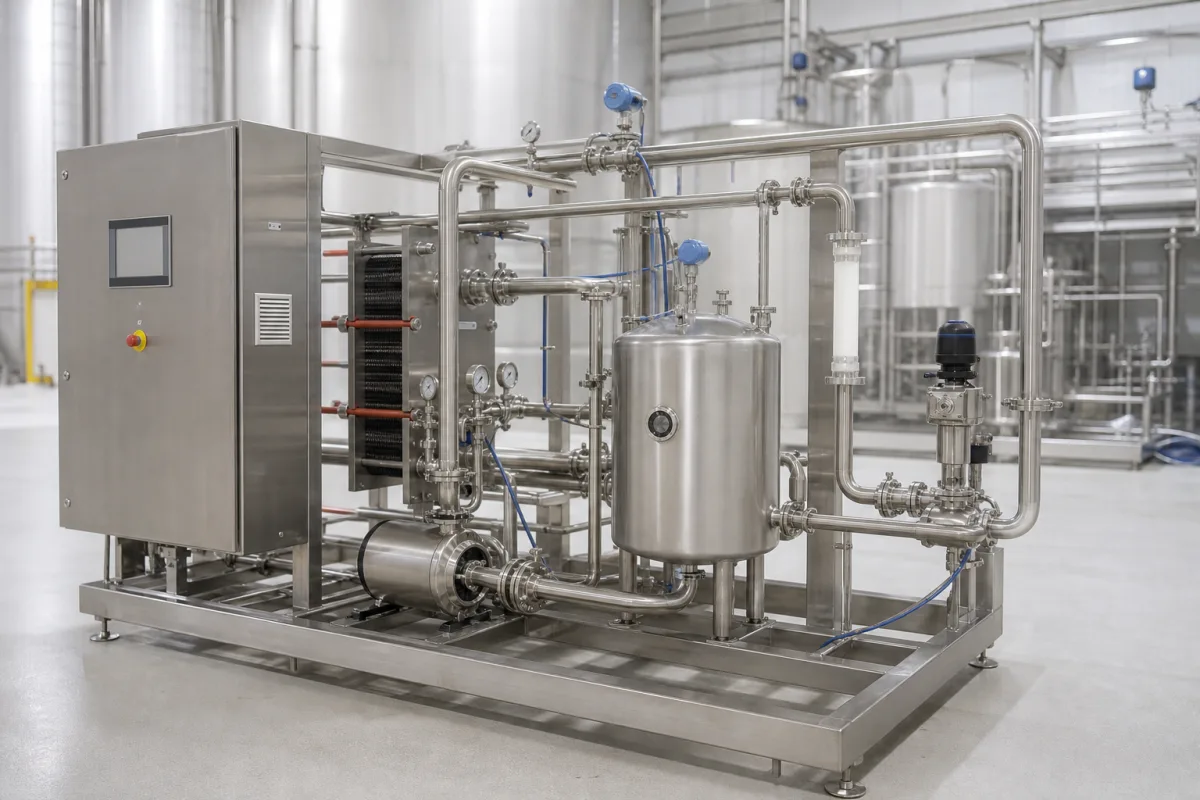
HTST and HHST pasteurisers · Legal time-temperature pairs, higher temperatures for rich products, flow-diversion device, sealed timing pump
A continuous-flow pasteurisation system heats milk or another liquid food in a plate or tubular heat exchanger, holds it at temperature in a holding tube for a set time, then cools it, with a timing pump fixing the flow, a recorder-controller proving temperature, and a flow-diversion valve sending under-processed product back. Ask three things first: which time-temperature pair your product and market require, how the system controls and records it, and how the flow-diversion device and timing pump are made fail-safe and sealed.
HTST and HHST continuous-flow pasteurisers for milk, dairy products and similar liquid foods, with heat exchanger, holding tube, timing pump, controls and flow-diversion device. Batch (vat) pasteurisers, UHT aseptic systems, tunnel pasteurisers for packaged products and heat exchangers sold alone are outside this page.
CNFX editorial research · Sources checked October 11, 2026 · 4 sources
The FDA's Grade 'A' Pasteurized Milk Ordinance (2025 revision) defines pasteurisation as heating every particle of milk or milk product, in properly designed and operated equipment, to one of its listed temperatures and holding it continuously at or above that temperature for at least the matching time. For continuous-flow (HTST and HHST) systems the pairs are 72 °C (161 °F) for 15 s, 89 °C (191 °F) for 1.0 s, 90 °C (194 °F) for 0.5 s, 94 °C (201 °F) for 0.1 s, 96 °C (204 °F) for 0.05 s and 100 °C (212 °F) for 0.01 s; batch pasteurisation is 63 °C (145 °F) for 30 minutes. [1]
If the product has 10% fat or more, 18% total solids or more, or added sweeteners, the 63 °C and 72 °C temperatures are raised by 3 °C (5 °F). For HHST systems with short holding tubes, holding time is determined from the pumping rate, and because laminar flow can make the fastest particle travel twice as fast as the average, holding tube lengths are calculated as twice the length needed to hold the average flow for the required time. [1]
Editorial calculation: at 5,000 L/h and 15 s, the holding tube must hold at least 5,000 ÷ 3,600 × 15 ≈ 20.8 L of product at average flow; for a sweetened mix the HTST temperature becomes 75 °C. Confirm the length the regulator accepts after its holding time test. [1]
Give the supplier the products (fat, solids, sweeteners), capacity, target time-temperature, market and regulator, heat exchanger type and regeneration, holding tube, timing method (positive-displacement pump or magnetic flow meter), controls and recording, flow-diversion device type and position, CIP, utilities and space.
02
Control, record and divert under-processed product
The PMO requires the timing pump to be driven so the holding time cannot be shortened without detection, with gear box, pulleys or variable-speed setting sealed by the regulatory agency after testing; variable-speed belts must slow the pump, not speed it, as they wear. Holding time is controlled by a positive-displacement timing pump or a magnetic flow meter-based timing system. [1]
The flow-diversion device (FDD) must divert automatically if its primary motivating power fails, must be located downstream of the holding tube with the flow-control sensor no more than 46 cm (18 in) upstream of its inlet, must have a tight forward-flow seat with a leak-escape device, and must drain diversions through a self-draining line. For regenerators, a controller diverts the FDD whenever pasteurised product pressure fails to exceed the heat-transfer medium pressure by at least 6.9 kPa (1 psi). [1]
Editorial note: these are US Grade 'A' requirements; other markets set their own, so ask the supplier which regulator's tests (seal, holding time, diversion) the system has passed.
03
Size the holding tube and the heat recovery
Tetra Pak's Dairy Processing Handbook explains that holding is done in an external holding cell, a pipe in a spiral or zig-zag pattern, sized so the time in it equals the required holding time at a given flow rate; holding time changes in inverse proportion to flow. Because the velocity profile is not uniform, an efficiency factor is applied to the tube length, in the range 0.8–0.9 when flow is turbulent and lower for viscous products in laminar flow; its worked example of 10,000 l/h, 15 s, 48.5 mm inner diameter and factor 0.85 gives about 26.5 m of tube. [2]
The handbook states that regenerative heat exchange can recover 94–95% of the heat content of the pasteurised milk, defines regenerative efficiency R from the milk temperature after regeneration, the raw milk temperature and the pasteurisation temperature, and uses 4 °C raw milk, 68 °C after regeneration and 72 °C pasteurisation as its example. It also notes that doubling product flow from 10,000 to 20,000 l/h doubles the required heat exchanger size, other factors being constant. [2]
For the EU (text as retained in UK law), Regulation (EC) No 853/2004, Annex III Section IX, defines pasteurisation as at least 72 °C for 15 seconds, at least 63 °C for 30 minutes, or another time-temperature combination with an equivalent effect, such that the products show, where applicable, a negative alkaline phosphatase test immediately after treatment; UHT is not less than 135 °C in continuous flow with a suitable holding time. [3]
Editorial calculation: R = (68 − 4) / (72 − 4) ≈ 94%. Using the handbook's method at 5,000 l/h, 15 s and factor 0.85, the tube holds 5,000 / 3,600 × 15 / 0.85 ≈ 24.5 l, about 13.3 m of 48.5 mm pipe; the PMO's laminar-flow rule above doubles the length instead, so state which rule your regulator applies. [2][1]
State flow rate per product, holding time and tube inner diameter, the efficiency or laminar-flow factor the regulator accepts, target regeneration, and the verification test (alkaline phosphatase or holding time test) for your market.
04
Verify the product leaving the pasteuriser, not only the recorder chart
The European Food Safety Authority's 2021 scientific report on alkaline phosphatase (ALP) testing notes that under Implementing Regulation (EU) 2019/627 an ALP test on cows' milk is negative when the measured activity is not higher than 350 mU/L by the reference method ISO 11816-1. It cites estimates that this limit corresponds to roughly 0.02–0.05% raw milk in pasteurised milk (Greenwood and Rampling, 1997), 0.05% (Punoo, 2018) and below 0.1% (Scintu et al., 2000). [4]
For goat and sheep milk, EFSA concludes from the data available that there is a 95–99% probability that pasteurised goat milk and sheep milk would have ALP activity below 300 and 500 mU/L respectively, while recommending more data. It points out that temperature monitoring with data loggers cannot detect other process failures such as cracked or leaking plates, and that Enterobacteriaceae counts suit hygiene monitoring rather than pasteurisation verification. [4]
For an equipment order this means asking how the supplier lets you prove both the heat treatment and the integrity of the regenerator: the recorder-controller and flow-diversion logic cover time and temperature, [1] while a plate leak from raw to pasteurised side would show up only in product testing such as ALP or in pressure or leak testing of the plates. Editorial calculation: at the 0.05% estimate, 350 mU/L corresponds to about 0.5 litre of raw milk per 1,000 litres of product. [4]
HTST and UHT pasteurisers from the listed beverage-line maker
Zhangjiagang Mars lists UHT and HTST pasteurisers as part of beverage filling line equipment; for Grade 'A' milk, ask whether its HTST unit includes the sealed timing pump, recorder-controller and flow-diversion device described in the control section above.
Listings include UHT and HTST pasteurisers within beverage and dairy filling line ranges.
06
Regenerator, holding tube, timing pump, recorder-controller and diversion device
The holding tube and the timing pump together fix holding time: the PMO has the pump setting sealed, and Tetra Pak sizes the tube from flow rate with an efficiency factor of 0.8–0.9 in turbulent flow. [1][2]
Capacity, time-temperature pair, regeneration and ALP verification for a pasteuriser
Capacity drives the holding tube: Tetra Pak's example of 10,000 l/h held 15 s in a 48.5 mm bore needs about 26.5 m. Time and temperature come from the PMO pairs, 72 °C for 15 s through 100 °C for 0.01 s. [2][1]
Field
What it means and published values
Ask the supplier for
Processing capacity (L/h)
Sets holding tube volume and heat exchanger size. [2]
1 company lists this product among what they make. Company figures are quoted from each
company's own website; every card states where the relationship came from.
Zhangjiagang Mars Packing Machinery Co., Ltd.
Manufacturing site to be confirmed for the order
Lists UHT and HTST pasteurisers within beverage filling line equipment.
Explore company information and manufacturing capabilities, then discuss the scope of your project with a relevant supplier.
Share this page
Compiled and source-reviewed by the CNFX editorial team.
Each manufacturer above links to the page on that company's own website where the product is listed, with the date we checked it. How we source and review
· Page last updated 13 October 2026
Buyer questions
What temperature and time does HTST pasteurisation use?
The PMO's minimum continuous-flow pair is 72 °C (161 °F) for 15 seconds, with higher temperatures for shorter times up to 100 °C for 0.01 s. [1]
When must the pasteurisation temperature be raised?
By 3 °C (5 °F) for products with 10% or more fat, 18% or more total solids, or added sweeteners. [1]
What does a flow-diversion device do?
It sends under-processed product back, must divert automatically on power failure, and sits downstream of the holding tube within 46 cm of the control sensor. [1]
How long is a holding tube?
In Tetra Pak's example, 10,000 l/h for 15 s in 48.5 mm pipe with an efficiency factor of 0.85 needs about 26.5 m. [2]
How much heat does a pasteuriser recover?
Regeneration can recover 94–95% of the heat content of the pasteurised milk. [2]
What does the EU require for pasteurisation?
At least 72 °C for 15 s, 63 °C for 30 min or an equivalent combination, with a negative alkaline phosphatase test where applicable. [3]
What alkaline phosphatase result shows cows' milk was pasteurised?
EFSA's 2021 report notes that under EU rules the ALP test is negative at not more than 350 mU/L by ISO 11816-1, equivalent to roughly 0.02–0.1% raw milk depending on the study cited. [4]
Sources and what still needs a direct check
Sources checked 2026-10-11. The Pasteurized Milk Ordinance is the US FDA and NCIMS model regulation for Grade 'A' milk; Regulation (EC) No 853/2004 and EFSA's 2021 report on alkaline phosphatase testing cover verification in the EU; other countries' dairy rules differ.