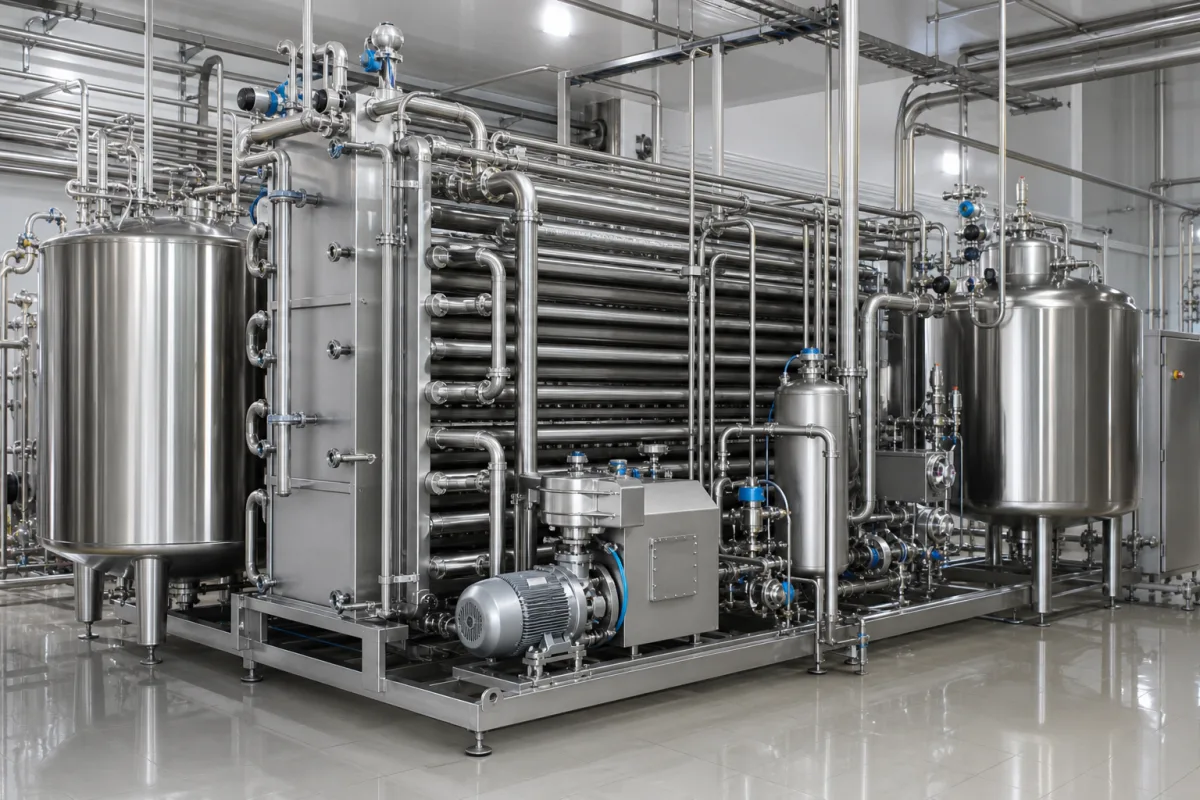
Automated ultra-high temperature sterilization line
UHT sterilization lines · Direct steam injection or infusion versus indirect tubular or plate heating, 135–150 °C for a few seconds, holding tube, regeneration, homogenization at 180–250 bar, aseptic cooling and the SIP, production, AIC and CIP modes
A UHT (ultra-high temperature) line heats a pumpable liquid such as milk to around 140 °C for a few seconds in continuous flow, holds it, cools it and sends it to aseptic filling so it keeps without refrigeration. Ask three things first: which products and capacity it must run, whether direct (steam injection or infusion) or indirect (tubular or plate) heating suits them, and how homogenization, aseptic storage, filling and cleaning will be arranged.
Continuous UHT sterilization plants for milk, cream, dairy drinks and other pumpable liquid foods, with their heating, holding, homogenizing, cooling and cleaning stages. Pasteurizers (see continuous flow pasteurization system), aseptic filling machines (see aseptic filling machine) and in-container retort or tower sterilizers are outside this page.
CNFX editorial research · Sources checked October 12, 2026 · 4 sources
Tetra Pak's Dairy Processing Handbook describes two main types of UHT system. Indirect systems transfer heat through a stainless steel wall in plate, tubular, scraped-surface or coiled-tube heat exchangers; direct systems mix the product with steam by injection or infusion and then flash-cool it in a vacuum vessel. [1]
In its indirect tubular example, product at about 4 °C is regenerated to about 75 °C against outgoing product, homogenized at 180–250 bar (18–25 MPa) with a non-aseptic homogenizer, heated to about 138 °C by a closed hot-water circuit, held in a tube sized for about 4 seconds, then cooled regeneratively before aseptic packaging or an aseptic tank. The handbook calls indirect heating the lowest-cost method and says tubular systems predominate in dairy UHT. [1]
In its direct steam injection example, product pre-heated to about 80 °C is raised to about 140–150 °C by steam injection, held a few seconds, flash-cooled in a vacuum vessel that removes as much vapour as steam was injected, and then homogenized in an aseptic two-stage homogenizer before cooling to about 20 °C. It lists such plants at 2,000–45,000 l/h and says direct systems suit heat-sensitive products because heating and cooling are faster; scraped-surface and coiled-tube exchangers are for very viscous or particulate products. [1]
A second equipment maker describes the same direct route for liquid foods beyond milk. Alfa Laval's Steritherm DSI module preheats product by regeneration in an indirect heat exchanger to about 80 °C, brings it to sterilization temperature in a steam injector, holds it in a holding tube, and flash-cools it in a vacuum vessel where pressure and temperature drop almost instantly to 85 °C and the excess water from the injected steam is removed as vapour; an aseptic homogenizer is optional before the cooling section. Alfa Laval states that the module controls product temperature and water content automatically, raises an alarm on a temperature deviation of more than ±1 °C, sterilizes in place with superheated water before production, uses 100% of the latent heat of the steam and needs no condensate return; it names soups, sauces, baby foods, coconut milk, plant-based beverages and starch-based products as applications, packed through an aseptic bag-in-box line. [4]
Editorial note: both Tetra Pak and Alfa Laval preheat to about 80 °C before injection, so the regeneration section sets much of the energy balance; ask the supplier for the temperature deviation that triggers an alarm or diversion, how water added by the steam is measured and removed, and the flash-vessel exit temperature for your product. [4][1]
Give the supplier the products and their viscosity and particles, capacity in l/h and any turndown, heating method, target temperature and holding time, homogenizer position and pressure, regeneration, outlet temperature, connection to aseptic tank and filling machines, steam, water, power and air supply, and cleaning requirements.
02
Set time, temperature, product quality and operating modes
The handbook defines UHT as continuous heating to not less than 135 °C with a suitable holding time so that no viable microorganisms or spores capable of growing remain, and says the practical range is 137–142 °C for 4–6 seconds, depending on product. Low-acid products above pH 4.5 are treated at 135–150 °C for a few seconds. [1] US rule 21 CFR 131.3 defines an ultra-pasteurized dairy product as one processed at or above 280 °F for at least 2 seconds. [2]
The handbook lists four automatic operating modes: pre-sterilization (SIP), production, aseptic intermediate cleaning (AIC) and full cleaning in place (CIP). Pre-sterilization uses hot water reaching at least 125 °C at all product-contact points for at least 30 minutes; a 30-minute AIC removes fouling without losing aseptic conditions; and a full CIP cycle takes 70 to 90 minutes. If the sterilization temperature drops during production, product is diverted to a reject tank. [1]
Indirect plants can be designed for 50–100% of nominal capacity, and a split heater can bypass the first heating section at reduced flow to limit over-processing. The handbook warns that milk below pH 6.65 at 20 °C has reduced thermal stability and fouls heating surfaces. [1]
Editorial calculation: 280 °F is about 137.8 °C; at 50% of nominal flow the holding time in the same tube doubles, so a 4-second tube gives about 8 seconds. [2][1]
In the US, 21 CFR 113.40 sets equipment requirements for aseptic processing and packaging systems for low-acid foods. The holding tube must hold every particle for at least the scheduled minimum time, must not be heatable between inlet and outlet, and must slope upward at least ¼ inch per foot (2.1 cm per metre). A temperature-recording sensor must sit in the product at the holding-tube outlet, before the cooler, and a flow control device upstream of the tube must keep the required flow, with a means to prevent unauthorised adjustment. Where a product-to-product regenerator is used, sterilized product must stay at higher pressure than unsterilized product, monitored by a differential pressure recorder-controller accurate to within 2 psi (13.8 kPa). A flow-diversion system, if fitted, should divert product away from the filler or aseptic tank automatically when holding-tube temperature or regenerator pressure differential falls below the scheduled values. [3]
Editorial calculation: a 10 m holding tube sloped at 2.1 cm per metre rises about 21 cm from inlet to outlet; check the supplier's layout drawing for the slope and for any heated section inside the tube length. [3]
03
Find automated UHT sterilization line manufacturers
The companies in the manufacturer list below show this product on their own websites. Confirm the legal seller, factory and scope for your order.
Ask any supplier for heating method, capacity and turndown, sterilization temperature and holding time with holding tube validation, regeneration rate, homogenizer type and pressure, steam, water, power and air consumption, SIP, AIC and CIP programs and times, control and recording system, footprint and installation scope.
04
Trace what each part does
This is a functional reference built from the sources cited; it is not one maker's specification.
Diverts product if holding temperature or pressure differential drops. [1][3]
Interlock.
Recorders and flow control
Outlet temperature recording; flow control upstream of the tube; differential pressure recorder-controller. [3]
Instruments; accuracy.
05
Fill the specification fields with values for your order
A UHT line quotation needs values for your products. The table explains each field, gives published values where a reviewed source states them, and says what to obtain from the supplier.
Field
What it means and published values
Ask the supplier for
Processing Capacity (L/h)
e.g. 2,000–45,000 l/h direct injection plants. [1]
Explore company information and manufacturing capabilities, then discuss the scope of your project with a relevant supplier.
Share this page
Compiled and source-reviewed by the CNFX editorial team.
Published product pages show what a company offers, not tested performance. Confirm the legal seller, factory and scope for your order. How we source and review
· Page last updated 13 October 2026
Buyer questions
What temperature and time does UHT use?
Tetra Pak's handbook gives at least 135 °C, in practice 137–142 °C for 4–6 seconds depending on product. [1]
What is the difference between direct and indirect UHT?
Direct systems mix steam into the product and flash-cool it; indirect systems heat through a wall in plate or tubular exchangers. [1]
How is ultra-pasteurized defined in US dairy rules?
21 CFR 131.3 requires processing at or above 280 °F for at least 2 seconds. [2]
What does US law require of a UHT holding tube?
Under 21 CFR 113.40 it must hold every particle for the scheduled time, have no heated section, slope upward at least 2.1 cm per metre and carry a temperature-recording sensor at its outlet. [3]
How tightly is sterilization temperature controlled in a direct steam injection UHT module?
Alfa Laval states that its Steritherm DSI raises an alarm on a temperature deviation of more than ±1 °C, after preheating to about 80 °C and before flash cooling to 85 °C. [4]
Sources and what still needs a direct check
Sources checked 2026-10-12. Tetra Pak publishes the Dairy Processing Handbook and Alfa Laval a product page for its own direct steam injection sterilizer; the US eCFR publishes dairy definitions and aseptic processing rules.