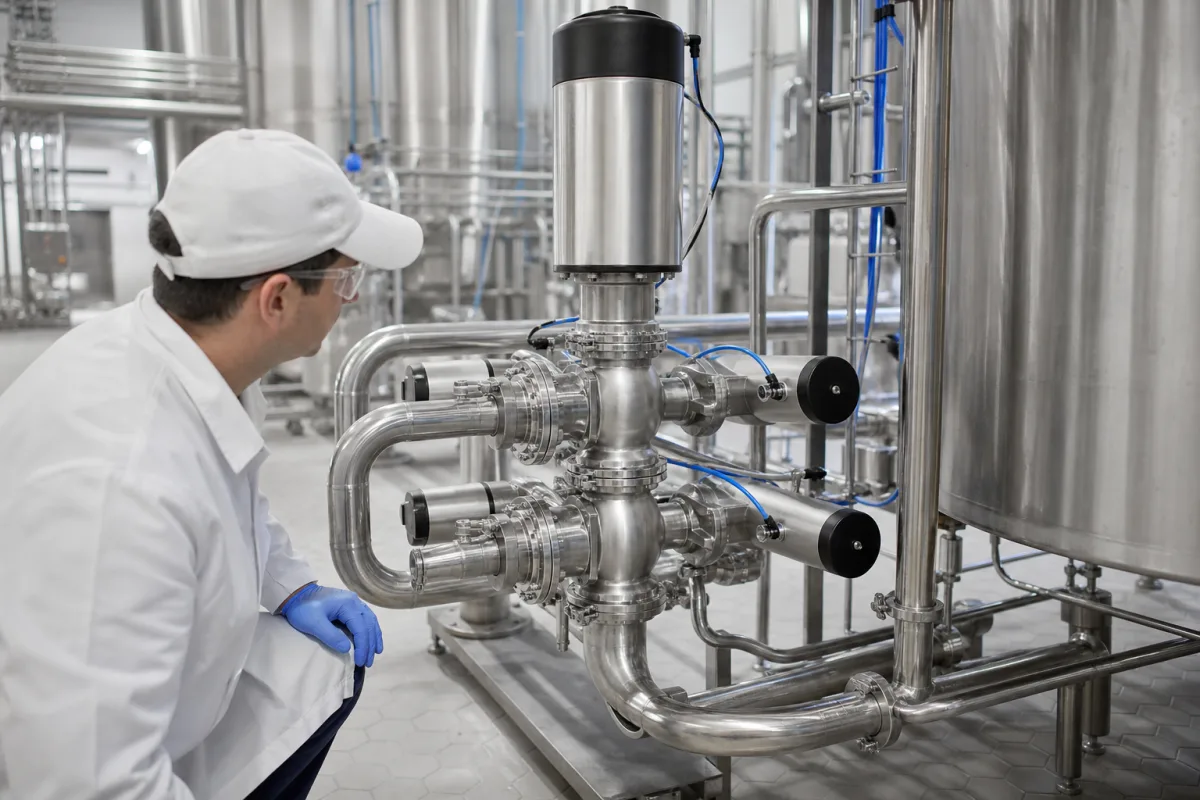
Dual-stem flow diversion valve for milk pasteurisers: the divert and leak-detect valves, their stems and position switches, and the time delays that sequence them
The two-valve assembly at the end of a dairy pasteuriser's holding section · divert valve and leak-detect valve, standard or reverse-acting stems, 1½ to 6 inch bodies, position switches in the control top, and the timers that sequence forward flow, inspection and CIP
Where the holding tube of a milk pasteuriser ends, the product reaches a valve assembly that decides whether it goes forward to the regenerator and cooler or back to the balance tank. In the dual-stem form two valves are combined: a divert valve that turns sub-temperature product back, and a leak-detect valve downstream of it that only opens to forward flow after a delay, with the space between them drained to the tank so a leaking divert seat cannot pass raw product forward. Buying one means choosing body size and stem design for the line's flow and pressure, the position switches and solenoids that report and drive each stem, and the timers that sequence product, inspection and cleaning modes.
Dual-stem (divert plus leak-detect) flow diversion valves and their control tops, solenoids and sequencing timers for HTST and HHST continuous-flow pasteurisers of milk and liquid dairy products: standard and reverse-acting stems, tangential drainable bodies, aseptic steam-barrier versions, sizes and pressure ratings, position sensing, product, inspect and CIP time delays, and the regulatory FDD tests. Complete pasteurisers with their time-temperature pairs, timing pump, holding tube and recorder-controller are covered on the Continuous-flow (HTST) pasteurisation system page; plate regenerators on the Regeneration section of a plate pasteuriser page; beer flash pasteuriser regeneration on the Regenerative section of a beer flash pasteuriser page; hot-fill holding tubes on the Product heating and holding tube for hot-fill beverages page; and turbocharger diverter valves on the Wastegate page.
CNFX editorial research · Sources checked October 13, 2026 · 4 sources
Divert valve over leak-detect valve: standard or reverse-acting stems, tangential bodies and the pressure each size takes
Alfa Laval's Tri-Clover 762 assembly comes as a standard upright valve, which closes with the flow, and a horizontally mounted reverse-acting valve that closes against the flow; the reverse-acting design is meant to stop hydraulic shock in systems where the differential pressure across the valve is 30 psig or more, and its tangential bodies keep it drainable for CIP, with the divert valve mounted above the leak-detect valve. [1][2] Its two-piece stem is joined by a nut and O-ring outside the product stream; if that O-ring fails, leakage runs out through leak-detect holes in the short stem and shows in a clear plastic stem guard. [2]
Alfa Laval lists 80 psi air supply for all sizes except the 4-inch reverse-acting valve at 90 psi, 316L wetted parts with a 32 Ra finish, and Buna, EPDM or fluoroelastomer seats or a replaceable PTFE ('TR') seat; product pressure can be raised at reduced capacity. [1] For aseptic lines its 862W-227M version adds a sterile-barrier collar and extended stem to each valve so steam can be piped around the upper stem, with a fluoroelastomer seat and high-temperature bushing. [2] Editorial calculation: 950 gpm is about 216 m³/h, roughly 4.4 times the 215 gpm of the largest standard upright valve.
GEA builds its VARIVENT FDD from two non-knocking shuttle valves welded into one assembly, with the diversion connection vertical (type XKR) or horizontal (type XWR), in 1 to 6 inch OD with 1.4404/316L product-contact parts and spring-to-close actuators. [3] It specifies 6 bar control air (4 to 8 bar) for a 5 bar product pressure with the standard actuator; for higher product pressure the manual prints 'max. 10 bar (116 psi)' with a correspondingly designed actuator, which does not convert (10 bar is about 145 psi), so the figure should be confirmed with GEA. [3] It warns against installing the valve spring-to-open, because loss of power or air would then open it and mix product. [3] EPDM seals are listed for −40 to +135 °C, HNBR −25 to +140 °C and FKM −10 to +200 °C as general resistance rather than maximum operating temperature. [3]
Give the bidder line flow, the pressure at the valve during forward flow and diversion, whether differential pressure across the divert seat can reach 30 psig, the CIP temperature, and whether the line is aseptic.
02
Divert, leak-detect and forward-flow positions: the delays between them and the FDD tests an inspector runs
GEA describes three positions. After assembly the valve rests in flow diversion, returning product to the surge tank while pasteurising temperature is not met; when the legal temperature is reached the shuttle valve moves to leak detection, flushing the space shared with the leak-detect valve back to the tank through a separate return line; only when its controller signals does the assembly move to flow, with both valves actuated. [3] Each control top carries two sensors that report the non-actuated and actuated positions to the main control. [3]
The same manual lists a response time above one second as one cause of a valve failing to assume the divert position, and gives 70 psig actuator air for 2, 2½ and 3 inch valves during its microswitch check. [2] Alfa Laval's PLC panels for the 762 run the valve-top solenoids and switches at 24 VAC from a 115 VAC supply and have provision for regulatory seals. [1]
The New York State Department of Agriculture and Markets test sheet for HHST systems, which refers to Appendix I of the PMO (2003 revision), lists the FDD checks as leakage past the FDD (5.1), freedom of movement (5.2), device assembly for dual-stem valves (5.4), manual diversion (5.5), response time (5.6), and the inspect and CIP time delays (5.7, 5.8); it marks the leak-detect flush time delay (5.9) as not applicable to HHST, and manual diversion as not required with an FDD located after the regenerator and final cooler. [4]
Delay in Alfa Laval's relay control panel
Purpose
Setting given in the manual
CRT1, leak-detect delay
Holds the leak-detect valve in divert after the divert valve goes to forward flow, to prevent forwarding unsafe product
Ask for the valve's position-switch adjustment method, the timer ranges in the panel, and which delays and switches carry regulatory seals, since those are the settings the inspector will retest.
03
Data for a dual-stem flow diversion valve
Paste it into your enquiry below or into an email to a maker, then replace every bracket.
Process: [HTST or HHST; product; flow rate; pressure at valve; CIP temperature]
Valve: [size; standard or reverse-acting; vertical or horizontal diversion port; aseptic steam barrier or not]
Materials: [316L; seat material EPDM, FKM, HNBR, Buna or PTFE]
Actuation: [air pressure available; spring-to-close; solenoids on valve or in panel; voltage]
Control: [position sensors; leak-detect, inspect and CIP delays; panel with regulatory seals; PLC or relay]
Location: [after holding tube, or after regenerator and cooler]
Explore company information and manufacturing capabilities, then discuss the scope of your project with a relevant supplier.
Share this page
Compiled and source-reviewed by the CNFX editorial team.
Each manufacturer above links to the page on that company's own website where the product is listed, with the date we checked it. How we source and review
· Page last updated 13 October 2026
Buyer questions
Why does a flow diversion valve have two stems?
A divert valve sends sub-temperature product back to the tank, and a leak-detect valve downstream opens to forward flow only after a delay, with the space between them flushed back to the tank so a leaking divert seat cannot pass product forward. [3][2]
What is a reverse-acting flow diversion valve?
Alfa Laval's 762-227MRAL closes against the flow instead of with it, to avoid hydraulic shock where differential pressure across the valve is 30 psig or more; it is mounted horizontally with drainable tangential bodies. [1][2]
How long is the leak-detect delay?
In Alfa Laval's relay panel the CRT1 timer is adjustable from 0 to 30 s and set at 1 to 5 s after the divert valve moves to forward flow. [2]
Which tests apply to the flow diversion device?
A New York State test sheet referring to PMO Appendix I lists leakage, freedom of movement, dual-stem assembly, manual diversion, response time and the inspect, CIP and leak-detect flush delays; the last is marked not applicable to HHST. [4]
Sources and what still needs a direct check
Sources checked 2026-10-13. Alfa Laval's Tri-Clover 762 product leaflet and instruction manual, GEA Tuchenhagen's operating instructions for the VARIVENT shuttle-valve FDD (2026), and a New York State Department of Agriculture and Markets equipment test sheet for HHST pasteurisers.