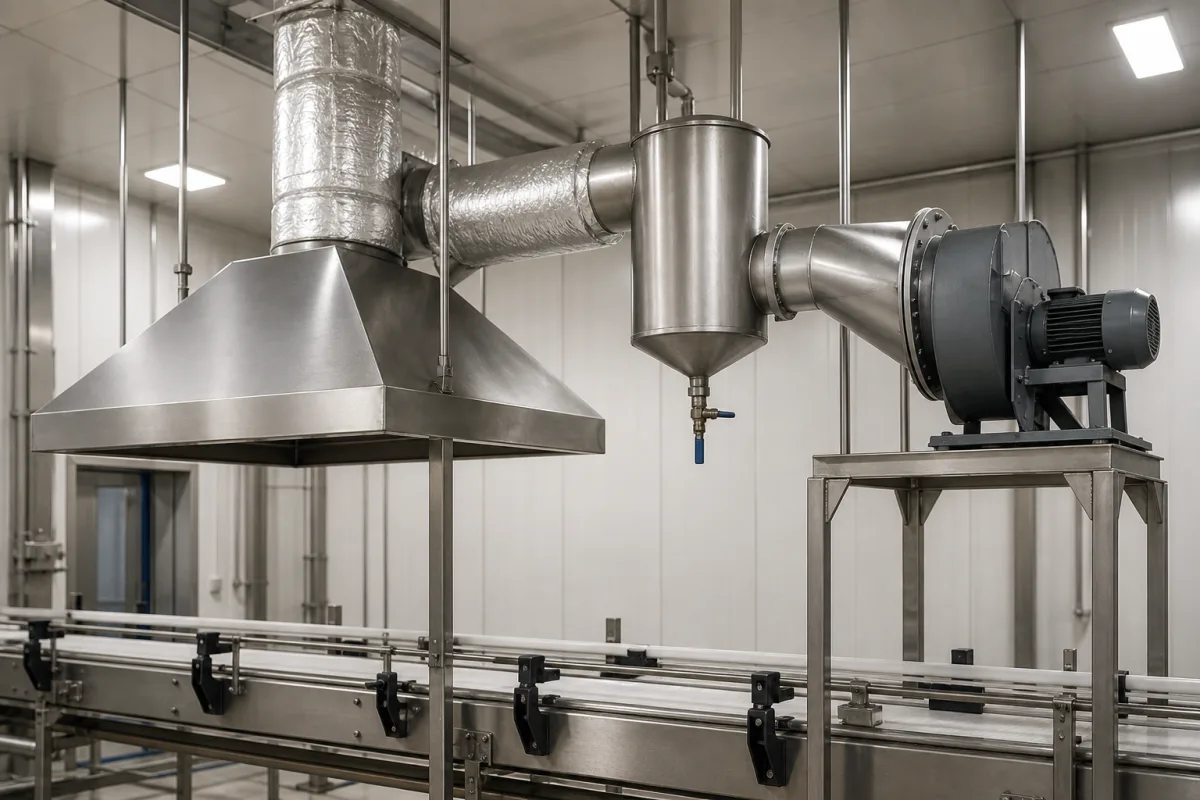
Humidity exhaust system: moist-air venting, condensate capture and exhaust humidity control
The vented side of a dryer or steam zone · humidity sensing that still works near saturation, a motorised exhaust valve, and a hood and duct that collect condensate instead of dripping it
Air leaving a dryer or a steam-producing process carries the water the product gave up. The exhaust system decides how much of that air is vented, and it has to keep working when the air is close to saturation: the humidity sensor must not drown in condensate, the valve must respond to a reliable signal, and the hood, duct and separator must catch and drain water before it drips back onto the product.
Exhaust trains that remove moist air from food dryers, dehydrators, ovens and steam-producing stations: humidity or dew-point sensing in the exhaust, the motorised exhaust valve or damper it drives, capture hoods with condensate channels, exhaust ducts with drain points, and the exhaust fan. The recirculation loop inside a dehydrator, including how much exhaust is returned to the fan and where fresh air enters, is covered on the Air circulation system for industrial food dehydrators page, and the complete belt or tray dryer on the Industrial food dehydrator (belt and tray dryers for fruit and vegetables) page. Local exhaust ventilation for dust and fumes is covered on the Industrial exhaust system page. Kitchen grease hoods and building ventilation are outside this page.
CNFX editorial research · Sources checked October 13, 2026 · 3 sources
Humidity signal and exhaust valve when the vented air is close to saturation
In Vaisala's case study of Koramic Pottelberg's roof-tile dryers, relative humidity transmitters in the drying chambers control the process and humidity is held by letting moist air out on the instrument's signal. The chambers run at 45–85 °C, fed with 130 °C air mixed from kiln exhaust at up to 750 °C and cool air. [1]
At the start of each cycle the chamber relative humidity is close to 100%, and Vaisala explains that the condensing environment can saturate a humidity sensor and leave it unresponsive; after a heat-recovery retrofit the plant's previous instruments did exactly that, and the humidity control misbehaved until they were replaced with HMT337 transmitters using a warmed probe. Vaisala notes that the HMT337 has since been replaced by the HMP7. [1]
An older approach is set out in Unisearch's patent for exhaust humidity control on industrial driers. A sample of exhaust air flows through a tube past a dry-bulb and a wet-bulb thermocouple; the wet bulb is dipped on a timer into a cup of condensate taken from the drier steam trap, which washes off dust and fluff, and the controller only acts once the wet bulb has re-equilibrated. The difference signal is compared with a %RH set point, and a reversible geared motor opens or shuts a butterfly valve in the exhaust duct, which is open to atmosphere at its other end. [2]
The patent states that it was designed for continuous running at high exhaust temperature and with heavy dust or other contamination, conditions under which the existing systems it describes could not run continuously. [2]
For a food dryer exhaust, give the supplier the exhaust temperature range, the humidity or dew point expected at the start and end of the cycle, dust, fines or sugar and fat in the air, the cleaning method, and whether the vent valve is on-off or modulating; ask how the sensor is kept out of condensate and how it is checked.
02
Capture hood with baffles, perimeter gutter and drain tap
Halton's CH Type II condensate hood is built to capture, condense and remove steam: angled internal baffles condense the vapour, the upper baffle drains onto the lower one, and lateral side slots that act as condensate channels keep water from dripping onto the work surface below. The specification calls for the condensate channel to run the entire perimeter of the hood and for a stainless steel drain tap. [3]
Halton specifies 18-gauge stainless steel (galvanised optional), all joints fully welded and polished for water tightness, and exposed welds ground and polished back to the original finish. Canopy models range from 18 to 168 in long, 18 to 84 in wide and 12 to 36 in high; the wall model can be as narrow as 12 in. [3]
Estimated crated shipping weights run from 30 lb per linear foot at 18 in wide to 45 lb per linear foot at 60 in wide. [3]
Editorial calculation: a 10 ft (120 in) hood 42 in wide at Halton's 37 lb per linear foot comes to about 370 lb shipped, before ductwork and fan. [3]
Halton states that the factory must be told of any special requirements of the authority having jurisdiction at the time of quote. Ask where the condensate from the hood, duct low points and any separator is piped, and whether the duct is insulated where it passes through cool rooms.
03
Information for a humidity exhaust quotation
Paste it into your enquiry below or into an email to a maker, then replace every bracket.
Source: [dryer, oven, steam station; product]
Exhaust air: [flow; temperature; humidity or dew point over the cycle]
Contaminants: [dust, fines, fat, sugar]
Control: [humidity or dew-point sensor; on-off or modulating valve; set point]
Capture: [hood size; baffles; perimeter gutter; drain tap]
Duct and fan: [route; insulation; drain points; fan material and temperature limit]
Explore company information and manufacturing capabilities, then discuss the scope of your project with a relevant supplier.
Share this page
Compiled and source-reviewed by the CNFX editorial team.
Each manufacturer above links to the page on that company's own website where the product is listed, with the date we checked it. How we source and review
· Page last updated 13 October 2026
Buyer questions
Why do humidity sensors fail in dryer exhaust?
Vaisala explains that near 100% RH a condensing environment can saturate the sensor and make it unresponsive; it used warmed-probe transmitters to restore control in a 45–85 °C dryer. [1]
How can the exhaust valve be driven from humidity?
Unisearch's patent compares a wet- and dry-bulb thermocouple signal with a %RH set point and drives a butterfly valve in the exhaust duct with a reversible geared motor. [2]
How does a condensate hood keep water off the product?
Halton's CH hood condenses steam on angled baffles and carries the water in perimeter condensate channels to a stainless drain tap. [3]
Sources and what still needs a direct check
Sources checked 2026-10-13. Vaisala and Halton describe their own instruments and hoods; the Unisearch patent describes a working exhaust humidity controller for industrial driers.