Industry-Verified Manufacturing Data (2026)

Overflow Vortex Finder

Based on aggregated insights from multiple verified factory profiles within the CNFX directory, the standard Overflow Vortex Finder used in the Food Manufacturing sector typically supports operational capacities ranging from standard industrial configurations to heavy-duty production requirements.

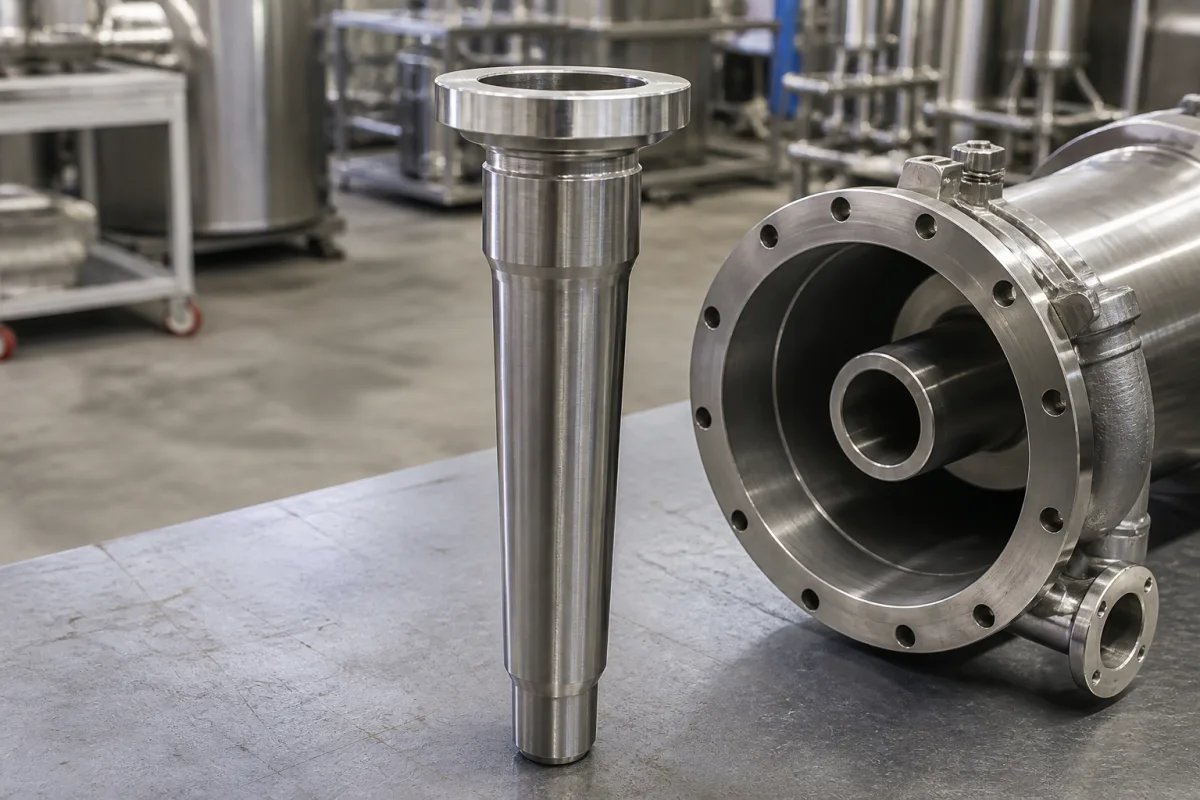
Technical Definition & Core Assembly

A canonical Overflow Vortex Finder is characterized by the integration of Finder Tube and Flange/Connection. In industrial production environments, manufacturers listed on CNFX commonly emphasize Stainless Steel (e.g., 304, 316) construction to support stable, high-cycle operation across diverse manufacturing scenarios.

A critical component of a Continuous Starch Hydrocyclone Separator that detects and directs the overflow stream containing fine starch particles.
Product Specifications

Technical details and manufacturing context for Overflow Vortex Finder

Definition
The Overflow Vortex Finder is an essential part within the Continuous Starch Hydrocyclone Separator system. It functions as the outlet component that specifically handles the overflow stream, which contains the finer starch particles that have been separated from the coarser material. Its design and positioning are crucial for maintaining proper separation efficiency and flow dynamics within the hydrocyclone.
Working Principle
The Overflow Vortex Finder operates by being positioned at the top center of the hydrocyclone. As the starch slurry enters under pressure and creates a vortex, the finer particles migrate toward the center and upward. The Overflow Vortex Finder captures this upward-moving, fine-particle-laden stream and directs it out of the hydrocyclone as the overflow product, while the coarser particles exit through the underflow at the bottom.
Common Materials
Stainless Steel (e.g., 304, 316), Polyurethane, Ceramic
Technical Parameters
  • Diameter of the vortex finder opening, critical for determining the split between overflow and underflow and the cut-point of starch particle separation. (mm) Per Request
Components / BOM
  • Finder Tube
    The central cylindrical section that channels the overflow stream out of the hydrocyclone.
    Material: Stainless Steel or Polymer
  • Flange/Connection
    Provides a sealed interface for connecting the vortex finder to the hydrocyclone roof or overflow outlet piping.
    Material: Stainless Steel
  • Apex/Tip
    The lower end of the tube immersed in the slurry; its shape affects entry conditions for the ascending vortex.
    Material: Wear-Resistant Ceramic or Hardened Steel
Engineering Reasoning
0.1-0.5 bar differential pressure, 0.5-2.0 m/s tangential inlet velocity, 60-80°C fluid temperature
0.8 bar differential pressure (vortex collapse), 2.5 m/s tangential velocity (boundary layer separation), 85°C fluid temperature (polymer degradation)
Design Rationale: Vortex breakdown due to excessive pressure differential exceeding Taylor-Couette stability limit, boundary layer separation at Reynolds number > 5000 causing flow detachment, thermal degradation of starch polymers above glass transition temperature
Risk Mitigation (FMEA)
Trigger Abrasive wear from silica particles > 25 μm diameter at concentrations > 2% w/w
Mode: Erosion of vortex finder tip leading to 15% reduction in separation efficiency
Strategy: Hardened tungsten carbide coating (1500 HV) with 0.5 mm thickness on internal surfaces
Trigger Cavitation at vapor pressure < 0.023 bar absolute pressure
Mode: Pitting corrosion and material loss at 0.1 mm/year rate on stainless steel surfaces
Strategy: Maintain NPSHa > 3.0 m with pressure control valve maintaining 1.2 bar minimum upstream pressure

Industry Taxonomies & Aliases

Commonly used trade names and technical identifiers for Overflow Vortex Finder.

Industrial Ecosystem & Supply Chain DNA

Complementary Systems
Downstream Applications
Specialized Tooling

Application Fit & Sizing Matrix

Operational Limits
pressure: Up to 6 bar (87 psi)
flow rate: 10-500 m³/h
temperature: 5°C to 80°C
slurry concentration: 5-40% solids by weight
Media Compatibility
✓ Starch-water slurries ✓ Corn/maize starch processing ✓ Potato/tapioca starch streams
Unsuitable: Abrasive mineral slurries with high silica content
Sizing Data Required
  • Required overflow capacity (m³/h)
  • Target particle cut size (microns)
  • Inlet slurry solids concentration (%)

Reliability & Engineering Risk Analysis

Failure Mode & Root Cause
Abrasive erosion
Cause: High-velocity slurry flow containing hard particles causing material wear on the vortex finder surface, leading to thinning and eventual perforation.
Fatigue cracking
Cause: Cyclic pressure fluctuations and vibration from turbulent flow patterns inducing stress concentrations at welded joints or geometric transitions, resulting in crack initiation and propagation.
Maintenance Indicators
  • Visible material thinning or localized wear patterns on the vortex finder surface during inspection
  • Increased vibration or abnormal noise (e.g., rattling, thumping) during operation indicating flow instability or component damage
Engineering Tips
  • Apply wear-resistant linings or coatings (e.g., ceramic, polyurethane) to critical surfaces exposed to abrasive flow to reduce erosion rates
  • Implement regular flow monitoring and adjust operational parameters (e.g., feed rate, slurry density) to maintain stable flow conditions and minimize turbulence-induced stresses

Compliance & Manufacturing Standards

Reference Standards
ISO 9001:2015 - Quality Management Systems ASTM A240/A240M - Standard Specification for Chromium and Chromium-Nickel Stainless Steel Plate, Sheet, and Strip for Pressure Vessels and for General Applications CE Marking - Conformity with EU Directives for Pressure Equipment (PED 2014/68/EU)
Manufacturing Precision
  • Bore Diameter: +/-0.05mm
  • Surface Flatness: 0.1mm per 100mm
Quality Inspection
  • Dye Penetrant Test (PT) for Surface Defects
  • Dimensional Verification with Coordinate Measuring Machine (CMM)

Factories Producing Overflow Vortex Finder

Verified manufacturers with capability to produce this product in China

✓ 93% Supplier Capability Match Found

T Technical Director from Germany Feb 15, 2026
★★★★★
"Standard OEM quality for Food Manufacturing applications. The Overflow Vortex Finder arrived with full certification."
Technical Specifications Verified
P Project Engineer from Brazil Feb 12, 2026
★★★★☆
"Great transparency on the Overflow Vortex Finder components. Essential for our Food Manufacturing supply chain. (Delivery took slightly longer than expected, but technical support was excellent.)"
Technical Specifications Verified
S Sourcing Manager from Canada Feb 09, 2026
★★★★★
"The Overflow Vortex Finder we sourced perfectly fits our Food Manufacturing production line requirements."
Technical Specifications Verified
Verification Protocol

“Feedback is collected from verified sourcing managers during RFQ (Request for Quote) and factory evaluation processes on CNFX. These reports represent historical performance data and technical audit summaries from our B2B manufacturing network.”

10 sourcing managers are analyzing this specification now. Last inquiry for Overflow Vortex Finder from India (49m ago).

Supply Chain Compatible Machinery & Devices

Automated Food Moisture Analyzer

Automated system for precise moisture content measurement in food products

Explore Specs →
Automated Food Color Consistency Analyzer

Automated inline system for real-time color measurement and consistency control in food processing.

Explore Specs →
Control Panel

A centralized interface for monitoring and controlling industrial equipment and processes

Explore Specs →
Industrial Vacuum Tumbler

Industrial machine for massaging and marinating meat under vacuum to enhance texture and flavor.

Explore Specs →

Frequently Asked Questions

What is the primary function of the Overflow Vortex Finder in starch processing?

The Overflow Vortex Finder detects and directs the overflow stream containing fine starch particles in a Continuous Starch Hydrocyclone Separator, ensuring efficient separation and product quality.

Which materials are commonly used for Overflow Vortex Finders in food manufacturing?

Common materials include Stainless Steel (grades 304 or 316 for corrosion resistance), Polyurethane for wear resistance, and Ceramic for extreme durability in abrasive starch processing environments.

What are the main components (BOM) of an Overflow Vortex Finder?

The key components are the Apex/Tip for flow direction, the Finder Tube that channels the overflow stream, and the Flange/Connection for secure integration into the hydrocyclone separator system.

Can I contact factories directly on CNFX?

CNFX is an open directory, not a transaction platform. Each factory profile provides direct contact information and production details to help you initiate direct inquiries with Chinese suppliers.

Get Quote for Overflow Vortex Finder

Request technical pricing, lead times, or customized specifications for Overflow Vortex Finder directly from verified manufacturing units.

Your business information is encrypted and only shared with verified Overflow Vortex Finder suppliers.

Thank you! Your message has been sent. We'll respond within 1–3 business days.

Need to Manufacture Overflow Vortex Finder?

Connect with verified factories specializing in this product category

Add Your Factory Contact Us
Previous Product
Outlet Valve
Next Product
Overflow Weir/Drain