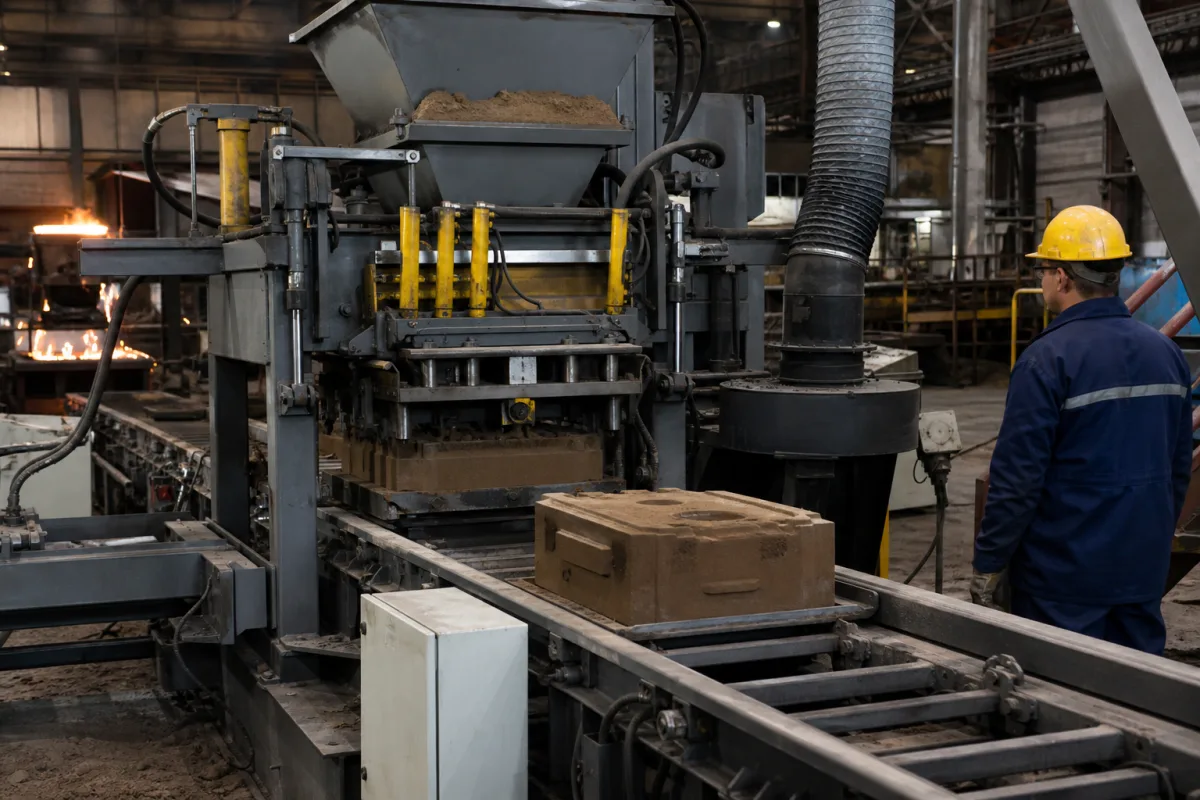
Green sand foundry · Mould size and rate, filling and squeeze, mould hardness control, air and sand demand
A sand moulding machine fills a flask or chamber with prepared moulding sand and compacts it around a pattern to make the mould halves for metal casting. Ask three things first: the mould size and moulds per hour, the filling and squeeze method that sets mould hardness, and the air, power and sand supply the line needs.
Green-sand moulding machines: flaskless horizontally and vertically parted machines, jolt-squeeze and multi-piston machines, and automatic moulding lines. Core shooters, resin-sand reclamation plants, composite and insole moulding presses are outside this page.
CNFX editorial research · Sources checked October 12, 2026 · 4 sources
Control mould hardness with filling and squeeze settings
AFS's Modern Casting describes mould hardness as the mould's resistance to indentation, closely tied to sand packing density. Too little hardness can cause shrink defects, porosity from mould-wall movement, poor surface finish and run-outs; too much can cause gas defects from low permeability, scabs, buckles, burn-on, penetration and poor shakeout. Both too high and too low a squeeze pressure can give low hardness, as can too short a shot time, low blow pressure or uneven filling; machines with zoned squeeze heads help even out density, and worn tooling or poor pattern-plate venting can cause local soft spots. [1]
The article recommends mould hardness or strength testers on the line, notes that B-scale (round penetrator) is the scale it reports green-sand foundries using, and says moisture and clay type also shift hardness: excess moisture risks washout, too little gives weak moulds, and high sodium bentonite can reduce flowability and leave soft areas without adequate aeration. [1]
Give the supplier the castings and alloys, mould size and cope/drag heights, moulds per hour, core setting needs, sand system (green sand properties and temperature), pattern plates, mould handling and pouring line, compressed air and power, and the mould hardness targets and test method.
02
Size the machine: mould size, rate, air and sand
Juneng's JN-FB series flaskless machine turns the flasks 90°, shoots sand vertically from the top, squeezes and strips moulds with a horizontal parting line; the drag slides out for core setting. The series lists mould sizes from 500 × 600 mm to 650 × 750 mm with cope and drag heights linearly adjustable within 130–250 mm. The JN-FB03 runs at up to 115 moulds per hour excluding core setting, using 1.2 Nm³ of air per mould at 0.5–0.55 MPa, with mould weights of 117–201 kg; the larger JN-FB04 runs at up to 95 moulds per hour using 2.5 Nm³ per mould, with 195–325 kg moulds. Hydraulics are driven by servo-controlled pumps. [2]
Editorial calculation: 115 moulds per hour is a 31 s cycle; at 1.2 Nm³ per mould the machine uses about 138 Nm³ of air per hour, and at 117–201 kg per mould it needs about 13–23 tonnes of prepared sand per hour. For the JN-FB04, 95 moulds per hour is a 38 s cycle and about 240 Nm³ of air per hour. [2] Size the sand plant, air supply and pouring line to the rate you will actually run, including core-setting time.
A second maker's horizontally parted flaskless range shows how rate, air and power scale with mould size. Sinto America lists its FBMX machines with top and bottom aeration sand filling, squeeze pressure balance control, mould-height feedback control to cut sand use, a maximum squeeze pressure of 1.0 MPa and a Mitsubishi PLC. Average maximum moulding rates fall from 163 moulds per hour on the smallest model to 100 on the largest, excluding core-setting time. [4]
Editorial calculation: at its rated speed the FBMX-II uses 163 × 2 ≈ 326 Nm³ of air per hour and the FBMX-V 100 × 6.5 = 650 Nm³ per hour, against about 138 Nm³ per hour worked out above for the Juneng JN-FB03 at 1.2 Nm³ per mould. The FBMX-V mould face (0.66 m²) is about 2.7 times that of the FBMX-II (0.25 m²) at 61% of its moulding rate. Size the compressor from the air per mould times the moulds per hour you plan to run. [4][2]
Sinto FBMX model
Mould size (W × L)
Cope / drag height
Average max. rate
Match plate thickness
Drive power
Air per mould
FBMX-II
550 × 450 mm
130–180 mm
163 moulds/h (22 s)
20 (15–25) mm
37 kW
2 Nm³
FBMX-III
508 × 610 mm
130–180 mm
150 moulds/h (24 s)
25 (20–30) mm
37 kW
3 Nm³
FBMX-IV
600 × 700 mm
200–250 mm
144 moulds/h (25 s)
35 (30–40) mm
22 + 22 kW
4 Nm³
FBMX-V
812.8 × 812.8 mm
200–250 mm
100 moulds/h (36 s)
50 (45–55) mm
30 + 30 kW
6.5 Nm³
03
Compare vertically parted lines on speed, mismatch and changeover
DISA's DISAMATIC D-line page describes its vertically parted green-sand moulding machines as reaching moulding speeds up to 555 moulds per hour, for an annual capacity of 30,000–40,000 tonnes, with mismatch of ±0.1 mm and automatic pattern changes in 60 seconds. It lists an automatic core setter it says inserts cores 10 times faster, and an automatic filter setter that lets filter jobs run at full moulding speed, 15% faster than using the core setter. [3]
The page also lists automatic and precision mould conveyors to move moulds through pouring without distortion at high speed. Compare these figures with horizontally parted flaskless machines such as the Juneng JN-FB series above on mould size, cycle time and core-setting access. [3][2]
Editorial calculation: 555 moulds per hour is one mould about every 6.5 s.
Feature stated by DISA (D-line)
Value or function
Maximum moulding speed
Up to 555 moulds/h
Annual capacity
30,000–40,000 t
Mismatch
±0.1 mm
Automatic pattern change
60 s
Automatic filter setter
Filter jobs 15% faster than with core setter
Control functions
True mould thickness measurement, adaptive pouring position, pre-strip with re-squeeze, adjustable squeeze distribution
Upgrade path
From DISA 2013, 230, 240, 250 lines
State casting size and weight, required moulds per hour with and without cores, filter use and the mismatch you can accept, and ask for the machine's speed on cored and filter jobs, mould size range and pattern change time.
04
Servo-hydraulic flaskless, multi-piston and jolt-squeeze machines with sand plants
Juneng lists servo-hydraulic flaskless moulding machines and mould conveyors; Sanzhuji lists horizontal and vertical flaskless, multi-piston and jolt-squeeze moulding machines with sand plants; HQAMUR (Huaqing) lists flaskless automatic moulding machines and resin-sand lines; Bestech and ZMZO list sand moulding machines with core shooters and sand plants.
05
Sand hopper and shot system, squeeze head, pattern plates, flasks and hydraulic drive
The first three rows set mould hardness: Modern Casting ties soft moulds to short shot time, uneven filling, squeeze pressure set too high or too low, and poor pattern venting. [1]
Part
Role
Fix in the order
Sand hopper and shot system
Fills the flask or chamber; shot time matters. [1][2]
Filling method and air.
Squeeze head
Compacts the sand; zoned heads even out density. [1]
Squeeze pressure and zones.
Pattern plates
Carry the pattern; venting affects soft spots. [1]
Squeeze force, mould size, cycle time, air pressure and mould hardness for a moulding machine quotation
Read the cycle-time row with core setting included: 115 moulds an hour is a 31 s cycle on the Juneng example, while a vertically parted DISA D-line runs up to 555 moulds an hour, about 6.5 s each. [2][3]
5 companies list this product among what they make. Company figures are quoted from each
company's own website; every card states where the relationship came from.
Quanzhou Juneng Machinery Co., Ltd.
Manufacturing site to be confirmed for the order
Lists servo-hydraulic flaskless moulding machines and mould conveyors.
Explore company information and manufacturing capabilities, then discuss the scope of your project with a relevant supplier.
Share this page
Compiled and source-reviewed by the CNFX editorial team.
Each manufacturer above links to the page on that company's own website where the product is listed, with the date we checked it. How we source and review
· Page last updated 13 October 2026
Buyer questions
Why are moulds soft even with high squeeze pressure?
Modern Casting says both too high and too low squeeze pressure can lower hardness, as can short shot time, low blow pressure or uneven filling. [1]
Can a mould be too hard?
Yes. Excess hardness lowers permeability and can cause gas defects, scabs, buckles, penetration and poor shakeout. [1]
How much air and sand does a flaskless moulder use?
One published machine uses 1.2 Nm³ of air per mould and makes 117–201 kg moulds; at 115 moulds/h that is about 138 Nm³/h and 13–23 t/h of sand (editorial calculation). [2]
How fast can a vertically parted green-sand moulding machine run?
DISA states its DISAMATIC D-line reaches up to 555 moulds per hour with ±0.1 mm mismatch and 60-second automatic pattern changes. [3]
How much compressed air does a flaskless moulding machine need?
Sinto lists 2 to 6.5 Nm³ per mould across its FBMX range, which at 163 and 100 moulds per hour is about 326 and 650 Nm³/h (editorial calculation). [4]
Sources and what still needs a direct check
Sources checked 2026-10-12. Modern Casting is published by the American Foundry Society. DISA and Sinto America describe their own moulding machines. Juneng is a supplier listed on this page; its specification is used as a worked example.