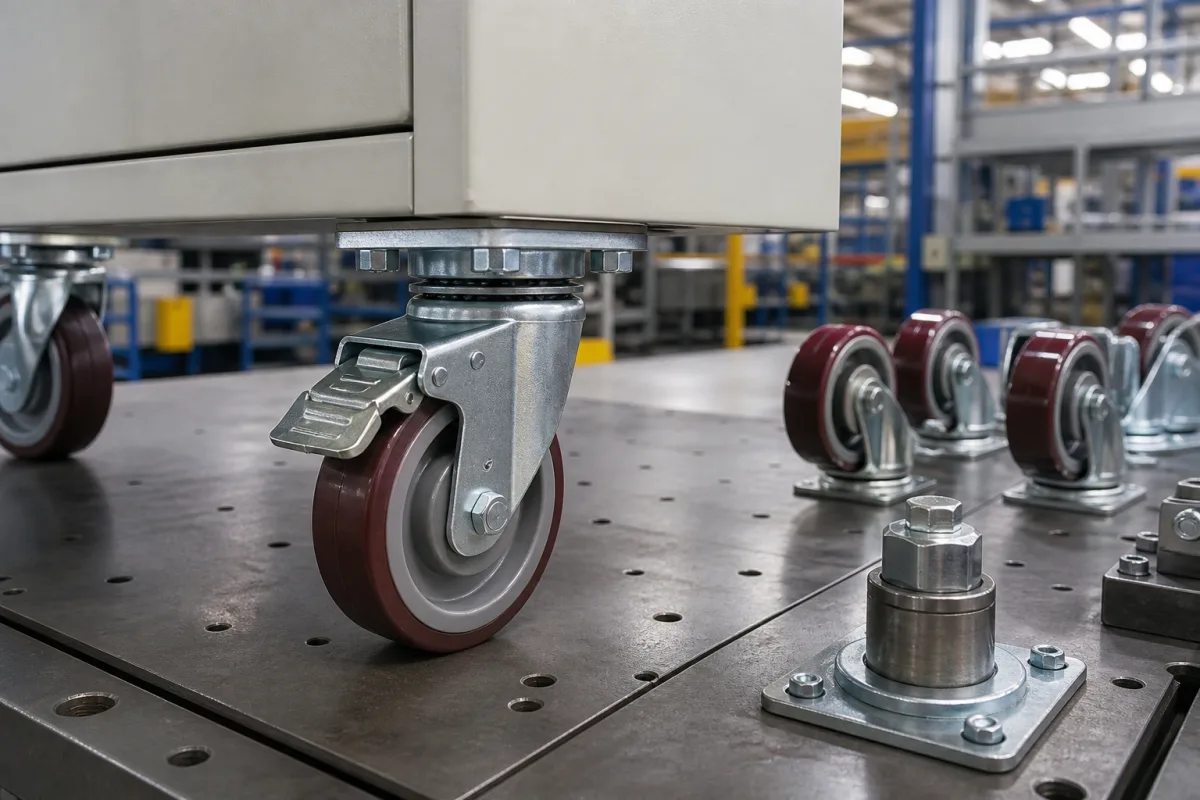
Furniture and chair castors · Load per castor, dynamic versus static rating, soft or hard tread for the floor, EN 12529 braking
A furniture caster is a small swivel or fixed wheel unit fitted to chairs, pedestals, tables and cabinets so they can be moved by hand. Ask three things first: what dynamic load each castor must carry once the weight is shared between fewer castors than are fitted, which tread hardness suits the floor, and whether the castor is for an office swivel chair, where load-dependent braking to EN 12529 applies.
Swivel and fixed castors with stem or plate fixing for office chairs and furniture such as pedestals, tables, trolleys and cabinets. Industrial and heavy-duty castors, conveyor rollers, scaffold castors and hospital bed castors are outside this page.
CNFX editorial research · Sources checked October 12, 2026 · 4 sources
CasterHQ, a US caster supplier, gives the rule W / (C − 1) = R: divide the total weight to be moved by one fewer than the number of castors to find the load rating each castor needs, and says its listed capacities are working (dynamic) loads to which a safety factor should be added. [4]
TENTE's datasheet for its 1470 swivel castor with a 50 mm polypropylene wheel lists a load capacity of 40 kg and a static load capacity of 80 kg, with an 18 mm tread, 25 mm offset, 70 mm overall height, 50 mm swivel radius, Shore D 65 tread hardness, a –20 to +60 °C temperature range and EN 12530 as its standard. [1] A distributor lists TENTE's 2478 Agila furniture castor, also 50 mm, at 40 kg dynamic and 80 kg static, with a soft tread for hard floors. [2]
Editorial calculation: a 5-castor office chair weighing 15 kg with a 120 kg user puts 135 / (5 − 1) ≈ 34 kg on each castor, within a 40 kg rating; a 4-castor pedestal of 30 kg holding 40 kg puts 70 / 3 ≈ 23 kg on each. Weights are assumed examples, before any extra safety factor. [4][1]
Give the supplier the furniture type and its gross weight with contents or user, number of castors, floor types, fixing (stem diameter and length, or plate size), wheel diameter and overall height, swivel or fixed, brake type, tread colour (non-marking), and the standards and test reports required.
02
Match tread to the floor and add braking for chairs
Kaiserkraft, a European office and workshop equipment supplier, states the rule soft castors for hard floors and hard castors for soft floors: laminate, tiles and floorboards need soft-coated castors that protect them from dirt particles, and kaiserkraft says hard-floor castors “are usually designed with two colours”. [3]
It explains that office chair castors must comply with EN 12529 and have load-dependent braking, so the chair rolls only when someone is sitting on it and does not shoot backwards when the user stands up; furniture castors need not meet that standard and so must not be fitted under office chairs as replacements, although chair castors can be used on furniture such as mobile pedestals. [3]
TENTE's datasheet expresses tread hardness on the Shore D scale (D 65 for its polypropylene-centred wheel), and rates roll performance, movement noise, attrition and corrosion resistance on a five-point scale. [1] Editorial note: ask for tread hardness in Shore A or D on every castor quoted, so soft and hard treads can be compared directly.
03
Small-duty PP, rubber, nylon and PU castors and chair caster wheels in the linked listings
Listings include small-duty castors in PP, rubber, nylon and PU and office chair caster wheels supplied with chair bases; ask each for dynamic and static ratings and tread hardness.
04
Wheel and tread, wheel centre and bearing, housing and swivel head, stem or plate, and brake
Load capacity, wheel diameter, height, tread material and brake values for a castor quotation
Published values in this table come from the TENTE 1470 and Agila data sheets and Kaiserkraft's guidance; where none states a value, the row says what to obtain from the supplier.
2 companies list this product among what they make. Company figures are quoted from each
company's own website; every card states where the relationship came from.
Ningbo Shangxin Caster Wheels Co.,Ltd
Manufacturing site to be confirmed for the order
Lists small-duty castors with PP, rubber, nylon and PU wheels, including stool and chair castors.
Explore company information and manufacturing capabilities, then discuss the scope of your project with a relevant supplier.
Share this page
Compiled and source-reviewed by the CNFX editorial team.
Each manufacturer above links to the page on that company's own website where the product is listed, with the date we checked it. How we source and review
· Page last updated 13 October 2026
Buyer questions
How do I calculate the load per castor?
CasterHQ divides the total weight by one fewer than the number of castors, then adds a safety factor. [4]
Which castors suit laminate or tile floors?
Kaiserkraft's rule is soft castors for hard floors and hard castors for soft floors. [3]
What does EN 12529 require for office chair castors?
According to Kaiserkraft, load-dependent braking so the chair only rolls when someone sits on it. [3]
How much can a 50 mm furniture castor carry?
TENTE's 50 mm 1470 castor is rated 40 kg dynamic and 80 kg static. [1]
Sources and what still needs a direct check
Sources checked 2026-10-12. TENTE is a castor maker publishing its own datasheet (copy hosted by a distributor); Kaiserkraft, CasterHQ and Hranipex are distributors explaining selection or listing TENTE data. The standards themselves govern requirements.