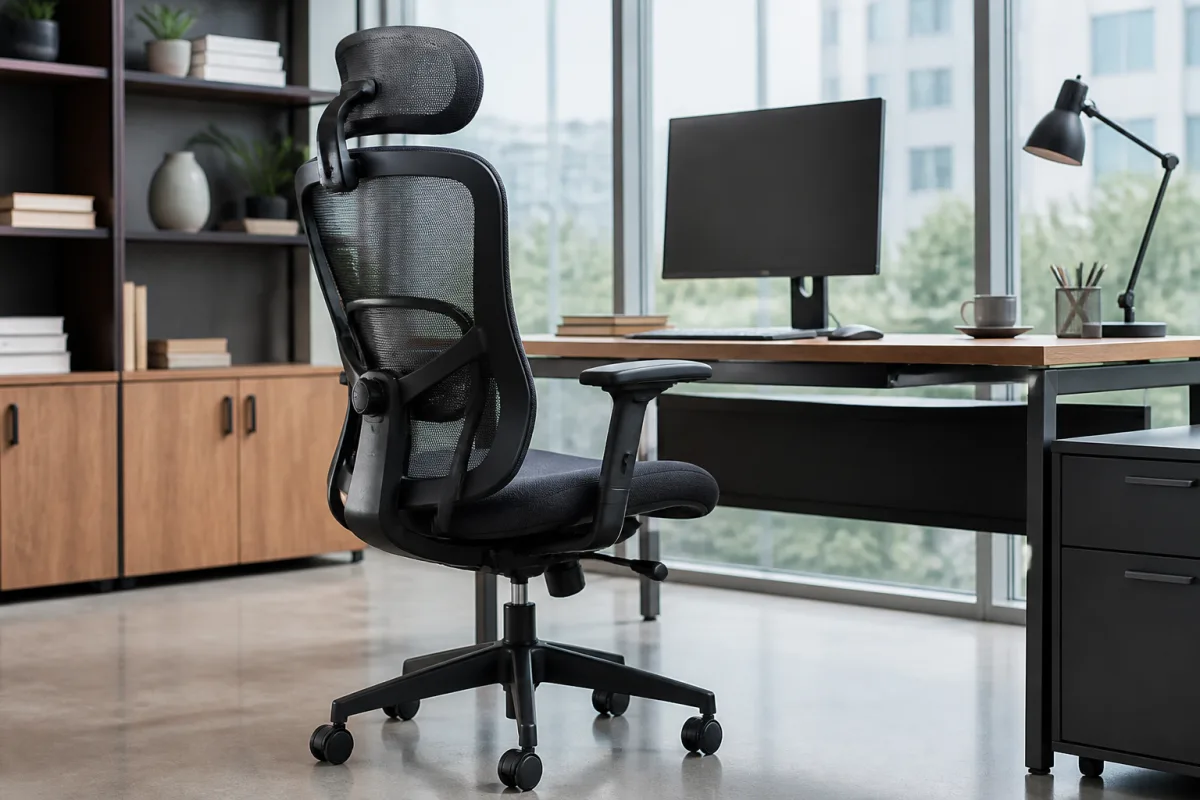
Office task chairs · Seat height and depth ranges, backrest recline and lumbar height, armrests, weight capacity
An ergonomic office chair, or task chair, is a swivel chair on a five-leg castor base whose seat, backrest and armrests adjust to fit the user and the task. Ask three things first: whether the seat height and depth ranges cover your shortest and tallest users, how far the backrest reclines and where the lumbar support can sit, and what user weight the chair is rated and tested for.
Office task chairs for computer and desk work with adjustable seat, backrest and armrests. Executive lounge chairs without task adjustments, stools, gaming chairs sold without stated ranges and laboratory chairs with special requirements are outside this page.
CNFX editorial research · Sources checked October 12, 2026 · 4 sources
The University of California's ergonomic requirements for task chair purchases (updated June 2015), based on ANSI/HFES 100-2007 and ANSI/BIFMA, require seat height to adjust at least 4.5 in within 15–22 in from the floor; seat depth preferably adjustable over up to 3 in including a 16.9 in depth, or no deeper than 16.9 in if fixed; a seat pan at least 17.7 in wide with a rounded front edge; a five-leg base with casters for the floor type; and weight capacity of at least 250 lb, preferably 275 lb. [1]
CCOHS, Canada's occupational health and safety centre, gives a rule of thumb that optimal seat height is about one quarter of body height, says users should sit with feet on the floor or a footrest without pressure under the thighs, and recommends a five-point base for stability. [3] OSHA's computer workstation eTool asks for a seat that is height-adjustable, especially when shared, padded with a rounded 'waterfall' edge, and depth-adjustable so the front edge does not touch the back of the knee. [2]
Editorial calculation: 15–22 in is 381–559 mm and a 4.5 in stroke is 114 mm; 16.9 in is about 429 mm; 250 and 275 lb are about 113 and 125 kg. By CCOHS's rule, users 1.60 m and 1.90 m tall would want seats near 400 and 475 mm. [1][3]
Give the supplier the user population (height and weight range), task and desk height, floor type, seat height and depth ranges required, recline and lumbar adjustment, armrest adjustment, upholstery and cleaning needs, standards and test reports (e.g. ANSI/BIFMA X5.1, EN 1335), warranty and quantities.
02
Check backrest recline, lumbar position and armrests
OSHA asks for a backrest that follows the spine's natural curve with a height-adjustable lumbar support, a recline of at least 15° from vertical that locks or has adjustable tension, and armrests, if fitted, that let the shoulders relax with elbows close to the body. [2]
The UC requirements specify a backrest top at least 17.7 in above the seat and at least 14.2 in wide, lumbar support adjustable within 5.9–9.8 in above the seat, backrest recline of 15° or more between 90° and 120° (with a headrest above 120°), angle lock with adjustable resistance, and armrests adjustable within 6.7–10.6 in above the seat with at least 18.1 in between them. [1] CCOHS adds that armrests may need to be adjusted or removed if they stop the user sitting close to the desk. [3]
Editorial calculation: in metric, the UC lumbar zone of 5.9–9.8 in is about 150–249 mm above the seat, armrest heights of 6.7–10.6 in are about 170–269 mm, and the 14.2 in minimum backrest width is about 361 mm. [1]
03
Compare a maker's user-weight rating and recline stops with procurement minimums
Steelcase's product page for its Leap task chair states that the chair is durable enough for users up to 400 lb, that the Leap stool is rated to 300 lb, and that the Leap Plus version supports users up to 500 lb with the same functions. The recline range includes full recline with four recline-angle stop settings and an upright back lock, and the back resistance is set manually. Lumbar support is height-adjustable as standard with a separate lower-back firmness control; the LiveBack backrest is designed to change shape with the spine, and the Natural Glide System moves the seat forward as the user reclines so the distance to the work surface stays the same. Arms are offered as armless or height-adjustable with further adjustable options, and the adjustment labels are in English and Braille. [4]
Editorial calculation: 400 lb is about 181 kg, 500 lb about 227 kg and 300 lb about 136 kg, compared with the University of California minimum of 250 lb (113 kg), preferably 275 lb (125 kg). Four recline stops plus an upright lock meet the OSHA guidance of a backrest that reclines and can be locked; when buying, ask for the user-weight rating with its test basis (such as ANSI/BIFMA), the recline angle at each stop, and the measured lumbar and seat-depth ranges. [4][1][2]
Suppliers linked to this page list ergonomic office or task chairs; each card links to the page reviewed.
Listings include task chairs, executive and conference seating and complete office furniture ranges; ask each for the measured adjustment ranges and the weight rating test report of the model offered.
05
Trace the chair components
This is a functional reference built from the sources cited; it is not one maker's specification.
Fill the specification fields with values for your parts
A task chair quotation needs values for your users. The table explains each field, gives published values where a reviewed source states them, and says what to obtain from the supplier.
Explore company information and manufacturing capabilities, then discuss the scope of your project with a relevant supplier.
Share this page
Compiled and source-reviewed by the CNFX editorial team.
Published product pages show what a company offers, not tested performance. Confirm the legal seller, factory and scope for your order. How we source and review
· Page last updated 13 October 2026
Buyer questions
What seat height range should a task chair have?
UC requirements ask for at least 4.5 in of adjustment within 15–22 in from the floor. [1]
How far should an office chair recline?
OSHA and UC both ask for at least 15° of recline. [2][1]
How do I pick seat height for a user?
CCOHS's rule of thumb is about one quarter of body height. [3]
What weight capacity should a task chair have?
UC asks for at least 250 lb, preferably 275 lb. [1]
What user weight should an ergonomic office chair be rated for?
University of California purchasing requirements ask for at least 250 lb (113 kg), preferably 275 lb; one maker rates its task chair to 400 lb and a heavy-duty version to 500 lb. [1][4]
Sources and what still needs a direct check
Sources checked 2026-10-12. The UC requirements are a public university's purchasing criteria citing ANSI/HFES and ANSI/BIFMA; OSHA and CCOHS are government and public occupational health guidance. The standards themselves govern tests.