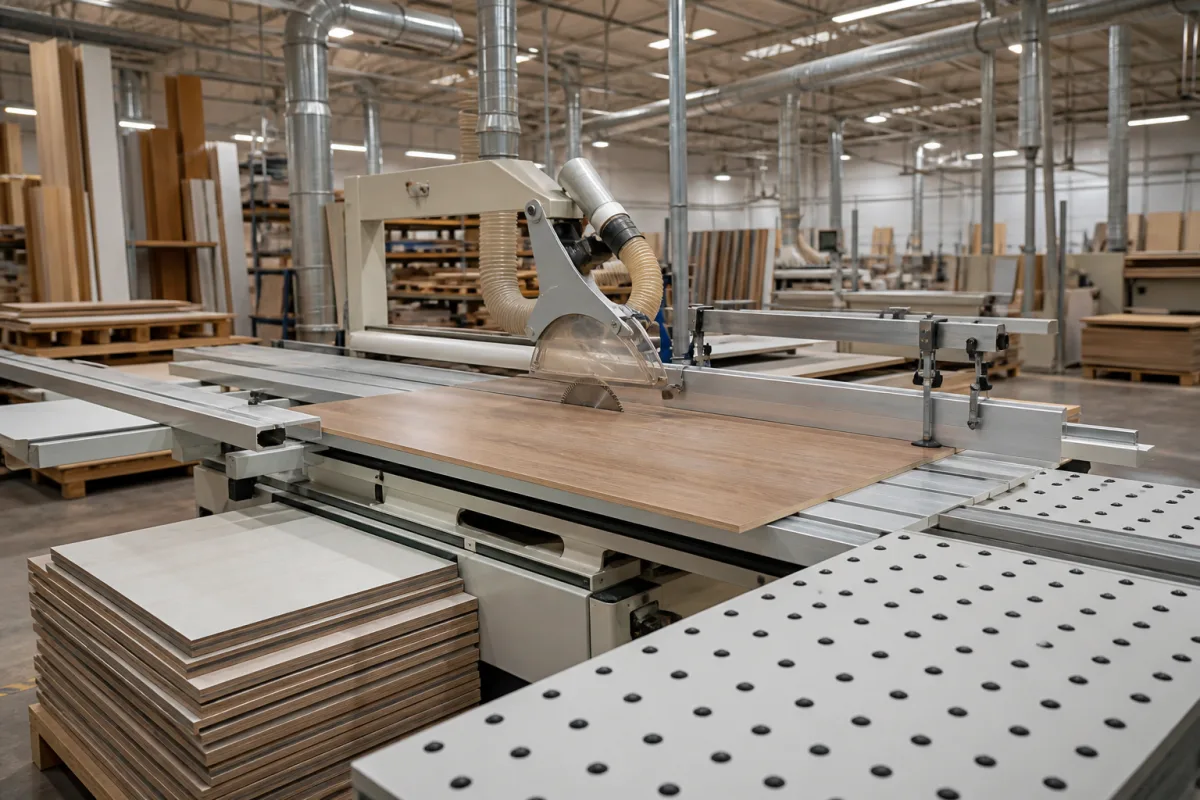
Sliding table panel saws · Braking, riving knife and top guard, blade size, extraction, push-sticks and workpiece support
A panel saw, here a sliding table saw, is a stationary circular saw with a sliding carriage that carries large sheets of plywood, MDF or particleboard past the blade for straight, square cuts; it may carry a scoring blade and an overhead guard with extraction. Ask three things first: how the saw is guarded and braked, which blade sizes it accepts and how they are marked, and how dust is extracted and long panels are supported.
Sliding table panel saws and circular saw benches used to cut wood-based panels in furniture and joinery. Vertical wall panel saws, CNC beam saws, CNC routers and handheld circular saws are outside this page.
CNFX editorial research · Sources checked October 11, 2026 · 4 sources
The UK Health and Safety Executive's information sheet WIS16 says circular saw benches account for more woodworking accidents than any other machine, that finger amputations are among them, and that HSE's investigations point to inadequate or missing guards as a cause, with kickback causing serious and even fatal accidents. New saw benches should carry a declaration of conformity and CE mark and be built to BS EN 1870-1, with blades to BS EN 847-1. Machines should be fully enclosed beneath the table and fitted with a braking device that stops the blade within 10 seconds. [1]
WIS16 specifies a riving knife with a chamfered leading edge, thicker than the blade body but thinner than the kerf, rigid, aligned and shaped to follow the largest blade, with the gap to the blade at table level not exceeding 8 mm. The top guard should be strong, adjustable and kept as close as possible to the workpiece, and the blade set so the teeth just project through the material. [1] WorkSafe New Zealand adds that the guard should never be more than 12 mm above the work, that guards should be used with pre-scoring blades, and that over 80% of serious-harm accidents with circular saws involve missing or poorly adjusted guards or unused push-sticks. [2]
The smallest blade that can safely be used should be marked on the machine: WIS16 warns that a blade under 60% of the largest diameter the saw accepts runs at low peripheral speed, cuts inefficiently and increases kickback risk. [1] Editorial calculation: on a saw taking a 400 mm blade, that means nothing smaller than 240 mm, and at the same spindle speed the 240 mm blade's rim moves 40% slower.
Give the supplier the panel sizes and materials, cutting length needed, blade sizes and scoring requirement, tilt and angle cutting, power supply, braking and guard type, extraction connection and airflow available, and the conformity documents you need.
02
Extract the dust and support the panel
WIS16 calls for effective local exhaust ventilation both above and below the table, and says HSE expects respiratory protective equipment with an assigned protection factor of at least 20 to be required during operation, maintenance and cleaning. Large workpieces need extension tables or roller supports at infeed and outfeed; where a second operator takes off cut pieces, the table should extend at least 1200 mm from the blade spindle to its rear edge. [1]
A push-stick at least 450 mm long with a bird's mouth should be used for any cut under 300 mm long, for the last 300 mm of longer cuts and to remove pieces between blade and fence unless wider than 150 mm; the rip fence front should be no further than the base of the blade gullet at table level. A demountable power feed reduces contact risk but does not replace the riving knife. [1]
WorkSafe NZ asks for blades marked with their maximum speed and never exceeded, unmarked blades not used, braking on machines supplied after 2001, and saws isolated during maintenance. [2]
03
Scoring blades, beam saws and CNC lines in the makers' ranges
Listings include heavy-duty sliding table saws, panel saws with scoring blades and, from some makers, beam saws and CNC woodworking machines.
04
Check the saw against US OSHA construction and control rules
For saws going to US workplaces, OSHA's 29 CFR 1910.213 sets construction rules that can be checked at acceptance. The machine must be free from sensible vibration with the largest tool mounted and run idle at full speed, and the saw frame or table needs lugs or an equivalent means to limit the blade size that can be mounted, so a larger-than-intended blade cannot cause overspeed. The fence must lock to the table without changing alignment and, on tilting tables or arbors, stay parallel to the saw at any tilt angle; gauges must slide in accurately machined grooves. Any part of the saw beneath or behind the table that could be contacted must be covered by an exhaust hood or a guard. [3]
On controls, the rule requires a power control the operator can reach without leaving the point of operation, provision to stop the machine restarting automatically when power returns where a restart could injure the operator, positive means to make controls inoperative during repairs or adjustments, and it recommends a disconnect switch lockable in the off position. Portable electric woodworking machinery operated at more than 90 volts to ground must be grounded. [3]
For hand-fed ripping, the saw needs a hood that adjusts itself to the stock thickness, a hard tempered steel spreader thinner than the kerf that stays aligned when the saw or table tilts, and nonkickback fingers or dogs. Dull, badly set or cracked saws must be removed from service. [3] Editorial note: list these items in the purchase order as acceptance checks for US-bound machines.
05
Read blade speed, saw unit and extraction data on the maker's sheet
Felder's technical data for its K 940 S sliding table panel saw list a 133 mm cutting height with a 400 mm saw blade, three blade speeds of 3,500, 4,500 and 5,500 rpm, a completely enclosed saw unit for extraction and a 120/80 mm extractor connection on the overhead saw guard. Cutting length runs from 2050 to 3700 mm by sliding table size, rip capacity is 800 mm as standard or 1250 mm as an option, the main motor is 4.0 kW with 5.5 kW and 7.30 kW (S6/40%) motors listed, the scoring unit is 1.1 kW and the machine weighs 885 kg in standard configuration. An optional saw unit takes 250–315 mm blades with a 90 mm cutting height and a EURO II guard instead of the overhead guard. [4]
Editorial calculation: at 3,500, 4,500 and 5,500 rpm the rim of a 400 mm blade moves at about 73, 94 and 115 m/s (π × 0.4 m × rpm ÷ 60). A 250 mm blade is 62.5% of the 400 mm maximum, above the 60% floor in HSE WIS16 [1]; check each blade's marked maximum speed against the spindle speed selected, as WorkSafe NZ asks. [4][2]
Samdy and Techpro list panel, sliding table and beam saws; Jinlu Hongda lists the MJ6132TA heavy-duty sliding table saw; Osetmac and iGolden list sliding table saws.
Foshan CNC Samdy Co.,Ltd
Manufacturing site to be confirmed for the order
Lists panel saws, sliding table saws and beam saws.
Explore company information and manufacturing capabilities, then discuss the scope of your project with a relevant supplier.
Share this page
Compiled and source-reviewed by the CNFX editorial team.
Each manufacturer above links to the page on that company's own website where the product is listed, with the date we checked it. How we source and review
· Page last updated 13 October 2026
Buyer questions
How quickly must a saw blade stop?
HSE WIS16 says circular saw benches should have a brake that stops the blade within 10 seconds. [1]
How should the riving knife be set?
Thicker than the blade body, thinner than the kerf, shaped to the blade and no more than 8 mm from it at table level. [1]
Do panel saws need dust extraction?
HSE calls for local exhaust ventilation above and below the table, and says HSE expects RPE with an APF of at least 20 to be required. [1]
What does OSHA require on a table or panel saw sold for US use?
OSHA's 29 CFR 1910.213 requires a self-adjusting hood, a spreader thinner than the kerf, nonkickback fingers or dogs for hand-fed ripping, a means to limit blade size against overspeed, and protection against automatic restart after a power failure where that could injure the operator. [3]
What blade speeds does a sliding table panel saw run at?
Felder lists three speeds, 3,500, 4,500 and 5,500 rpm, for the 400 mm blade of its K 940 S sliding table panel saw. [4]
Sources and what still needs a direct check
Sources checked 2026-10-11. HSE (UK) and WorkSafe New Zealand are workplace safety regulators; their guidance reflects their own legal frameworks and should be checked against local rules.