Structured Manufacturing Data (2026)

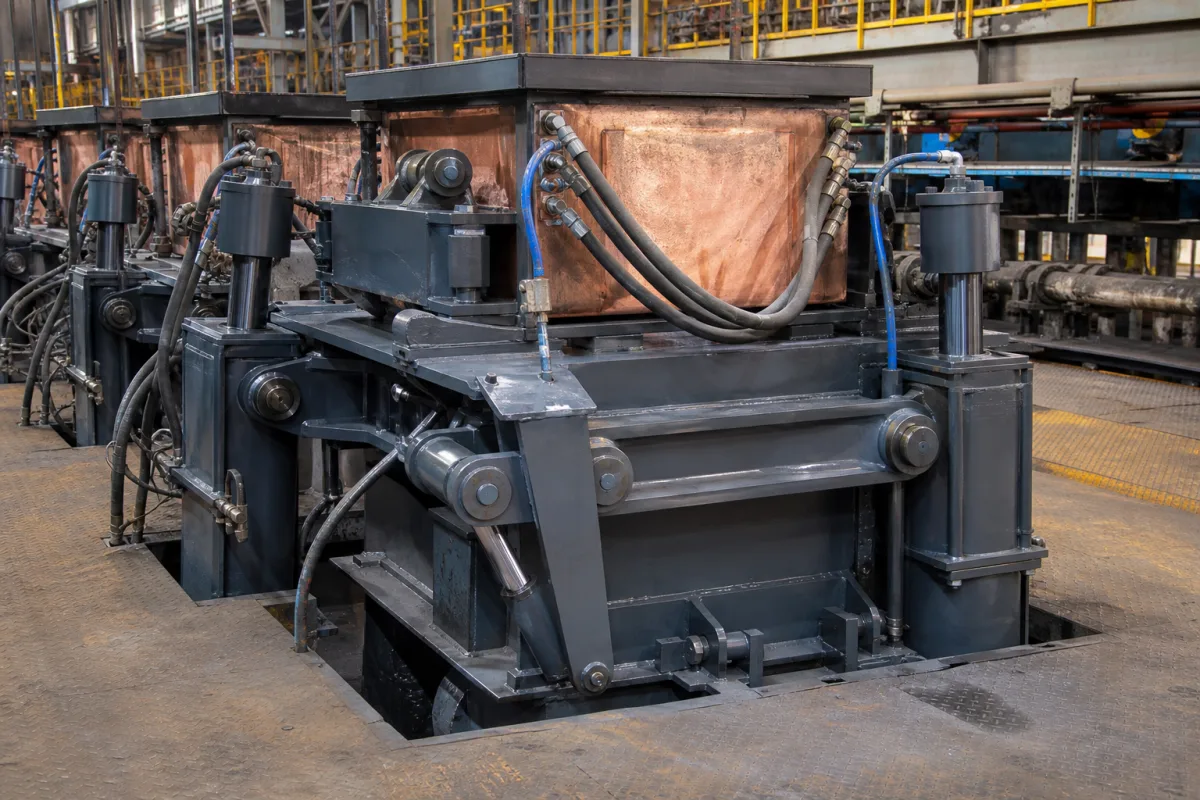
Heavy-Duty Continuous Casting Mold Oscillator

Based on aggregated insights from structured factory profiles within the CNFX directory, the standard Heavy-Duty Continuous Casting Mold Oscillator used in the Iron and Steel Basic Production sector typically supports operational capacities ranging from standard industrial configurations to heavy-duty production requirements.

Technical Definition & Core Assembly

A canonical Heavy-Duty Continuous Casting Mold Oscillator is characterized by the integration of Oscillation Drive Unit and Mold Connection Frame. In industrial production environments, manufacturers listed on CNFX commonly emphasize High-strength alloy steel construction to support stable, high-cycle operation across diverse manufacturing scenarios.

Industrial machine that precisely oscillates continuous casting molds to prevent steel sticking
Product Specifications

Technical details and manufacturing context for Heavy-Duty Continuous Casting Mold Oscillator

Definition
A heavy-duty industrial machine designed specifically for continuous casting operations in steel production. It provides controlled oscillatory motion to the copper mold during the solidification process of molten steel. This oscillation prevents the newly formed steel shell from sticking to the mold walls, ensuring smooth withdrawal and surface quality. The machine is engineered for high-temperature environments and continuous operation in demanding steel mill conditions.
Working Principle
Utilizes hydraulic or electromechanical actuators to generate precise sinusoidal or non-sinusoidal oscillatory motion, transmitting controlled vibration to the continuous casting mold through a robust mechanical linkage system.
Common Materials
High-strength alloy steel, Heat-resistant copper alloys, Industrial-grade hydraulic components
Technical Parameters
  • Maximum vertical displacement of mold movement (mm) Standard Spec
  • Frequency of mold oscillation cycles (Hz) Standard Spec
Components / BOM
  • Oscillation Drive Unit
    Generates and controls oscillatory motion
    Material: High-strength steel housing with precision bearings
  • Mold Connection Frame Part
    Securely attaches to continuous casting mold
    Material: Heat-resistant alloy steel
  • Hydraulic Power Unit Optional
    Provides hydraulic power for oscillation (if hydraulic type)
    Material: Industrial hydraulic components with steel casing
  • Control Panel
    Operator interface for frequency and amplitude adjustment
    Material: Industrial-grade electronics in steel enclosure
  • Vibration Dampers Optional Part
    Absorbs excess vibration and protects surrounding equipment
    Material: Rubber-metal composite

Industry Taxonomies & Aliases

Commonly used trade names and technical identifiers for Heavy-Duty Continuous Casting Mold Oscillator.

Industrial Ecosystem & Supply Chain Structure

Complementary Systems
Downstream Applications
Specialized Tooling

Application Fit & Sizing Matrix

Operational Limits
pressure: Hydraulic system: 10-25 MPa, Mold contact pressure: 0.5-5 MPa
flow rate: Hydraulic oil: 20-200 L/min (depending on oscillation frequency)
temperature: Ambient to 150°C (mold contact surface up to 400°C with cooling)
stroke length: 2-15 mm (adjustable)
max mold weight: 500-5000 kg (depending on model)
slurry concentration: Mold powder/lubricant: 5-25% solids by weight
oscillation frequency: 50-400 cycles/min
Media Compatibility
✓ Continuous casting steel molds (carbon/low-alloy steels) ✓ Copper alloy mold plates (with proper cooling) ✓ Mold flux/lubricant slurry systems
Unsuitable: High-chloride or acidic environments (causes corrosion of hydraulic/pneumatic components)
Sizing Data Required
  • Required oscillation frequency and stroke length (based on casting speed and steel grade)
  • Mold dimensions and weight (determines actuator force requirements)
  • Available hydraulic/pneumatic power supply capacity (pressure and flow rate)

Reliability & Engineering Risk Analysis

Failure Mode & Root Cause
Bearing fatigue and seizure
Cause: High cyclic loading from continuous oscillation under extreme thermal gradients leads to lubricant breakdown, contamination ingress, and eventual bearing surface degradation.
Guide rail and linkage wear
Cause: Abrasive particles from casting powder and scale accumulation cause accelerated wear on sliding surfaces, compounded by misalignment from thermal expansion.
Maintenance Indicators
  • Audible grinding or knocking during oscillation cycles
  • Visible metal shavings or abnormal lubricant discoloration around bearing housings
Engineering Tips
  • Implement condition-based lubrication with high-temperature synthetic grease and install desiccant breathers to prevent contamination ingress.
  • Establish laser alignment verification protocols during thermal cycles and use hardened/coated wear surfaces on guide components.

Compliance & Manufacturing Standards

Reference Standards
ISO 9001:2015 - Quality Management Systems ASTM A370 - Standard Test Methods and Definitions for Mechanical Testing of Steel Products CE Marking - Machinery Directive 2006/42/EC
Manufacturing Precision
  • Bore diameter tolerance: +/-0.02mm
  • Surface flatness tolerance: 0.1mm per meter
Quality Inspection
  • Dye Penetrant Testing for surface defects
  • Hardness testing using Rockwell or Brinell methods

Factories Producing Heavy-Duty Continuous Casting Mold Oscillator

Manufacturer profiles with relevant production capability in China

Manufacturer listings support early research and capability understanding. They are not certification, ranking, or transaction guarantees.

Technical documentation
4/5
Manufacturing capability
4/5
Inspection readiness
5/5
Supplier transparency
3/5

These scores are example evaluation dimensions, not real customer ratings, country-specific buyer feedback, or live inquiry activity.

Frequently Asked Questions

What is the primary function of a continuous casting mold oscillator?

The oscillator precisely moves continuous casting molds to prevent molten steel from sticking to the mold walls, ensuring smooth casting and reducing defects in the final steel product.

What materials are used in heavy-duty mold oscillators for durability?

These oscillators are constructed from high-strength alloy steel for structural integrity, heat-resistant copper alloys for thermal management, and industrial-grade hydraulic components for reliable operation in harsh environments.

How does the oscillation pattern affect continuous casting quality?

The oscillation pattern (typically sinusoidal or non-sinusoidal) controls mold movement to optimize lubrication and heat transfer, directly impacting surface quality and internal structure of the cast steel strand.

Can I contact factories directly on CNFX?

CNFX is an open directory, not a transaction platform. Each factory profile provides direct contact information and production details to help you initiate direct inquiries with Chinese suppliers.

Data Basis

CNFX manufacturer profiles, technical classification, publicly available product information, and ongoing plausibility checks.

Preliminary Technical Classification
This page supports structured research, RFQ preparation, and supplier evaluation. It does not replace buyer-led supplier qualification, standards review, or technical approval.

Request Manufacturing Insight for Heavy-Duty Continuous Casting Mold Oscillator

Ask for use case, specification boundaries, supplier type, and RFQ preparation information for Heavy-Duty Continuous Casting Mold Oscillator.

Your business information is used only to process this request.

Thank you! Your message has been sent. We'll respond within 1–3 business days.

Need to Manufacture Heavy-Duty Continuous Casting Mold Oscillator?

Compare manufacturer profiles with relevant product and process capability.

Create Manufacturer Profile Contact Us
Previous Product
Electric Arc Furnace Electrode Manipulator
Next Product
Heavy-Duty Rolling Mill Hydraulic Gap Control System