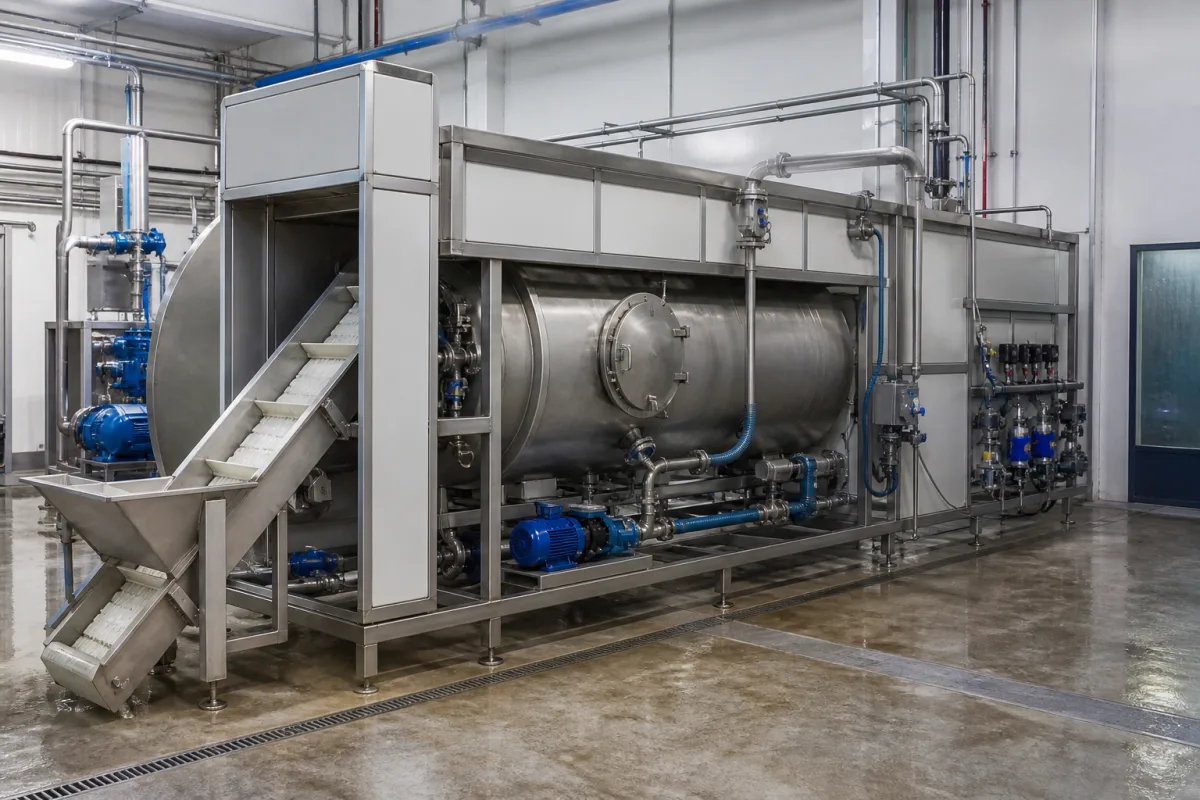
Hair-save beamhouse module: liming vessel with liquor circulation and hair filter
Hair-save beamhouse module · a soaking and liming vessel with external liquor circulation and a hair-screening filter, sized by recirculation flow, effluent load per tonne of raw hide and running cost
In conventional liming, sulphide dissolves the hair into the float, and the breakdown products of hair keratin leave with the effluent. A hair-save beamhouse module keeps the hair whole: after the soak, an immunised lime float loosens hair at the root, the liquor is pumped out of the vessel through a screening filter that captures the intact hair, and the filtered float returns to the vessel before reliming. Specify it by the vessel and its circulation valves, the filter's flow and mesh, and the effluent loads and costs it is meant to change.
Beamhouse modules for soaking, hair-save unhairing and liming of hides and skins: the processing vessel with drain valves and external liquor circulation, the hair-screening and compacting filter with its return pump, and the valve circuit that lets one filter serve a sequence of vessels. Rotating processing drums sized on their own by load, float, drive and speed are covered on the Tanning drum system page. Whole wet-end lines with a drum row, central water mixing and dosing are covered on the Integrated leather wet-end processing line page; fleshing machines, drying tunnels and spray finishing lines have their own pages. Effluent treatment plants are outside this page.
CNFX editorial research · Sources checked October 13, 2026 · 3 sources
Liquor circulation and hair filter on the liming vessel
UNIDO's review of hair-save liming states that the process requires a vessel equipped with an external circulation and filtration system so the hair can be removed from the bath; sulphide destroys only the non-immunised hair roots, the hair is released into the float, and the pelt is limed after unhairing. [1] TFL describes the same loop: the liquor is recirculated through a screening filter and returned free of hair to the drum, mixer or paddle, using the same chemicals as normal liming apart from hair-save grades of its liming auxiliary. [3]
SC Costruzioni Meccaniche's Hairpress filter, as described in MPA's Tannery magazine, is a semicircular filtering pipe of thick perforated stainless plate with a screw that scrapes the inner surface, brushes that keep the holes clear, and a shaped rubber cone that squeezes water out of the retained hair; an internal immersion pump returns the filtered float to the drum. [2]
The same description sets the installation: the filter is gravity-fed when the drums stand about 100–200 cm above the floor, otherwise the float is pumped; liquor leaves the drum through its drain valves into semicircular gutters; recirculation lasts until the hair is fully removed, about 1 hour; the hair leaves the cone at 40–50% residual moisture; and one filter can serve drums in sequence through manual, automated or servo-controlled valves. [2]
Editorial calculation: at 800–1,000 L/min for about 1 hour, a Hairpress 300 passes 48–60 m³ of float through the screen per drum cycle; at 1,500–2,000 L/min a Hairpress 500 passes 90–120 m³. [2]
SC Costruzioni Meccaniche states that flow rate changes with the concentration of suspended solids, so give the filter maker the hide type and weight per batch, float length, drum drain valve size and height above floor, the number of vessels the filter must serve, and the time allowed for hair removal.
02
Liming and soaking effluent loads per tonne of raw hide
UNIDO's figures give the baseline a hair-save module is bought to change. Conventional liming effluent, including washing waters, runs at 9–15 m³ per tonne of raw hide, carrying 53–97 kg suspended solids, 79–122 kg COD, 28–45 kg BOD and 3.9–8.7 kg sulphide per tonne. [1]
In industrial practice UNIDO reports hair-save liming effluent lower than conventional by 46–52% in organic matter of the dry solids and by 43–56% in TKN, and a sulphide offer of 1.3% on salted weight proven sufficient for pelt quality. [1] SC Costruzioni Meccaniche quotes reductions of 30–50% in COD and 40–60% in suspended solids for non-destructive liming. [2]
Recycling spent floats without hair saving also changes the load: in the UNIDO test, after 10 cycles of liming float and 20 of unhairing float, sulphide fell from 2.4 to 0.7 kg/t raw hide and Ca(OH)₂ from 4.1 to 0.28 kg/t. [1]
The soak ahead of liming has its own load in the same review: 11–17 kg suspended solids, 22–33 kg COD, 7–11 kg BOD and 85–113 kg chloride per tonne of raw hide for conventional soaking. [1]
Stream
Load per tonne of raw hide
What the module changes
Conventional liming effluent
9–15 m³; COD 79–122 kg; SS 53–97 kg; S²⁻ 3.9–8.7 kg [1]
Running cost of hair-save against hair-burning liming
UNIDO applies data from a Scandinavian tannery processing bovine hides: chemicals for hair-burning liming cost US$42.0 per tonne of wet-salted hides, while hair-save liming cost US$66.4 in chemicals plus US$8.9 for hair disposal, US$75.3 in total, a surplus of US$33.3 per tonne. [1]
The same tannery saw BOD in its mixed wastewater fall by 20% after introducing hair-save liming and calculated a saving of US$36.4 per tonne of wet-salted hides in payments for effluent treatment, which UNIDO says fully offset the surplus; it adds that a tanner must also allow for the capital cost of the liquor circulation and filtering equipment. [1]
Editorial calculation: US$36.4 saved − US$33.3 surplus = US$3.1 per tonne of wet-salted hides net, before the capital cost of the circulation and filter. [1]
04
Information for a hair-save beamhouse module quotation
Paste it into your enquiry below or into an email to a maker, then replace every bracket.
Hides: [bovine, sheep, goat; salted or fresh; kg per batch]
Process: [soak; hair-save unhairing; reliming; float %]
Vessel: [drum, mixer or paddle; material; drain valves; height above floor]
Circulation: [pump flow; vessels served; valve control]
Filter: [flow L/min; screen; hair moisture after compaction]
Effluent: [current m³/t and COD, sulphide; discharge limits]
Explore company information and manufacturing capabilities, then discuss the scope of your project with a relevant supplier.
Share this page
Compiled and source-reviewed by the CNFX editorial team.
Each manufacturer above links to the page on that company's own website where the product is listed, with the date we checked it. How we source and review
· Page last updated 13 October 2026
Buyer questions
What does a beamhouse module need for hair-save liming?
UNIDO says the vessel must have an external circulation and filtration system so intact hair can be removed from the bath; the filtered float is returned to the vessel. [1][3]
How much float does a hair filter handle?
SC Costruzioni Meccaniche lists its Hairpress 300 at 800–1,000 L/min and Hairpress 500 at 1,500–2,000 L/min, with recirculation lasting about 1 hour per drum. [2]
Does hair-save liming cost more to run?
In UNIDO's Scandinavian example it cost US$33.3 more per tonne of wet-salted hides than hair burning, offset by US$36.4 saved on effluent treatment payments. [1]
Sources and what still needs a direct check
Sources checked 2026-10-13. UNIDO's 1998 regional review gives effluent loads and costs; TFL is a leather chemicals supplier; the Hairpress data are SC Costruzioni Meccaniche's as published in MPA's Tannery magazine.