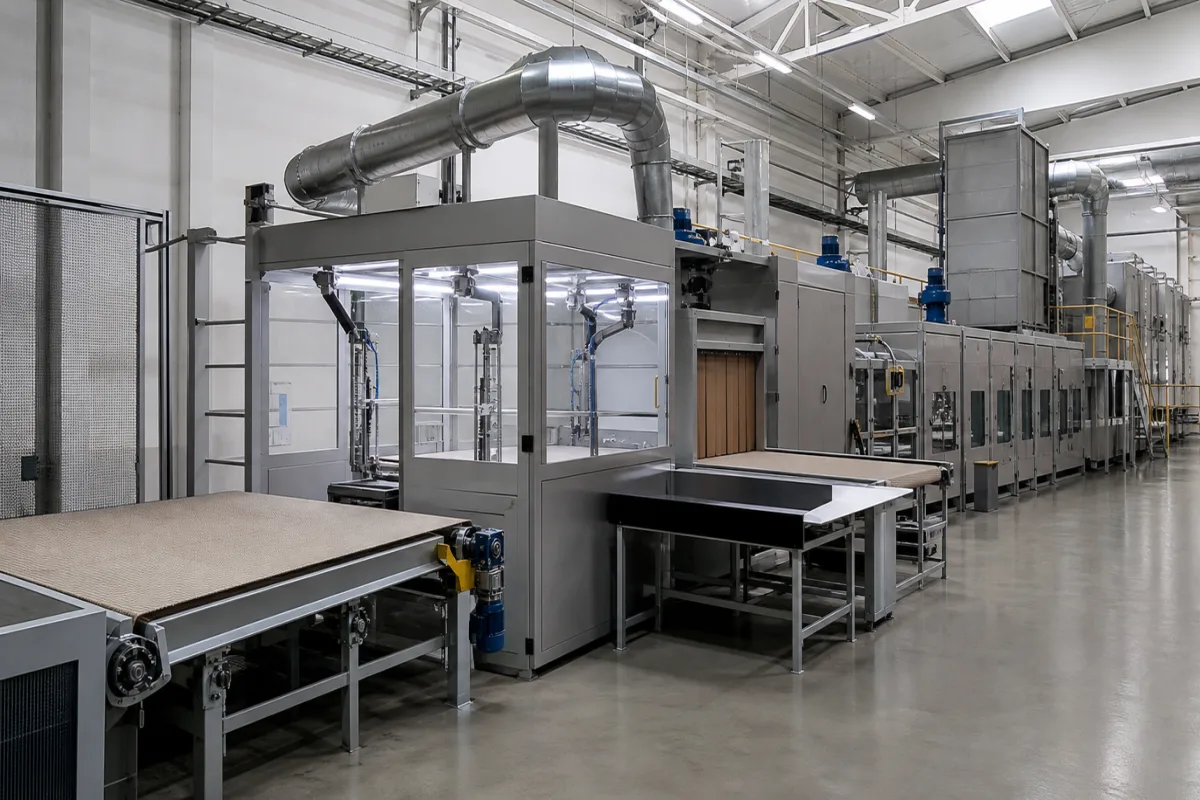
Leather spray finishing line: spray booth, conveyor and drying tunnel
Leather spray finishing · Rotary and reciprocating spray booths, gun transfer efficiency, drying tunnels, and US HAP limits by finish add-on
A leather spray finishing line takes dried crust leather after the wet-end drums and builds its surface: a wire or net conveyor carries hides through a spray booth where guns on rotating or reciprocating arms apply base, colour and top coats, then through a drying tunnel. Ask three things first: the booth type and working width for your hides, the gun technology and its transfer efficiency, and how the tunnel dries the coat and how emissions are controlled.
Spray finishing lines for crust leather and leather-like materials: hide conveyors, rotary and reciprocating spray booths, guns and fume abatement, and drying tunnels, specified as a line. Wet-end processing drums for soaking, liming, tanning and dyeing are covered on the Tanning drum system page. Roller coaters, embossing presses and buffing machines on their own, and battery or metal finishing lines, are outside this page except where compared.
CNFX editorial research · Sources checked October 12, 2026 · 3 sources
In a 2022 trade-press interview, the Italian maker Gemata describes two booth types. Its rotary booths are stainless steel, octagonal to prevent fume stagnation in the corners, with six front doors and working widths of 1,800, 2,200, 2,600, 3,000, 3,400 and 3,800 mm. Its reciprocating SPRAYSTORM booth moves up to twelve independent gun arms perpendicular to the leather in the 3,400 mm model, and each gun can carry a different colour or quantity. [3]
Gemata explains why: in a rotary booth, guns moving in the same direction as the leather lay down more product than on the opposite side of their arc, while independently moving arms distribute the chemical more evenly. It also cites automatic colour change with simultaneous cleaning of all guns in under twenty seconds, and arms carrying two guns so one set sprays while the other is cleaned. [3]
Graco's finishing chart, published for wood finishing, shows how gun technology changes how much coating reaches the surface. Under EN 13966 (flat panel) it lists transfer efficiency of 60–70% for conventional air spray, 70–78% for compliant and HVLP guns, 75–85% for air-assisted airless and 70–80% for airless; under ASTM D-5009 the same guns score 17–40%, and Graco notes the ASTM conveyor method caps results at 50%. [2]
Editorial calculation: to leave 40 g/m² of finish on the leather, a gun at 65% transfer efficiency must spray about 40 ÷ 0.65 ≈ 62 g/m², and one at 74% about 54 g/m², roughly 12% less coating sprayed. The add-on and efficiencies are assumed mid-range examples; ask for transfer efficiency measured on your leather and line. [2]
Give the supplier the leather type and hide size, crust thickness, the finish build (base, colour, top coats and add-on per pass), the line speed and hides per hour, the working width, booth type and number of guns, coating system (water-based or solvent), drying method available (IR, gas, steam, electric), fume abatement required, and the emission rules that apply to the plant.
02
Plan the drying tunnel and the emission limit
Gemata describes infrared drying tunnels whose lamps heat the applied chemical rather than the whole hide, with surface temperature checked cell by cell and lamp power self-adjusting; the latest cells, where the chemical is already dry, add inverter-controlled hot-air recirculation, and sensors switch the lamps off when no leather passes for a set time. It contrasts steam and gas tunnels, which warm the entire hide with hot air. [3]
For US plants that are major sources of hazardous air pollutants (10 tons a year of any single HAP or 25 tons of combined HAP), 40 CFR part 63 subpart TTTT sets leather finishing limits in pounds of HAP loss per 1,000 ft² processed: 2.6 for existing and 0.5 for new upholstery lines with at least 4 g of finish add-on per ft²; 6.8 and 2.5 below 4 g; 5.6 and 4.9 for water-resistant or specialty leather; and 3.7 and 2.1 for non-water-resistant leather. Water resistance is set at 5,000 Maeser flexes. [1]
The rule says the ≥4 g finishes are “used primarily for automobile seating covers” and “tend to be aqueous-based,” while the <4 g finishes, “typically used for furniture seating covers,” “tend to be solvent-based.” [1] Editorial calculation: 4 g per ft² is about 43 g/m² (4 ÷ 0.0929), and an existing upholstery line finishing 5 million ft² a year at ≥4 g may lose up to 5,000 × 2.6 = 13,000 lb of HAP a year. The throughput is an assumed example. [1]
03
Rotary or reciprocating booth, HVLP or air-assisted guns, IR or hot-air tunnel
The booth sets how evenly coat lands across the hide, the gun sets how much of it lands at all, and the tunnel sets whether the whole hide or only the coat is heated.
Option
What the source states
Check
Rotary booth
Guns travel in arcs; more product where gun and leather move the same way. [3]
Coat uniformity across the width.
Reciprocating (independent arm) booth
Up to 12 arms at 3,400 mm; colour and quantity per gun. [3]
Hide conveyor, spray station, fume abatement and drying tunnel in line
Gemata's description covers the conveyor, booth, abatement and tunnel; the buffing, polishing and embossing units in this product's component list are separate machines that the sources reviewed do not describe.
Part
Role
Fix in the order
Hide conveyor
Strings or large-mesh net carrying hides through booth and tunnel. [3]
Type, cleaning system.
Spray station
Rotary or reciprocating booth with guns and water curtain. [3]
Line data to quote for leather: width, add-on per pass, drying setpoints and extraction
Width, add-on and gun pressure have figures from Gemata, the US leather finishing rule and Graco; capacity, speed and heating load depend on your hides and must come from the line builder.
Explore company information and manufacturing capabilities, then discuss the scope of your project with a relevant supplier.
Share this page
Compiled and source-reviewed by the CNFX editorial team.
Each manufacturer above links to the page on that company's own website where the product is listed, with the date we checked it. How we source and review
· Page last updated 13 October 2026
Buyer questions
What working widths do leather spray booths come in?
Gemata lists rotary booths at 1,800, 2,200, 2,600, 3,000, 3,400 and 3,800 mm. [3]
How much does gun choice change coating use?
Graco's chart gives 60–70% transfer efficiency for air spray and 70–78% for HVLP under EN 13966; spray needed per m² falls as efficiency rises. [2]
What are the US HAP limits for leather finishing?
40 CFR 63 subpart TTTT sets 0.5–6.8 lb HAP per 1,000 ft² depending on leather type and whether the source is new or existing; for example, 2.6 for existing upholstery lines at ≥4 g/ft². [1]
Sources and what still needs a direct check
Sources checked 2026-10-12. 40 CFR 63 subpart TTTT is a US EPA regulation via eCFR; Graco's chart describes its own spray technologies; the Gemata description is a maker interview in MPA Style.