Editorial Technical Reference

Industrial Rotary Hook

This page explains how Industrial Rotary Hook is classified within Leather and Related Product Manufacturing. Technical values and manufacturer relationships are research references; confirm the current specification and supplier evidence for each order.

Technical Definition & Core Assembly

A rotating hook mechanism in industrial sewing machines that forms stitches by catching and looping the thread.
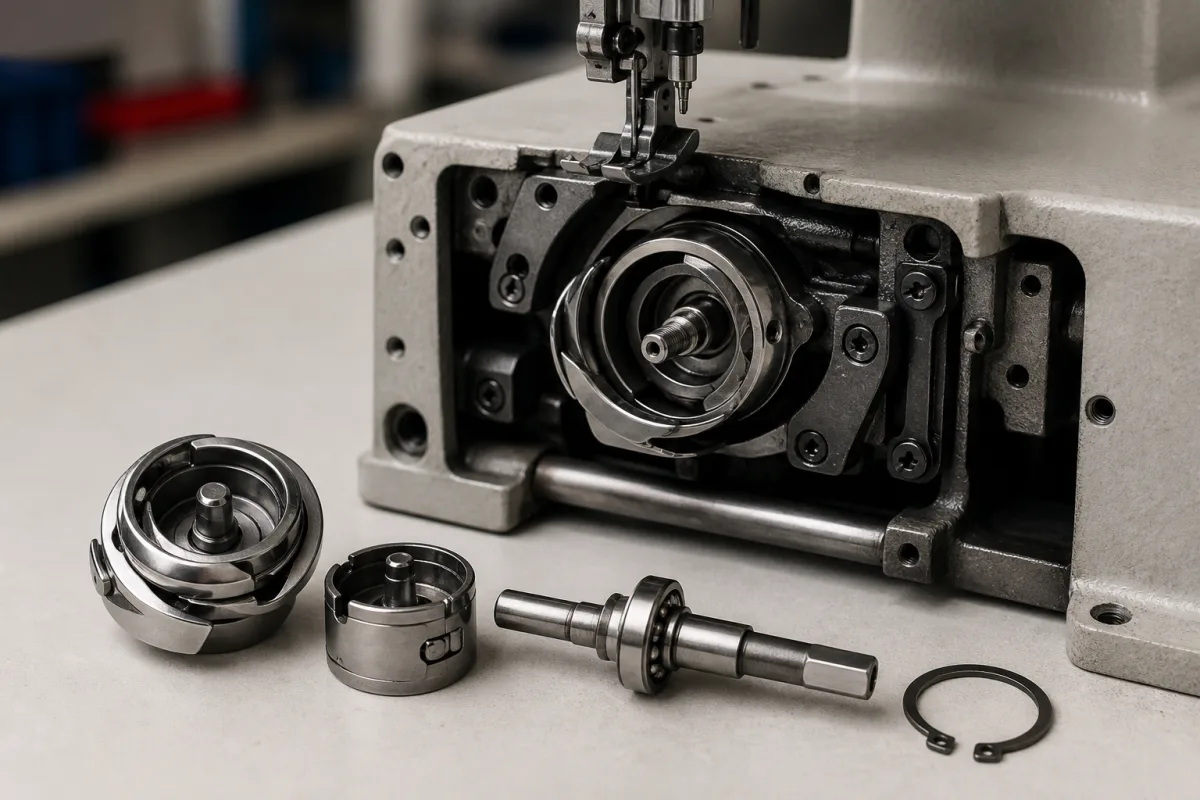
Industrial Rotary Hook in a manufacturing environment
Representative product image. Confirm appearance and specifications with the manufacturer.

Product Specifications

Technical details and manufacturing context for Industrial Rotary Hook

Definition
The industrial rotary hook is a critical component within industrial leather stitching machines, responsible for forming lockstitches by rotating to catch the needle thread loop and interlocking it with the bobbin thread. It operates in synchronization with the needle and feed mechanisms to create durable, consistent stitches on leather and other heavy materials. This component is typically manufactured from high-carbon steel or hardened alloy steel, offering the necessary strength and wear resistance for demanding applications. Key parameters include a hook speed of 2500–4000 rpm, a thread size range of 20–8 Nm, a hook diameter of 24–32 mm, a bobbin capacity of 20–40 cm³, rotation accuracy of ±0.05 mm, hardness of 58–62 HRC (per DIN EN ISO 6508-1), operating temperature of -10 to 50 °C, lubrication oil viscosity of 10–30 cSt at 40 °C (per ISO 3448), and weight of 0.5–1.5 kg. These values are reference ranges; actual specifications must be confirmed for the specific model and application. The rotary hook's design and precision are essential for achieving consistent stitch quality, especially when working with heavy materials like leather. Proper lubrication and maintenance are crucial to ensure smooth operation and longevity. When selecting a rotary hook, consider the machine's compatibility, the required stitch type, and the material being processed. Always verify model-specific parameters and standards with the legal manufacturer or supplier before procurement.
Working Principle
The rotary hook rotates continuously or intermittently around a stationary bobbin case. As the needle rises after penetrating the material, it creates a thread loop. The rotating hook point catches this loop, expands it, and carries it around the bobbin case, allowing the bobbin thread to pass through the loop to form a lockstitch. This synchronized action with the needle and feed mechanisms ensures consistent stitch formation on heavy materials.
Common Materials
High-carbon steel, Hardened alloy steel
Technical Parameters
ParameterTypical rangeNotes & selection driver
Hook Speed2500–4000 rpmHigher speeds require balanced hook and proper lubrication
Thread Size Range20–8 NmFor leather and heavy fabrics
Hook Diameter24–32 mmDetermines bobbin capacity and stitch formation
Bobbin Capacity20–40 cm³Larger capacity reduces thread changes
Rotation Accuracy±0.05 mmEnsures consistent stitch quality
Hardness58–62 HRCWear resistance for long service lifeDIN EN ISO 6508-1
Operating Temperature-10–50 °COutside range may affect lubrication and material properties
Lubrication Oil10–30 cStViscosity at 40°C; proper oil ensures smooth operationISO 3448
Weight0.5–1.5 kgAffects machine balance and inertia

Ranges are indicative industry figures for RFQ preparation, not a supplier commitment. Confirm every value and standard with the legal manufacturer before ordering.

Components / BOM
  • Hook Point Part
    Catches and expands the needle thread loop
    Material: Hardened steel
  • Hook Body Part
    Main rotating structure that houses the bobbin case
    Material: Alloy steel
  • Drive Shaft Connection Part
    Connects to machine drive system for rotation
    Material: Steel
  • Bobbin Case
    Holds the bobbin stationary while the hook carries the needle thread loop around it.

Industrial Ecosystem & Supply Chain Structure

Complementary Systems
Downstream Applications
Specialized Tooling

Application Fit & Sizing Matrix

Operational Limits
pressure: Atmospheric only
other spec: Max rotational speed: 8000 RPM, Thread tension: 0.1-5 N
temperature: -10°C to 80°C
Media Compatibility
✓ Polyester thread ✓ Nylon thread ✓ Cotton thread
Unsuitable: Abrasive particulate environments
Sizing Data Required
  • Thread diameter (mm)
  • Machine RPM requirement
  • Hook material compatibility with thread type

Reliability & Engineering Risk Analysis

Failure Mode & Root Cause
Bearing fatigue and seizure
Cause: Inadequate lubrication, contamination ingress, or excessive radial/axial loads leading to overheating and premature bearing failure.
Shaft misalignment and imbalance
Cause: Improper installation, foundation settling, or coupling wear causing vibration, increased stress, and accelerated component degradation.
Maintenance Indicators
  • Excessive vibration or unusual audible knocking/grinding noises during operation
  • Visible oil leaks around seals or abnormal temperature rise on housing surfaces
Engineering Tips
  • Implement precision laser alignment during installation and periodic re-alignment checks to minimize dynamic loads and vibration.
  • Establish a proactive lubrication regimen using manufacturer-specified grease/oil with contamination control and regular oil analysis.

Indicative industry ranges for design and RFQ preparation. Confirm the exact figures and applicable standard with the manufacturer before specifying.

Compliance & Manufacturing Standards

Applicable Standards
ANSI B18.2.1 - Square and Hex Bolts and Screws (Inch Series) DIN 931 - Hexagon Head Bolts with Metric Thread

Quoted from the published standard.

Manufacturing Precision
  • Bore Diameter: +/-0.01mm
  • Surface Hardness: HRC 58-62
Quality Inspection
  • Magnetic Particle Inspection for Surface Cracks
  • Coordinate Measuring Machine (CMM) Dimensional Verification

Manufacturers of Industrial Rotary Hook

Manufacturer profiles associated with Industrial Rotary Hook.

Sourcing Industrial Rotary Hook from China?
Tell us your specification and target quantity — we will match it against manufacturer records and come back with the factories that fit.
Request manufacturers We manufacture this

Manufacturer listings support early research and capability understanding. They are not certification, ranking, or transaction guarantees.

Share this page
Technical documentation
Request current drawings, revision history, and a signed specification sheet.
Manufacturing capability
Verify equipment lists, process limits, capacity, and representative production evidence.
Inspection readiness
Confirm test methods, calibrated equipment, sampling plans, and traceable reports.
Supplier transparency
Check the legal entity, factory address, ownership, certifications, and direct contacts.

CNFX does not score or rank suppliers. Buyers must verify all claims and documents with the legal manufacturer before ordering.

Supply Chain Compatible Machinery & Devices

Industrial Leather Skiving Machine

Precision machine for thinning leather edges in luggage, handbag, and saddlery manufacturing

Explore Specs →
Automated Footwear Assembly System

Integrated production line for automated footwear manufacturing with modular assembly stations.

Explore Specs →
Leather Hydraulic Piston Seal

This precision-engineered leather seal is designed specifically for hydraulic piston applications.

Explore Specs →

Frequently Asked Questions

What is the function of an industrial rotary hook?

The rotary hook catches the needle thread loop and interlocks it with the bobbin thread to form a lockstitch, enabling durable stitching on heavy materials like leather.

What materials are used for industrial rotary hooks?

Common materials include high-carbon steel and hardened alloy steel, providing strength and wear resistance for demanding applications.

How do I select the right rotary hook for my machine?

Consider compatibility with your sewing machine model, required stitch type, and material. Verify parameters such as hook diameter, speed, and bobbin capacity with the manufacturer.

What maintenance does a rotary hook require?

Regular lubrication with recommended oil (viscosity 10–30 cSt at 40°C) and periodic inspection for wear are essential to ensure smooth operation and consistent stitch quality.

Data Basis

Editorial classification, named public sources where available, and source-reviewed manufacturer records.

Preliminary Technical Classification
This page supports structured research, RFQ preparation, and supplier evaluation. It does not replace buyer-led supplier qualification, standards review, or technical approval.
Buyer enquiry

Request manufacturing insight for Industrial Rotary Hook

Ask for use case, specification boundaries, supplier type, and RFQ preparation information for this product.

Where it goes
Straight to the CNFX editorial desk, and to the manufacturer if this product is linked to a claimed profile. Nothing is broadcast to a supplier list.
Your details stay here
We do not sell or rent enquiry data, and we do not add you to a mailing list. Used only to answer this request.
No commission, no middleman
CNFX is a directory. We take no cut of any order and never negotiate on a supplier's behalf.
What we don't claim
A listing is not an endorsement. Qualify every supplier and verify every figure yourself before ordering.

Your business information is used only to process this request.

Thank you! Your message has been sent. We'll respond within 1–3 business days.
Sorry, we couldn't send your message. Please try again, or email us at [email protected].

Need to Manufacture Industrial Rotary Hook?

Compare manufacturer profiles with relevant product and process capability.

Previous Product
Loading/Unloading Door
Last Product
Get QuotesChat