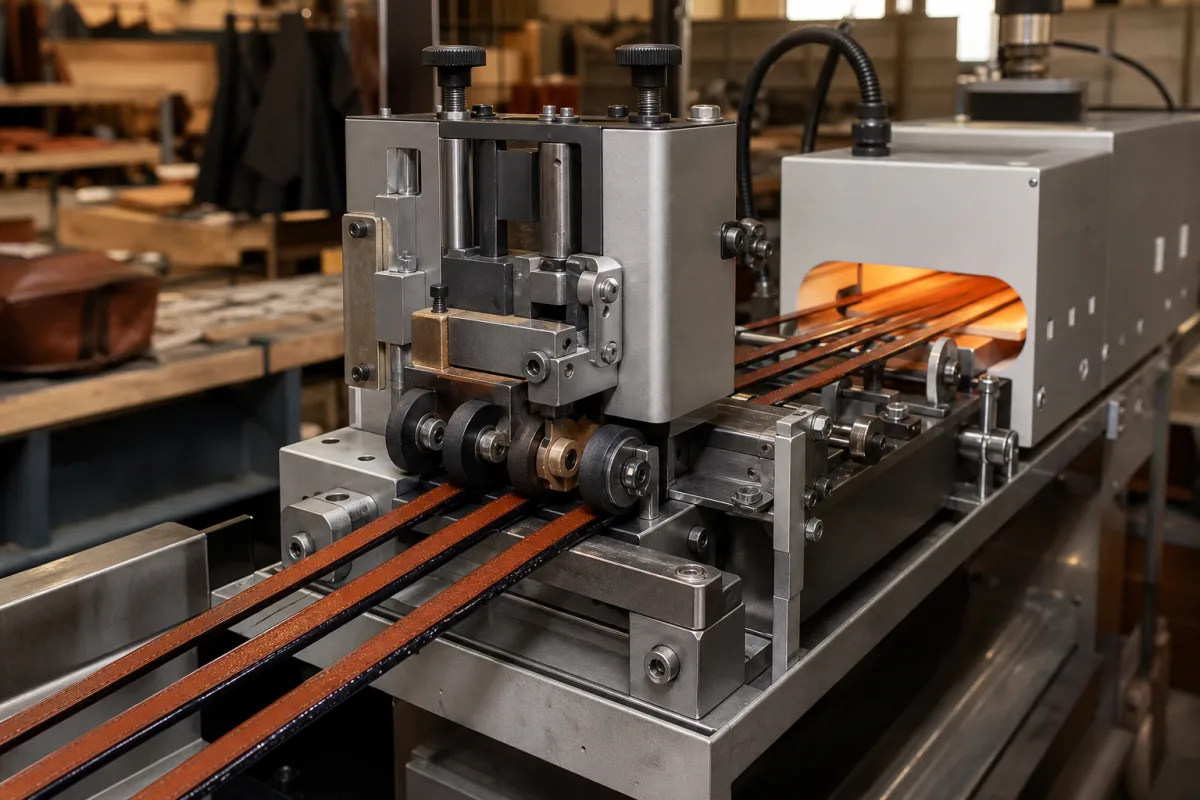
Leather edge coating application system (edge inking machine)
Edge inking and edge colouring machines for leather belts and strips · Edge-guided feed rollers, edge cutters and brushes, roller-fed colouring heads, tip colouring, drying tunnel, and where hand painting and burnishing fit
A leather edge coating system applies edge paint or dye to the cut edges of belts, straps and other leather pieces in a continuous line instead of by hand. In the line patented for belts, the strip is pulled along by its edges, the edges are trimmed and brushed, colouring rollers carry colour from a vat to each edge and the tip, and the strips pass through a dryer before being collected. Ask three things first: what pieces and edge profiles it must handle, how the colour is metered onto the edge, and how the edges are dried and finished afterwards.
Automatic edge inking, edge painting and edge colouring machines and lines for belts, straps and strip-like leather or synthetic pieces, including feed and guide units, edge trimming and brushing, colouring heads, tip colouring and dryers. Edge paints themselves, hand edge rollers, skiving machines and burnishing machines are outside this page except where compared.
CNFX editorial research · Sources checked October 12, 2026 · 5 sources
European patent EP 1 075 552 B1 (Continuous automatic installation for processing and colouring the edges and tip of belts or other strips of leather or synthetic material) explains that in automatic installations the strip is laid flat and carried forward by rollers pressing on both faces, which can spoil the visible front end, may not give enough pull for proper cutting, and makes colouring of irregularly cut edges unsatisfactory; changing rollers and guides for different strips is also slow. The installation it describes pulls and guides strips by their edges with replaceable pairs of motor-driven rollers having a V-shaped groove, adjustable in spacing for the strip width, with knurled grooves at the front heads and smooth grooves at the rear. [1]
Between the front and rear roller heads, pairs of disc cutters and brushes treat the side edges. Each colouring head has a tapered roller whose lower end dips in a small vat of colour and transfers it to a grooved colouring roller in contact with the strip edge; an elastic ring keeps the two rollers in contact, spring tension adjusted by a screw keeps the colouring rollers against the advancing strip, and a brush on an elastic plate, set by a knob, regulates how much colour the rollers carry. The roller surfaces in contact with colour are coated with diamond powder for uniform transfer. Further versions colour the strip tip with small rollers or with a colouring unit that moves round the stopped tip guided by a cam. [1]
Galli's 2026 finishing and colouring catalogue gives figures for two edge inking machines. The semi-automatic RC 200 EVO takes strips 8–80 mm wide (an optional kit covers 3–8 mm), runs at up to 15 m/min, draws 0.14 kW and weighs 44 kg. The TEKNOCOLOR EVO used in its automatic Tecno System 100 line takes strips 15–60 mm wide and 800–1,800 mm long, also at up to 15 m/min, with 1.5 kW installed and a weight of 430 kg. [3]
Editorial note: send the supplier sample pieces with the real edge profile and the edge paint you use, and ask it to show the number of coats and the colour change procedure on those samples.
Give the supplier the piece types (belts, straps, small parts), length, width and thickness range, leather or synthetic material and tannage, edge profile, whether tips and curved outlines must be coloured, edge paint or dye type and viscosity, number of coats, colours and change frequency, required line speed, drying method and available length, upstream cutting and downstream burnishing, and power and extraction available.
02
Plan drying, collection and burnishing
In EP 1 075 552 the coloured strips are carried on continuous bands; coloured tips pass through a jet of warm air produced by fans and an electric resistance, and the drying means is preferably a tunnel oven with a continuous band placed in line between the processing and collecting machines. A collecting machine with a horizontal band and transverse thrust means, started by a microswitch when hit by the strip tip, moves each finished strip onto a chute where the strips pile up. [1]
US patent 5,941,101 (Belt edge burnishing machine) notes that depending on the leather grade and natural colour it may be necessary to paint or dye belt edges, that cutting leaves rough edges which are burnished, and that painting the edges before burnishing helps stiffen and flatten the fibres so they are knocked off more easily. In the burnishing machine it describes, the patent describes the edges being painted by hand before the loaded edge finishing boards entered the machine. [2]
The same catalogue lists the HORIZON belt dryer used after the RC 200 EVO in the Tecno System 10 line, with a 165 × 1,500 mm entrance opening, a maximum transport speed of 15 m/min and 3.5 kW installed power; an XL version takes 2,000 mm. Its data sheet gives a maximum temperature of 80 °C, while its feature list states 60 °C, so confirm the working limit for your edge paint. The GATE loader that places belts on the dryer has a 1,500 mm opening and also runs at up to 15 m/min. [3]
Editorial calculation: at 15 m/min, a line feeding 1,200 mm belts end to end with no gaps would pass about 12.5 belts per minute (15,000 ÷ 1,200). Real output is lower once gaps between pieces, extra coats and drying time are counted. [3]
Editorial note: if the coating line feeds a burnishing or second-coat step, agree with the supplier the dryness the edge must reach at the end of the dryer and the time available between steps.
03
Compare a camera-guided edge oiling machine for cut leather pieces
Two 2018 Chinese patent applications from Beijing Shen Chang Science and Technology Development Co., Ltd. describe a different layout from the strip line above: an edge oiling machine for cut leather pieces, in which a camera images the piece on a pallet of support cylinders, the control module calculates the edge point coordinates, and a motor-driven oiling head follows the edge. The oiling head is a cylindrical gear that turns in a horizontal plane while immersed in edge oil in an oil groove, with its side projecting through the groove's outlet onto the leather edge. [4]
The applications give these settings: channels on the gear's side surface spaced 1–3 mm apart, a 1–3 mm gap between the gear and the oil-groove outlet, and channel inclination angles between 0° and 180° set against the direction of rotation so that the feed is more even. The pallet support cylinders chosen to hold the piece stay at least a set distance from the edge, 3 mm in the example, so they neither block the head nor pick up oil; in the worked example a piece covered seven support cylinders. [4][5]
The oil supply uses two reservoirs and two pumps controlled by a pressure sensor that weighs the first reservoir; the example low threshold is the signal produced when that reservoir holds 20% of its capacity, at which point the second pump refills it and the first pump stops drawing from the oil groove. [5]
Editorial note: patent applications describe an inventor's design, not tested performance; ask a supplier of camera-guided machines for the edge-tracking accuracy and the minimum piece size it can hold. [4]
Which strip widths and dryer temperatures can the line handle?
Width range and dryer temperature are the rows with Galli figures; check the dryer limit with care, since its data sheet and feature list disagree. [3]
Field
What it means and published values
Ask the supplier for
Conveyor Speed (m/min)
Strip feed speed; example machines up to 15 m/min. [3]
Find leather edge coating application system manufacturers
Zengshi lists automatic edge inking and double edge colouring machines with conveyor oven dryers; Dongguan Daojiao Hongfeng lists edge paint machines for leather, PU and PVC belts and handbags.
ZengShi Leather Machine Factory Co.,Limited
Manufacturing site to be confirmed for the order
Lists automatic leather edge inking machines, double edge colouring machines for leather belts and matching conveyor oven dryers.
Explore company information and manufacturing capabilities, then discuss the scope of your project with a relevant supplier.
Share this page
Compiled and source-reviewed by the CNFX editorial team.
Each manufacturer above links to the page on that company's own website where the product is listed, with the date we checked it. How we source and review
· Page last updated 13 October 2026
Buyer questions
How does an automatic edge inking machine apply colour?
In EP 1 075 552 a tapered roller dips in a colour vat and transfers colour to a grooved colouring roller that touches the strip edge; a brush meters the amount. [1]
Why pull leather strips by their edges?
The patent says pulling the strip flat can spoil the visible surface and front end; edge-guided V-groove rollers protect the face. [1]
Why paint leather edges before burnishing?
US 5,941,101 says painting stiffens and flattens the fibres so they are knocked off more easily during burnishing. [2]
How fast do automatic edge inking lines run?
Galli's 2026 catalogue gives a maximum transport speed of 15 m/min for its RC 200 EVO and TEKNOCOLOR EVO inking machines and for the HORIZON dryer. [3]
Can edge oiling be automated for cut pieces rather than strips?
Chinese applications CN 107999324 A and CN 107999341 A describe a camera locating the piece edge and an oiling-head gear with 1–3 mm channel spacing following it. [4][5]
Sources and what still needs a direct check
Sources checked 2026-10-12. The European and US patents (priority 1998 and 1999) describe machines in their own terms; they are not performance tests. Two Chinese patent applications from Beijing Shen Chang Science and Technology Development (2018) describe a camera-guided edge oiling machine for cut pieces.