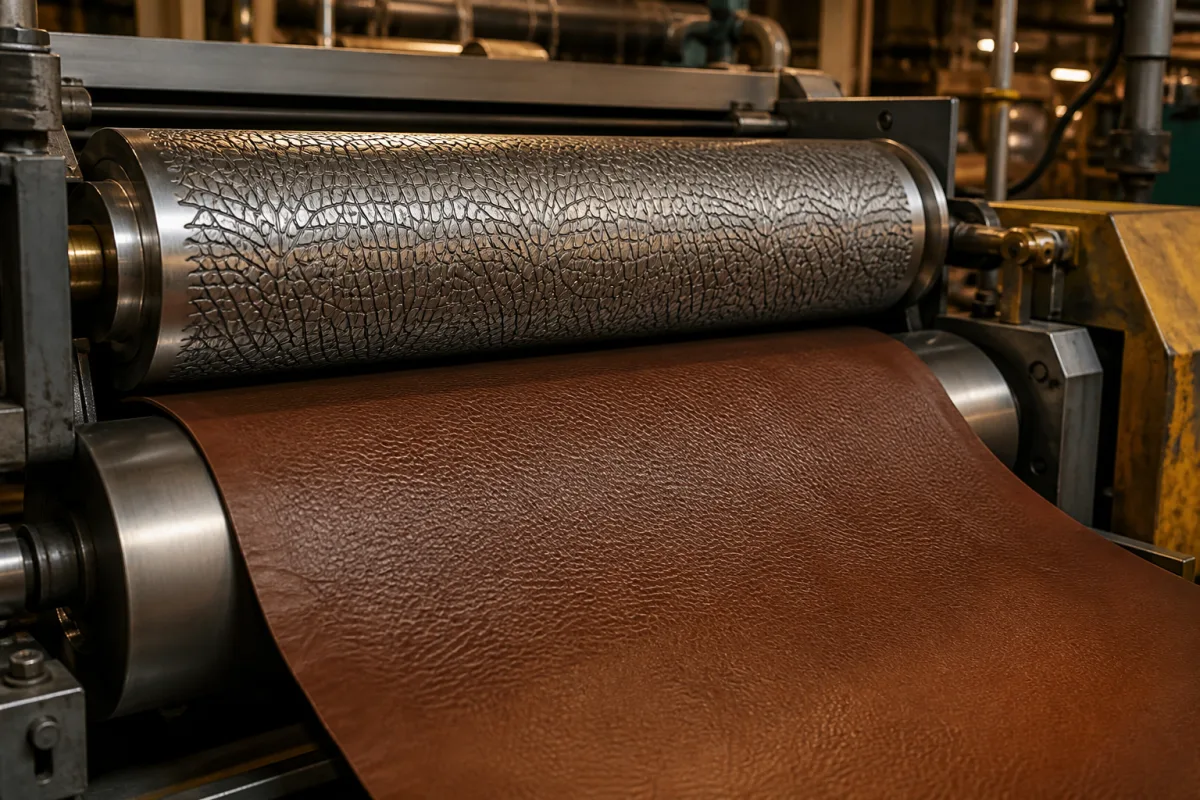
Leather grain embossing system (grain pattern replication)
Leather grain embossing systems that reproduce a natural or designed grain pattern on hides and leather, by heated embossing plates in hydraulic presses or by engraved rollers in through-feed machines · Pattern tool making, plate or roller format, heating, pressure, cyclic or continuous operation, material thickness and handling
A leather grain embossing system copies a grain pattern onto the surface of leather, so corrected-grain or split leather takes the look of a chosen natural hide or a designed texture. The pattern lives on a metal plate or roller, which heat and pressure press into the leather. Ask three things first: how the pattern tool is made and from what master, whether embossing runs in a cyclic plate press or a continuous roller machine, and what heat, pressure, width and throughput the leather needs.
Leather embossing presses and through-feed roller embossing machines, together with the grain plates and rollers that carry the pattern. Plating or ironing used only to smooth leather is compared where the same machines do both. Hot-foil stamping of small leather goods, embossing of synthetic leather on coating lines and cutting presses are outside this page.
CNFX editorial research · Sources checked October 11, 2026 · 4 sources
Make the grain plate or roller from the pattern master
US patent 615,703 describes reproducing the grain of a chosen leather on an embossing roller: the grain side of that leather is coated with an electrically conductive layer and a thin layer of metal is deposited on it in an electrolytic bath; the deposit should be no thicker than two or three millimetres, or the reproduced grain would distort when the plate is bent. The plate is then bent, fixed to the roller by a transverse rail in a groove, and left free to expand with heat in the rolling mill. [1]
Editorial note: the master hide or design file, the tool's material and engraving or deposition method, and its repeat length decide what the finished leather looks like; ask for a sample embossed on your own leather before the tool is approved.
Give the supplier the pattern master (natural hide sample or design file), leather type, thickness and finish, plate or roller format and repeat, embossing area or working width, required temperature and pressure, dwell or speed, cyclic or continuous operation, throughput, and tool storage and changeover needs.
02
Choose cyclic press or continuous roller embossing
US patent 4,194,376 describes hydraulic presses for smoothing or embossing leather with a fixed upper platen and a vertically moving lower platen that presses the leather to a set pressure; in its embodiment the upper platen is heated to about 200 °F and the press is closed by wedges before a hydraulic diaphragm applies the working pressure. [3]
US patent 4,142,386 explains that embossing had been done in tanneries with large hydraulic presses pressing large steel embossing plates into the leather at high pressure and temperature in a cyclic operation, which took much time, and proposes a through-feed embossing and ironing machine in which a thick-walled tubular embossing element, loaded at its ends by rollers, presses the leather carried on elastic supports against a counter-pressure roll. [2]
Editorial calculation: 200 °F is about 93 °C ((200 − 32) × 5/9). [3]
03
Compare a roller press's width, pressure and heat with your leather
Bergi, an Italian maker of tannery finishing machines, publishes approximate technical data for its Supervario T, a heavy-duty through-feed press for ironing and embossing. It fits a leather pre-heating system as standard and gives a wider under-pressure contact between the operative roller and the leather, which Bergi says brings the result closer to that of a plate press. [4]
Editorial note: these are one maker's approximate figures for one heavy-duty roller press, not limits for the category. The 160 °C maximum is a machine capability; the patented leather press above heats its platen to about 200 °F (about 93 °C; editorial calculation: (200 − 32) × 5/9) [3]. Ask the supplier for the temperature, pressure and speed settings used to emboss a sample of your own leather, and for the unit in which working pressure is stated.
Machine 9,700 / 10,800 kg without hoist and roller; operator roller 2,600 / 2,700 kg [4]
Floor loading; roller handling and storage.
Basic footprint
4960 × 2970 × 3210 mm (h) / 5280 × 2970 × 3210 mm (h) [4]
Layout drawing.
04
Grain plate, tubular embossing element, heated platen and counter-pressure roll
The two machine types share only the grain tool: the plate press closes a heated upper platen onto a rising lower platen, while the through-feed machine of US 4,142,386 runs the leather on elastic supports between a roller-loaded tubular element and a counter-pressure roll. [2][3]
Grain fidelity, platen heat, pressure and leather thickness for an embossing order
Two rows carry a patent figure: the electro-deposited grain layer is kept to 2–3 mm so the pattern does not distort when the plate is bent, and the patented press heats its platen to about 200 °F. The other rows have no published value and come from the maker's offer. [1][3]
Field
What it means and published values
Ask the supplier for
Pattern Resolution
Fidelity of the reproduced grain; deposited layer no thicker than 2–3 mm to avoid distortion. [1]
Sample on your leather.
Maximum Throughput Speed
Continuous machines run faster than cyclic presses. [2]
Explore company information and manufacturing capabilities, then discuss the scope of your project with a relevant supplier.
Share this page
Compiled and source-reviewed by the CNFX editorial team.
Each manufacturer above links to the page on that company's own website where the product is listed, with the date we checked it. How we source and review
· Page last updated 13 October 2026
Buyer questions
How is a natural leather grain copied onto an embossing tool?
One method coats the grain side of the chosen leather with a conductive layer, electro-deposits a thin metal plate on it and bends that plate onto an embossing roller. [1]
Are leather embossing presses heated?
Yes; one patented leather press heats the upper platen to about 200 °F (93 °C) before applying hydraulic pressure. [3]
Why use a through-feed embossing machine instead of a plate press?
Cyclic plate presses take time to open and close; a through-feed machine embosses continuously between an embossing element and a counter-pressure roll. [2]
How wide and how hot can a through-feed leather embossing press run?
Bergi lists its Supervario T with 3200 or 3400 mm working width, 3–14 m/min speed and working temperatures up to 160 °C; it states working pressure as 50–350 Kg/cm. [4]
Sources and what still needs a direct check
Sources checked 2026-10-11. Three patents cover grain tool making, a heated leather press and through-feed embossing; Bergi's Supervario T page gives one Italian maker's approximate roller-press data. None endorses a supplier.