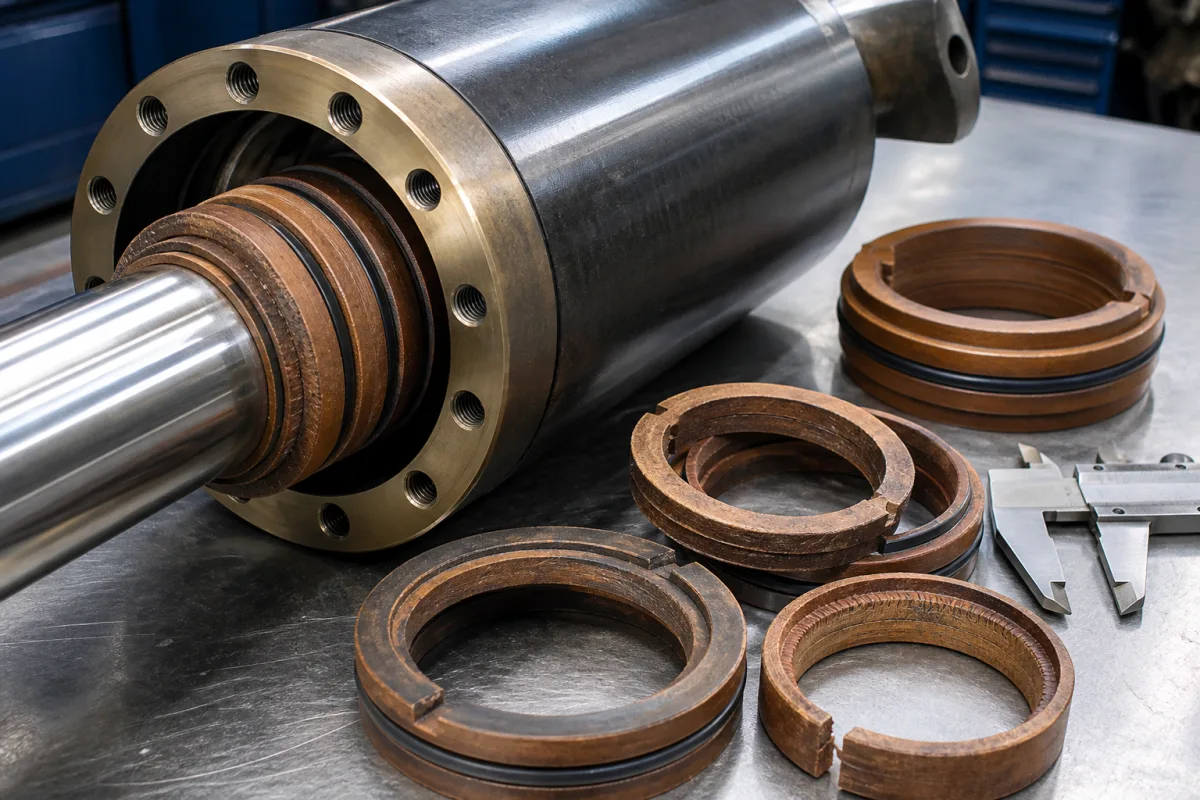
Leather piston seals and packings for hydraulic and pneumatic cylinders, presses, jacks and pumps · cups, U-packings, flanges, vee packings and washers, packing-leather grade and thickness, tensile strength, impregnation (wax, oil, resin, synthetic rubber), temperature and pressure, comparison with rubber and plastic seals
A leather piston seal is a cup, U-packing, flange or vee ring cut and moulded from tanned leather that seals a piston or ram in a hydraulic or pneumatic cylinder, press, hoist or hand pump; flat leather washers and back-up washers are cut from the same material. The leather is impregnated so that it does not pass fluid or air. Ask three things first: the seal form and dimensions your cylinder needs; the leather grade, tannage and impregnation for your fluid; and the pressure and temperature it must hold.
Leather cup, U-, flange and vee packings for pistons, plungers and rams, and leather washers used as flat gaskets or back-up rings in hydraulic and pneumatic equipment. Rubber, polyurethane and PTFE seals, O-rings, rotary shaft oil seals and leather belting are outside this page except where compared.
CNFX editorial research · Sources checked October 11, 2026 · 5 sources
Page Belting, a leather packing maker, lists cup packings for air engines, hoists, presses and hand pumps; U packings for plungers, rams and sealing pistons; vee packings for pistons and rods; flange packings that stop material passing along piston rods or shafts; and leather washers. It describes leather packings for air, water and oil, says they will not score or abrade, can be stored indefinitely and are not affected by sub-zero temperatures, and asks buyers for a dimensioned sketch, the equipment, the gas or liquid in contact, and the operating temperature and pressure. [5]
CW Marsh, another leather packing maker, lists back-up washers, flanges, cups, U- and V-packings and states that its packings operate in temperatures from 30° to 150° F. [3] Editorial calculation: (30 − 32) ÷ 1.8 ≈ −1 °C and (150 − 32) ÷ 1.8 ≈ 66 °C.
US patent 2,494,598 (filed 1947, published 1950), for a high-pressure hydraulic piston packing, says leather grooved rings used with synthetic rubber rings give fairly satisfactory service at comparatively low pressures and still good results up to 1,000 psi, but that for higher pressures its PTFE (Teflon) rings are far superior to leather; its own aim is a packing that does not leak at approximately 3,000 psi. [4] Editorial calculation: 1,000 psi × 0.006895 ≈ 6.9 MPa; 3,000 psi ≈ 20.7 MPa.
CW Marsh argues that leather cups, flanges and U-packings take the shape they need to seal and fill voids from slight wear or out-of-true bores where rubber or plastic cannot, that leather is unaffected by cold so it withstands high pressure at low temperature, and that its low friction generates less heat. [2]
Give the supplier a dimensioned sketch (bore or outside diameter, inside diameter or rod size, height and leather thickness), the seal form (cup, U, flange, vee, washer), the equipment (press, jack, hoist, pump, air cylinder), the fluid or gas in contact, the operating pressure and temperature, the speed and stroke, the impregnation wanted, and the quantity.
02
Specify the leather, tannage and impregnation
The US government master specification for hydraulic packing leather (Federal Specifications Board No. 496, Bureau of Standards Circular 340, 1927) requires tannage with oak bark or a combination of vegetable tanning materials, full-grain leather free from holes, cuts and spongy spots, and three grades by thickness: A, light, 10/64 up to 12/64 inch; B, medium, 12/64 up to 14/64 inch; C, heavy, 14/64 up to 16/64 inch. The leather must not crack open on the grain when bent 180 degrees over a ½-inch rod, must have a minimum tensile strength of 3,000 psi and an average of not less than 3,500 psi, must stretch no more than 15% in 2 inches at 2,500 psi, and must absorb no more than 15% water in a 30-minute soak. [1]
Editorial calculation: 10/64 inch × 25.4 ≈ 4.0 mm and 16/64 inch × 25.4 ≈ 6.4 mm; 3,000 psi × 0.006895 ≈ 20.7 MPa and 3,500 psi ≈ 24.1 MPa. [1]
CW Marsh states that leather is impregnated with greases, oils, waxes, synthetic resins or synthetic rubber as required for the application, so that its seals are impermeable to hydraulic fluids and air, and quotes a paint-pump maker's engineers that leather impregnated with synthetic rubber, used with plastic seals, absorbs abrasive particles without seal damage. [2] The trade note on CW Marsh's packings lists greases, oils, waxes or rubber to enhance lubricity and sealability. [3]
Editorial note: the specification reviewed covers vegetable-tanned leather only. If a chrome-tanned or combination-tanned leather is offered, ask the supplier for its tannage, test data for tensile strength, stretch and water absorption, and its temperature limit in your fluid.
03
Compare what suppliers offer
No manufacturer record has been reviewed for this product yet.
When requesting quotations, ask each supplier for the leather tannage and grade, impregnation, test data, dimensional drawings, pressure and temperature limits in your fluid, and samples.
04
Trace the seal and its leather
This is a functional reference built from the sources cited; it is not one maker's design.
Fill the specification fields with values for your cylinder
A leather piston seal quotation needs values for your cylinder. The table explains each field, gives published values where a reviewed source states them, and says what to obtain from the supplier.
Explore company information and manufacturing capabilities, then discuss the scope of your project with a relevant supplier.
Share this page
Compiled and source-reviewed by the CNFX editorial team.
Published product pages show what a company offers, not tested performance. Confirm the legal seller, factory and scope for your order. How we source and review
· Page last updated 13 October 2026
Buyer questions
What leather is used for hydraulic packings?
The 1927 US government specification calls for oak-bark or vegetable-tanned, full-grain leather in three grades from 10/64 to 16/64 inch thick. [1]
What are leather seals impregnated with?
CW Marsh lists greases, oils, waxes, synthetic resins or synthetic rubber, chosen for the application. [2]
How do leather seals compare with plastic rings at high pressure?
US patent 2,494,598 rates leather rings with rubber backing to 1,000 psi and calls PTFE rings far superior above that. [4]
Sources and what still needs a direct check
Sources checked 2026-10-11. Sources are a US government leather specification, a US patent, two leather packing makers' pages and a trade-press product note; values for your seal must come from the supplier's tests.