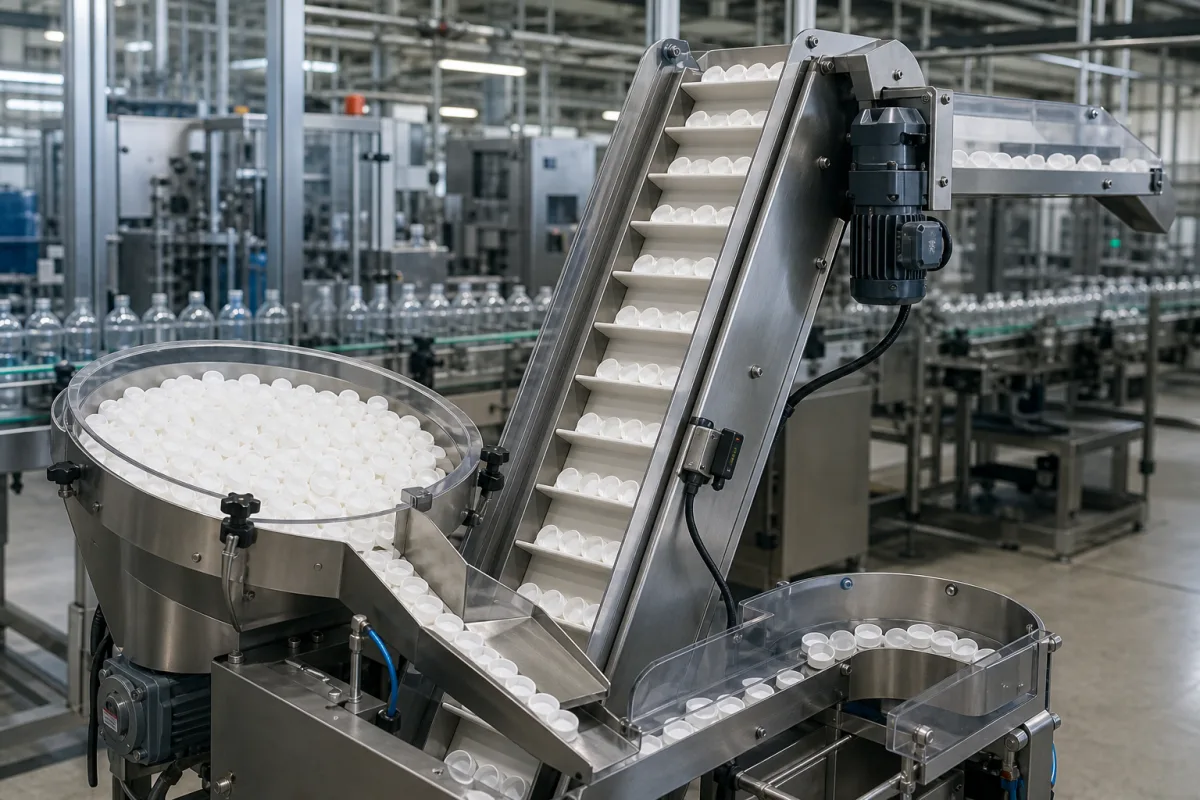
Cap elevators · Cleat-belt orienting, wrong-way caps falling back, cleat spacing for changeovers, air-jet discharge, vision inspection
A cap sorter and elevator lifts bulk caps from a hopper on a steep cleated belt, lets wrongly oriented caps fall back, and delivers caps all facing the same way into a chute feeding the capping machine. Ask three things first: how the elevator orients your cap shape and how changeovers to other sizes are made, what rate it delivers with margin over the capper, and whether it inspects and rejects defective caps.
Cleated-belt cap elevators and orienting sorters feeding cappers on bottling and packaging lines, including versions with vision inspection. Centrifugal and vibratory bowl sorters, cappers themselves and bulk cap hoppers sold alone are outside this page.
CNFX editorial research · Sources checked October 11, 2026 · 4 sources
Jalbert Automatisation's patent for an adjustable cap sorter describes a closed-loop belt whose receiving portion passes under the bulk caps at a slant and whose sorting portion is close to vertical. Caps that land between adjacent cleats with their end wall away from the belt fall back toward the pickup because the cleats are thin enough that the cap's centre of gravity lies beyond them; caps not caught between cleats also fall back, while caps with the end wall against the belt ride up to discharge. [1]
At the discharge section it uses pulsed air jets from nozzles to move caps sideways off the cleats into the chute, timed by a controller. [1] Fowler Products' patent for a cap sorter cleat likewise lets caps that are too tall or improperly oriented fall off the cleats in the vertical run, and mentions a blower or mechanical arm at the top to move caps off the belt. [2]
Editorial calculation: to deliver 300 caps per minute on cleats at 50 mm pitch, if an assumed half of the cleat positions carry a correctly oriented cap, the belt must run at 300 × 0.05 ÷ 0.5 = 30 m/min; ask the supplier for the measured fill rate with your caps and the margin over the capper's speed.
Give the supplier the cap types and drawings (diameter, height, sports or flip-top features), line speed in caps per minute, number of sizes and changeover frequency, hopper volume and refill method, chute to the capper, inspection and reject requirements, materials and hygiene class, and floor space.
02
Plan changeovers and inspection
The Jalbert sorter uses two belts carrying interleaved cleats, driven by separate actuators; changing the phase between the belts changes the spacing between adjacent cleats to suit the cap size, set by driving the two motors at different speeds until the desired spacing is reached. A suitable slope in the sorting section makes unseated caps fall back while seated ones stay on the cleats. [1]
Arol's patent for an elevator for caps integrates a vision system: caps rest on projections on their side wall so cameras can see the top, the inner thread and the safety ring through transparent guide walls, and caps not in the set position fall into a duct back to the orientation device. It notes that vision systems identify defects such as deformation or ovality of the cap or safety ring, dirt and missing projections. [3]
Editorial note: ask suppliers whether changeover is by adjustable cleat spacing, change parts or a different belt, how long it takes, and whether inspection and rejection are built in or added downstream.
03
Cap sorter elevators sold beside filling, capping and labelling machines
Listings include cap sorter elevators alongside filling, capping and labelling machines.
04
Compare rated speed, cap size range, changeover time and discharge
Closure Systems International (CSI), a closure maker, lists its SE24 elevator sorter at a sorting speed of up to 1,000 caps per minute. It handles flat caps from 26 to 43 mm in diameter and sports caps from 26 to 28 mm; quick-change cleats let the operator adjust for closure size without extra belts, and CSI quotes a full changeover in 15 minutes. A quick-change Slope-Lok lets the operator adjust sorting while the machine runs to eliminate upside-down caps, a louver system is said to reduce closure knock-off, and the bin has an adjustable shelf that meters closure flow. [4]
Unlike the air-jet discharge in the Jalbert patent above, CSI says the SE24 needs no compressed air to discharge closures. Its footprint is 58 × 56 × 121 in with the 25 cubic foot option and 58 × 84 × 121 in with the 50 cubic foot option; custom elevations can be accommodated and discharge can be right- or left-handed. [4]
Editorial calculation: 1,000 caps per minute is about 16.7 caps per second; against a capper needing 600 caps per minute (illustrative), the rating is 1.67 times demand. CSI states the speed as a maximum, so ask the supplier for the measured rate with your cap, the cap sizes covered by each cleat set, the changeover time, and whether discharge uses compressed air.
Hopper, cleated belts, discharge, return path, vision option and drive
Discharge is where designs split: the Jalbert patent blows oriented caps off the cleats with timed air jets, while CSI says its SE24 discharges closures without compressed air. [1][4]
Output, cap diameter and height, hopper volume, changeover time and inspection for an elevator order
The output row needs your capper's demand beside it: CSI rates the SE24 at up to 1,000 caps a minute as a maximum, so ask for the measured rate with your own caps and the margin over the capper. [4]
1 company lists this product among what they make. Company figures are quoted from each
company's own website; every card states where the relationship came from.
Shanghai Npack Automation Equipment Co., Ltd.
Manufacturing site to be confirmed for the order
Lists cap sorter elevators alongside filling, capping and labelling machines.
Explore company information and manufacturing capabilities, then discuss the scope of your project with a relevant supplier.
Share this page
Compiled and source-reviewed by the CNFX editorial team.
Each manufacturer above links to the page on that company's own website where the product is listed, with the date we checked it. How we source and review
· Page last updated 13 October 2026
Buyer questions
How does a cap elevator orient caps?
In Jalbert's design, thin cleats let caps lying the wrong way tip back to the hopper while correctly oriented caps ride up to discharge. [1]
How are different cap sizes handled?
Jalbert's sorter changes cleat spacing by shifting the phase between two belts carrying interleaved cleats. [1]
Can a cap elevator inspect caps?
Arol's patent integrates cameras that inspect the top, thread and safety ring and return misoriented caps. [3]
How fast can a cap elevator sorter run?
Closure Systems International lists its SE24 elevator sorter at up to 1,000 caps per minute for 26–43 mm flat caps and 26–28 mm sports caps, with a full changeover in 15 minutes. [4]
Sources and what still needs a direct check
Sources checked 2026-10-11. Three sources are patents describing their owners' designs (Jalbert Automatisation, Fowler Products, Arol) and the fourth is Closure Systems International's SE24 product page; other machines differ, so ask for trials with your caps.