Industry-Verified Manufacturing Data (2026)

Chemical Tank

Based on aggregated insights from multiple verified factory profiles within the CNFX directory, the standard Chemical Tank used in the Machinery and Equipment Manufacturing sector typically supports operational capacities ranging from standard industrial configurations to heavy-duty production requirements.

Technical Definition & Core Assembly

A canonical Chemical Tank is characterized by the integration of Tank Body and Lid / Cover. In industrial production environments, manufacturers listed on CNFX commonly emphasize Stainless Steel (e.g., 304, 316L) construction to support stable, high-cycle operation across diverse manufacturing scenarios.

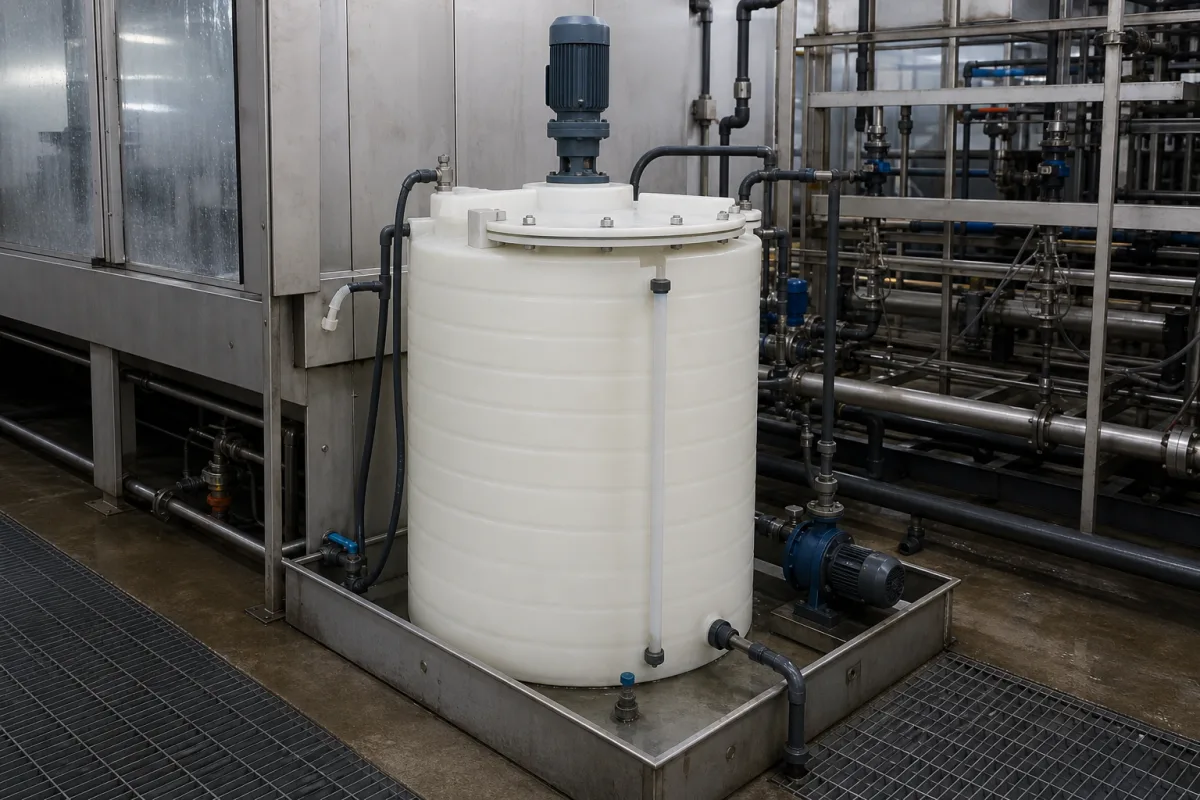
A container designed to hold and dispense chemical solutions within a pretreatment washer system.
Product Specifications

Technical details and manufacturing context for Chemical Tank

Definition
The chemical tank is a critical component of a pretreatment washer system, specifically engineered to store, mix, and supply chemical cleaning agents (such as degreasers, etchants, or conversion coatings) to the washer's spray or immersion modules. It ensures controlled chemical delivery for surface preparation processes like cleaning, degreasing, phosphating, or passivation of metal parts prior to painting or coating.
Working Principle
The tank stores a prepared chemical solution. It is typically connected via pumps and piping to the washer's application system. Level sensors monitor chemical volume, and agitation or recirculation systems may be used to maintain solution homogeneity and concentration. The tank often includes features for safe chemical handling, such as sealed lids, venting, and corrosion-resistant construction.
Common Materials
Stainless Steel (e.g., 304, 316L), Polypropylene (PP), Polyethylene (PE), Fiberglass Reinforced Plastic (FRP)
Technical Parameters
  • The nominal capacity of the tank, indicating the maximum volume of chemical solution it can hold. (L) Standard Spec
Components / BOM
  • Tank Body
    The primary containment vessel for the chemical solution.
    Material: Stainless Steel / Plastic
  • Lid / Cover
    Seals the tank to prevent evaporation, contamination, and fume release.
    Material: Matching tank material
  • Agitator / Mixer
    Maintains solution homogeneity and prevents settling of chemicals.
    Material: Stainless Steel / Plastic
  • Level Sensor
    Monitors the volume of chemical solution in the tank for low-level alerts or automated refilling.
    Material: Stainless Steel / Plastic
  • Drain Valve
    Allows for complete drainage of the tank for maintenance, cleaning, or solution changeover.
    Material: Stainless Steel / Plastic
Engineering Reasoning
0-2.5 bar internal pressure, -10°C to 80°C temperature, 0-95% relative humidity
3.0 bar internal pressure (yield strength threshold), 90°C temperature (HDPE glass transition), 0.5 mm wall thickness reduction (corrosion allowance)
Design Rationale: Polymer creep deformation at 3.0 bar exceeds HDPE yield strength of 26 MPa; thermal expansion coefficient mismatch (HDPE: 200×10⁻⁶/°C vs. steel: 12×10⁻⁶/°C) causes stress cracking at 90°C
Risk Mitigation (FMEA)
Trigger Sulfuric acid concentration exceeding 15% w/w
Mode: Polymer embrittlement and stress corrosion cracking
Strategy: Install inline conductivity sensor with automatic dilution valve at 10% concentration threshold
Trigger Thermal cycling between 20°C and 70°C at 5 cycles/hour
Mode: Fatigue crack propagation at weld seams
Strategy: Implement double-welded seam design with 2.0 mm reinforcement and thermal insulation jacket

Industry Taxonomies & Aliases

Commonly used trade names and technical identifiers for Chemical Tank.

Applied To / Applications

This component is essential for the following industrial systems and equipment:

Industrial Ecosystem & Supply Chain DNA

Complementary Systems
Downstream Applications
Specialized Tooling

Application Fit & Sizing Matrix

Operational Limits
pressure: 0 to 2 bar (gauge)
flow rate: Up to 50 L/min
temperature: -10°C to 80°C
slurry concentration: Up to 20% solids by weight
Media Compatibility
✓ Alkaline cleaning solutions ✓ Acidic pickling solutions ✓ Phosphate conversion coatings
Unsuitable: Hydrofluoric acid solutions
Sizing Data Required
  • Required chemical volume (L)
  • Dispensing cycle time (min)
  • Maximum chemical viscosity (cP)

Reliability & Engineering Risk Analysis

Failure Mode & Root Cause
Corrosion
Cause: Chemical attack from stored substances, leading to material degradation and potential leaks.
Structural fatigue
Cause: Cyclic loading from filling/emptying cycles, thermal expansion, or external vibrations causing crack propagation.
Maintenance Indicators
  • Visible leaks, stains, or weeping at seams, welds, or connections
  • Unusual audible hissing, dripping, or structural creaking during operation
Engineering Tips
  • Implement regular non-destructive testing (e.g., ultrasonic thickness gauging) to monitor wall integrity and corrosion rates
  • Install and maintain proper ventilation, temperature control, and secondary containment systems to minimize chemical exposure and thermal stress

Compliance & Manufacturing Standards

Reference Standards
ISO 28300: Chemical tank design and construction ANSI/ASME B96.1: Welded aluminum-alloy storage tanks DIN 28010: Chemical apparatus - Materials of construction
Manufacturing Precision
  • Wall thickness: +/-0.5mm
  • Circularity: 0.3% of diameter
Quality Inspection
  • Hydrostatic pressure test
  • Ultrasonic thickness measurement

Factories Producing Chemical Tank

Verified manufacturers with capability to produce this product in China

✓ 96% Supplier Capability Match Found

T Technical Director from Australia Jan 14, 2026
★★★★★
"The technical documentation for this Chemical Tank is very thorough, especially regarding technical reliability."
Technical Specifications Verified
P Project Engineer from Singapore Jan 11, 2026
★★★★☆
"Reliable performance in harsh Machinery and Equipment Manufacturing environments. No issues with the Chemical Tank so far. (Delivery took slightly longer than expected, but technical support was excellent.)"
Technical Specifications Verified
S Sourcing Manager from Germany Jan 08, 2026
★★★★★
"Testing the Chemical Tank now; the technical reliability results are within 1% of the laboratory datasheet."
Technical Specifications Verified
Verification Protocol

“Feedback is collected from verified sourcing managers during RFQ (Request for Quote) and factory evaluation processes on CNFX. These reports represent historical performance data and technical audit summaries from our B2B manufacturing network.”

9 sourcing managers are analyzing this specification now. Last inquiry for Chemical Tank from Vietnam (1h ago).

Supply Chain Compatible Machinery & Devices

Heavy-Duty CNC Plasma Cutting Machine

Industrial machine for precision metal cutting using plasma arc technology

Explore Specs →
Automated Assembly Line System

Integrated production system for sequential component assembly operations

Explore Specs →
Automated Powder Coating System

Integrated industrial system for applying dry powder coatings to metal substrates.

Explore Specs →
Centrifugal Pump Impeller

Rotating component that transfers energy to fluid in centrifugal pumps.

Explore Specs →

Frequently Asked Questions

What materials are best for chemical tanks in pretreatment systems?

Stainless steel (304/316L) offers corrosion resistance for harsh chemicals, polypropylene (PP) and polyethylene (PE) provide chemical inertness for acids/bases, and fiberglass reinforced plastic (FRP) combines strength with chemical resistance for versatile applications.

Why include an agitator in a chemical tank?

Agitators ensure proper mixing of chemical solutions, preventing sedimentation and maintaining consistent concentration for effective pretreatment processes in washer systems.

How do level sensors improve chemical tank safety?

Level sensors monitor chemical volume, preventing overfilling, enabling automated refill alerts, and ensuring optimal chemical usage while reducing spill risks in industrial environments.

Can I contact factories directly on CNFX?

CNFX is an open directory, not a transaction platform. Each factory profile provides direct contact information and production details to help you initiate direct inquiries with Chinese suppliers.

Get Quote for Chemical Tank

Request technical pricing, lead times, or customized specifications for Chemical Tank directly from verified manufacturing units.

Your business information is encrypted and only shared with verified Chemical Tank suppliers.

Thank you! Your message has been sent. We'll respond within 1–3 business days.

Need to Manufacture Chemical Tank?

Connect with verified factories specializing in this product category

Add Your Factory Contact Us
Previous Product
Checkpoint Trigger Module
Next Product
Chiller Unit