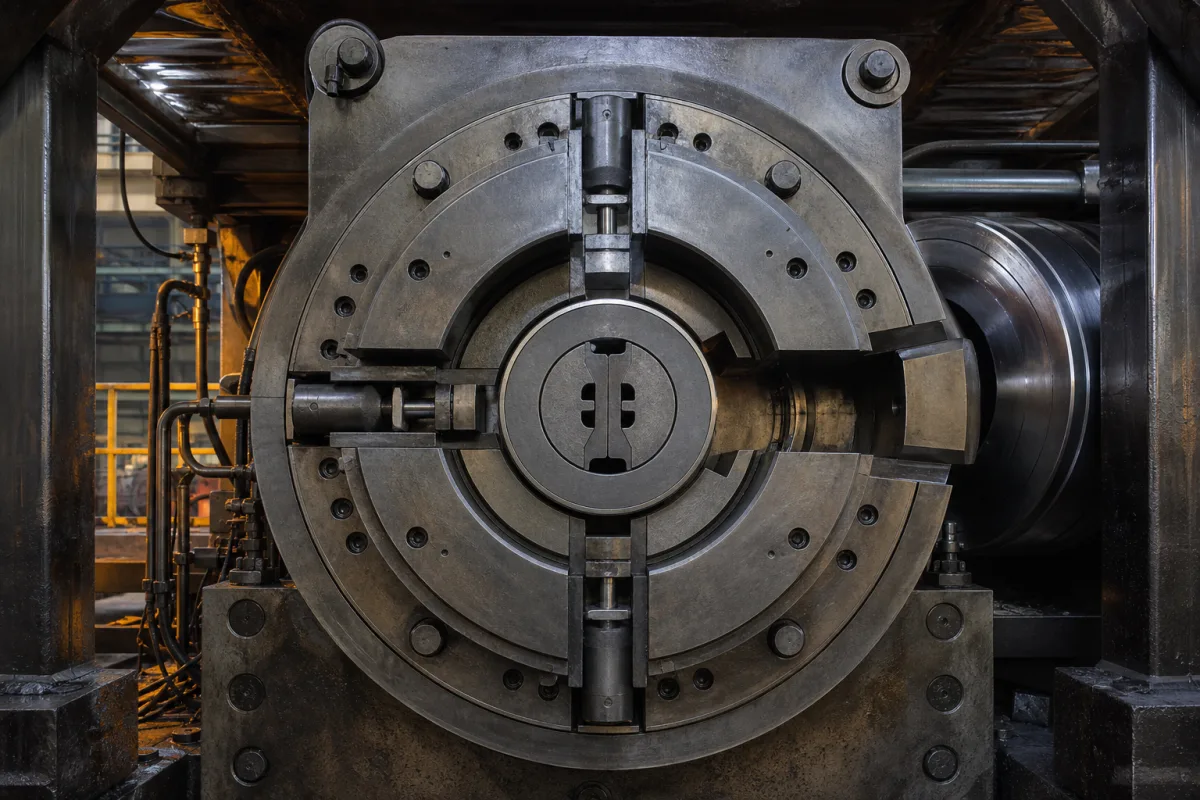
Die holder for aluminium extrusion presses: die ring, bolster and wedge stack, and the die slide that changes it
Support tooling between the die and the press platen · die ring, backer and bolster in the stack, wedge clamping, 40–44 HRC die rings and ~45 HRC bolsters, die slide and rotary carriers for changing dies
A die holder, also called a die carrier or die cassette, is the press-side support tooling that positions the extrusion die on the press axis and carries the load from the die back to the platen. It holds the die in a die ring, backs it with a backer and one or more bolsters, is clamped by a wedge or locking device, and sits in a die slide or rotary carrier that moves it out of the press for a die change. Check three things first: which parts of the stack are shared across profiles and which are made for each one, the steel and hardness of each part at working temperature, and how the holder is clamped and moved out for changing.
Die holders and their support tooling for aluminium extrusion presses: die rings, backers, bolsters and sub-bolsters, wedge blocks and clamps, die slides, shuttles and rotary die carriers. The complete press with its main cylinder, container, stem and billet sizing is covered on the Aluminium extrusion press page; pullers, cooling tables, stretchers and saws after the press are covered on the extrusion handling and profile line pages. The extrusion die's own profile design, and press-brake die holders for sheet bending, are outside this page. The die that forms the profile, with its bearing lengths, tongue ratio and die steel, is on the Aluminium extrusion die page.
CNFX editorial research · Sources checked October 12, 2026 · 6 sources
Die ring, backer, bolster and wedge: what sits between the die and the platen
Alexandria Industries, an aluminium extruder, describes the die stack for a solid shape as a die ring, die plate, backer and bolster, and for hollow or semi-hollow shapes as a die ring, hollow mandrel, cap section and bolster. Die rings and some backers and bolsters can be universal across shapes; die plates, mandrels and cap sections are made for each shape, and hollow shapes also need a customised backer. [2]
Uddeholm's extrusion tooling guide puts the die in a die ring that is attached to, and supported by, holder parts such as die rings, bolsters and wedge blocks; it notes that for complicated shapes it can be difficult to arrange adequate support for the die. [1] Loewy Engineering's patent describes annular bolsters behind the die or its holder that transmit pressure from the die to the press frame, such as the platen. [5]
A Schloemann patent of 1937 explains why the holder is a costly part: its central bore must pass the largest section it will extrude, it is made of special alloy steel with a great deal of machining, and it is clamped against the press cross beam by a wedge at its rear that also takes up the extrusion pressure. Schloemann's answer was interchangeable filling plates inside a U-section holder, so one holder serves large and small sections. [4]
Alexandria reports using made-for-the-profile die plates and backers, and custom bolsters for some shapes, to limit flexing of the die face; it states that sharing bolsters or backers lowers tooling cost but can give fluctuating results. [2]
Give the supplier the press make and force, container bore, the die diameter and thickness the holder must take, the stack parts to be supplied (die ring, backer, bolster, sub-bolster, wedge), whether the stack is for solid or hollow profiles, and the die slide or carrier interface.
02
40–44 HRC die rings, about 45 HRC bolsters, 300–400 HB wedge blocks
Uddeholm's steel and hardness table for aluminium and magnesium extrusion lists die rings in Orvar 2 Microdized at 40–44 HRC (Formvar is also named in that row), bolsters in Alvar 14 at about 45 HRC, and wedge blocks in prehardened Impax Supreme at about 310 HB or Alvar 14 at 300–400 HB; the dies themselves are listed from 45–50 HRC (Vidar 1, Orvar 2 Microdized, QRO 90 Supreme) up to 52–58 HRC (Unimax). [1]
Uddeholm advises that where there is any risk of overloading the support tooling, the steel should be chosen for adequate hardness at its working temperature, and limits prehardened Impax Supreme for wedge blocks and die heads to low service temperatures. [1] For scale, the Lesniak et al. extrusion trials on a 25 MN press ran with container and die at 450 °C. [3]
Editorial note: the die ring sits next to the hot die while the wedge block sits further back; ask the supplier which steel and hardness each stack part is made to, and for the hardness certificate, rather than one figure for the whole holder.
What the holder must resist: a 25 MN, 7-inch press and a 0.5 mm die-deflection limit
Lesniak and co-authors (AGH Kraków, Łukasiewicz Institute of Non-Ferrous Metals, Albatros Aluminium) designed two-hole porthole dies for Ø50 × 2 mm tubes in 7021 alloy and tested them on a 25 MN direct hydraulic press with a 7-inch container, using Ø178 × 800 mm billets at an extrusion ratio of 42. Their die design criteria were a force not exceeding 25 MN and elastic deflection of the die not exceeding 0.5 mm. [3]
Editorial calculation: a 7 in container is 177.8 mm in bore, about 0.0248 m² in area, so the full 25 MN corresponds to about 25 ÷ 0.0248 ≈ 1,000 MPa on the billet face; the die, die ring, backer and bolsters pass the reaction of that force to the platen. [3]
In the same study, the die with 28 mm thick, 70 mm long bridges showed much lower mandrel deflection than one with 16 mm × 55 mm bridges, and the authors list elastic deflection of the die among the direct causes of lost profile dimensional accuracy. [3] Editorial note: deflection is set by the die and by how fully the backer and bolster support it, so ask the toolmaker for the support design behind each die, especially for hollow profiles.
04
Die slide, shuttle or rotary carrier: getting the holder out of the press
Farrel's die slide patent describes a die seated in a die holder that runs on a track beside the platen; one hydraulic cylinder shears the extrusion from the die and a second, carried on the slide itself, shuttles the holder to a transfer station at the side of the platen, keeping the cylinders short and out of the scrap. [6]
Loewy's patent puts the die assembly and the bolster assembly on two separate rotary carriers turning about spaced axes, so dies and bolsters are exchanged on opposite sides of the press; with two die assemblies on one carrier, one can be reconditioned outside the press while extrusion continues through the other. [5]
Schloemann's holder instead moves along the press axis and is removed with its wedge for die replacement after each extrusion, in that design the die being loosely fitted into the holder. [4] Editorial note: specify the change method with the holder, since the holder's outer form, guides and clamping surfaces have to match the press's slide, cassette or carrier.
05
Send the press, stack and change-system data together
Paste it into your enquiry below or into an email to a maker, then replace every bracket.
Press: [make; force in MN; container bore; direct or indirect]
Die: [diameter; thickness; solid or hollow; number of cavities]
Stack: [die ring; backer; bolster; sub-bolster; wedge block; which are shared and which per profile]
Steel: [grade and hardness per part; working temperature]
Change system: [die slide, shuttle, cassette or rotary carrier; interface drawing]
Documents: [hardness certificates; dimensional inspection]
Explore company information and manufacturing capabilities, then discuss the scope of your project with a relevant supplier.
Share this page
Compiled and source-reviewed by the CNFX editorial team.
Each manufacturer above links to the page on that company's own website where the product is listed, with the date we checked it. How we source and review
· Page last updated 13 October 2026
Buyer questions
What hardness are extrusion die rings and bolsters?
Uddeholm lists die rings at 40–44 HRC and bolsters at about 45 HRC for aluminium extrusion, with wedge blocks at about 310 HB or 300–400 HB. [1]
Which die stack parts can be shared between profiles?
Alexandria Industries states that die rings and some backers and bolsters can be universal, while die plates, mandrels and cap sections, and the backer for hollow shapes, are made for each shape. [2]
How much may an extrusion die deflect?
In the Lesniak et al. porthole die study the design limit was 0.5 mm of elastic die deflection on a 25 MN press. [3]
How are dies changed on an extrusion press?
Patents show a die slide that shuttles the holder to a side transfer station (Farrel), rotary carriers for die and bolster (Loewy) and an axially removable holder clamped by a wedge (Schloemann). [6][5][4]
Sources and what still needs a direct check
Sources checked 2026-10-12. Uddeholm is a tool steel maker giving its own grade recommendations; Alexandria Industries is an extruder describing its practice; the press patents date from 1937 to 1980 and show mechanisms rather than current products; the 25 MN example is from a peer-reviewed study.